New Arrivals — Browse our catalog for the latest authentic Japanese sword arrivals. Browse →
8th month of Tenshō 10 (1582)
Nakatomigawa River, Awa Province (present-day Itano District, Tokushima Prefecture)
Forces
Chosokabe forces
Miyoshi-Sogo coalition
About 11 min read
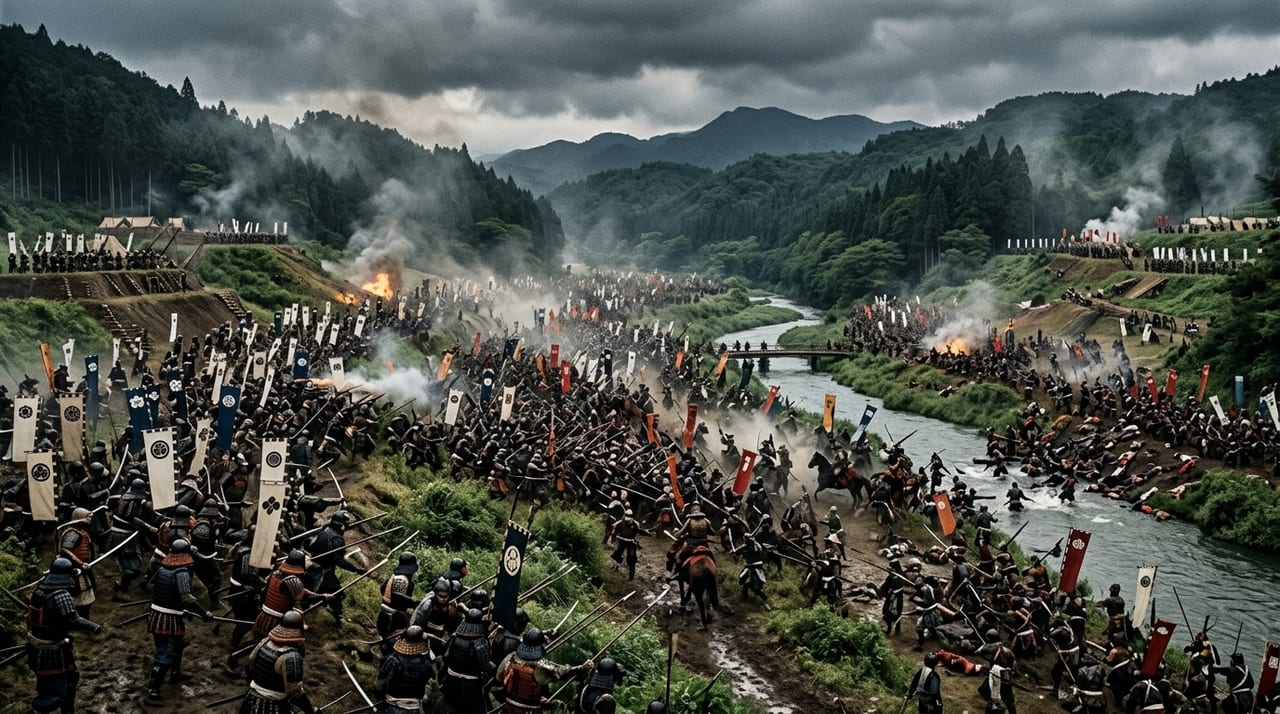
The Battle of Nakatomigawa was fought in the 8th month of Tenshō 10 (1582) at the Nakatomi River in Awa Province (present-day Itano District, Tokushima Prefecture). The Shikoku unification army of Chosokabe Motochika, lord of Tosa Province, faced the defending army of the Miyoshi clan and Sogo Masayasu. In this battle, Motochika crushed the combined Miyoshi and Sogo forces and took near-complete control of Awa Province. The Battle of Nakatomigawa is the decisive turning point in Motochika's bid for hegemony and the unification of Shikoku, and it is regarded as the greatest climax in the military history of Sengoku-period Shikoku.
Chosokabe Motochika (1539–1599) was born as the son of Chosokabe Kunichika, a minor daimyō of Tosa Province (present-day Kōchi Prefecture). As a child, Motochika was mocked as "Hime-wako" ("little princess") because he was fair-skinned and quiet. However, he distinguished himself in his first battle, in Eiroku 3 (1560), and afterward advanced the unification of Tosa Province at a remarkable pace. The military strength of Motochika's forces rested on the "ichiryō gusoku," a system said to have been devised by his father, Kunichika. These were half-farmer, half-soldier warriors who worked as farmers in peacetime and armed themselves immediately in wartime. Motochika used them most actively and made them the foundation of the Chosokabe army, which was known as a strong force from Tosa. After completing the unification of Tosa, Motochika began moving into Awa, Iyo, and Sanuki around Tenshō 3 (1575) with the aim of unifying all of Shikoku. Awa was under the remnants of the Miyoshi clan, with Sogo Masayasu holding real power. Sanuki was held by remnants of the Miyoshi clan, and Iyo was controlled by the Kōno clan. Motochika skillfully combined diplomacy and military force to subdue the daimyō of Shikoku one by one. By Tenshō 10 (1582), he effectively controlled Tosa Province, along with parts of Awa, Sanuki, and Iyo.
On the 2nd day of the 6th month of Tenshō 10 (1582), Oda Nobunaga died in the Honnōji Incident. For Chosokabe Motochika, Nobunaga's death had complicated significance. Nobunaga had already prepared an expedition against the Chosokabe clan for the pacification of Shikoku, an army with his third son, Oda Nobutaka, as commander-in-chief and Miyoshi Yasunaga as vanguard, and Motochika had been facing Nobunaga's pressure. However, the Honnōji Incident dissolved this punitive army, and Motochika's path to unifying Shikoku was once again opened. At this point, Motochika decided to launch a full-scale invasion of Awa. He sought to draw the main force of the Miyoshi–Sogo alliance to the Nakatomi River and complete the conquest of Awa in one decisive battle. The Motochika army, led by elite soldiers of Tosa and joined by local Awa warriors who had come over to his side, invaded Awa and clashed with the Miyoshi and Sogo forces, which were positioned along the Nakatomi River.
The Battle of Nakatomigawa began on the 28th day of the 8th month of Tenshō 10 (1582), by the lunar calendar. The two armies faced each other across the Nakatomi River, a tributary of the Yoshino River, and the Chosokabe forces crossed the river to attack. The Miyoshi–Sogo alliance, at some 5,000 men, was greatly outnumbered, and under the fierce Chosokabe offensive it became difficult to maintain organized resistance. The Chosokabe infantry, centered on the ichiryō gusoku, crossed the river in dense assaults and broke through the enemy lines one after another. Sogo Masayasu desperately directed the defense, but he could not hold the front and withdrew to Shōzui Castle. The Miyoshi–Sogo alliance suffered heavy losses, and many of its subordinate castellans were killed. The Chosokabe army surrounded Shōzui Castle. On the 21st day of the 9th month of Tenshō 10 (1582), Masayasu surrendered, handed over Shōzui Castle, and withdrew to Toramaru Castle in Sanuki. Because of this defeat, the Miyoshi clan's rule over Awa effectively came to an end, and Motochika brought most of Awa Province under his control.
The Battle of Nakatomigawa is also connected to the history of swords. Before setting out for Awa, the Chosokabe forces visited Tosa Shrine and offered a gold-mounted tachi and other items, praying for victory. Because the ichiryō gusoku were the main body of the army and were farmer-soldiers, it is thought that practical swords were widely used on the battlefield rather than expensive famous blades. Motochika himself later submitted to Toyotomi Hideyoshi and also took part in the Bunroku–Keichō campaigns.
After the victory at Nakatomigawa, Motochika nearly completed the conquest of Awa. It is said that in spring of Tenshō 13 (1585) he subdued the Kōno clan of Iyo and unified Shikoku. But that very year, Toyotomi Hideyoshi dispatched his campaign army to Shikoku. The large army led by Hashiba Hidenaga, Hideyoshi's younger brother, exceeded 100,000 men, and Motochika was forced to surrender on the 25th day of the 7th month of Tenshō 13 (1585), just about a month after the campaign began. Motochika was reduced to Tosa Province alone, and his dream of unifying Shikoku collapsed in less than ten years. Motochika's eldest son, Chosokabe Nobuchika, was killed in the Battle of Hetsugigawa (Bungo) in the 12th month of Tenshō 14 (January 1587), and Motochika struggled with the question of succession. If Nobuchika had lived, the history of the Chosokabe clan might have turned out very differently. Even so, the strength the Chosokabe forces displayed at the Battle of Nakatomigawa is still passed down today as a brilliant milestone in the military history of Sengoku-period Shikoku. The Nakatomi River area remains within Itano District, Tokushima Prefecture, where historic sites that preserve the memory of the battle are scattered. The memory of the blades exchanged between the Chosokabe clan's sword culture and the ichiryō gusoku warriors is passed down to later generations as the core of Shikoku's history of bushidō.