New Arrivals — Browse our catalog for the latest authentic Japanese sword arrivals. Browse →
Sixth month (16th–19th), Tenshō 10 (July 5–8, 1582)
Around the Kanna River, Kami district, Musashi Province (present-day Gunma/Saitama border)
Forces
Takigawa forces (Oda)
Hōjō forces
About 8 min read
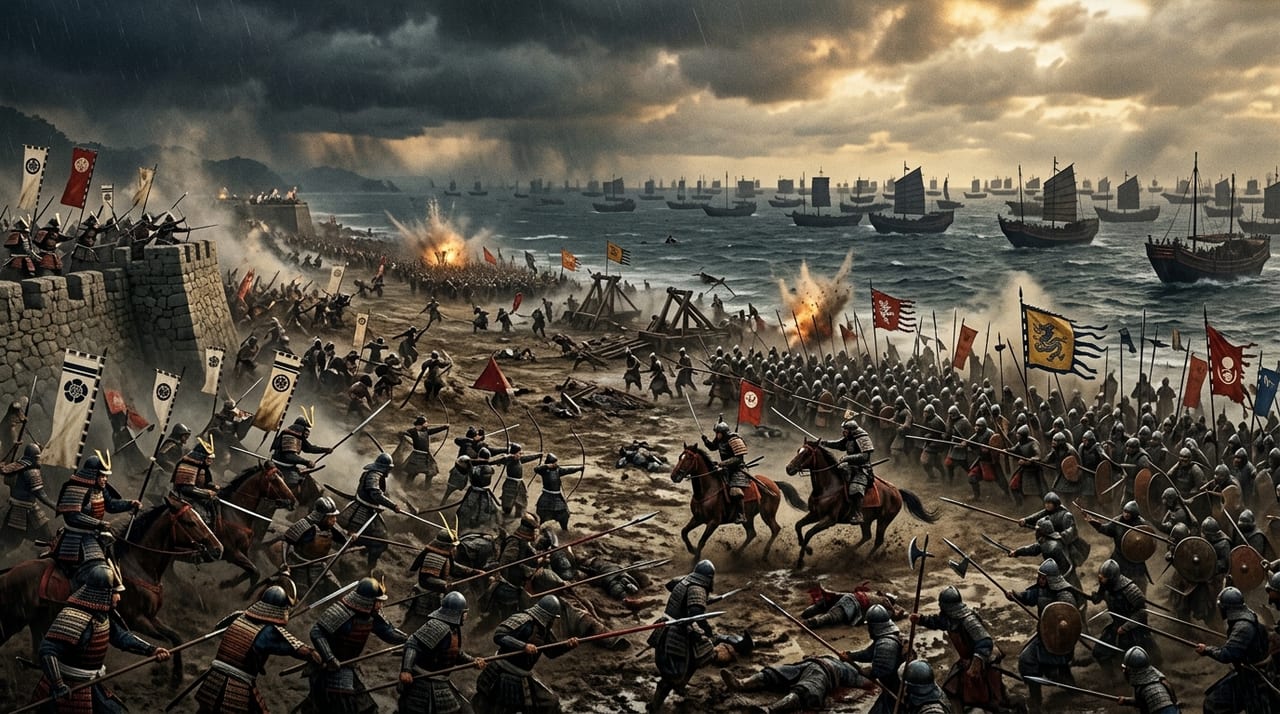
From the 16th to the 19th day of the 6th month of Tenshō 10 (1582), corresponding to July 5–8 in the Julian calendar, the Battle of the Kanna River was fought in the area around the Kanna River in Kami District of Musashi Province. It is traditionally regarded as one of the largest field battles in the Kantō region during the entire Sengoku period. The political vacuum created by the death of Oda Nobunaga in the Honnō-ji Incident developed directly into a major battle that shook the balance of power in Kantō.
The Oda house's Kōshū campaign, which began in the 2nd month of Tenshō 10, ended with the suicide of Takeda Katsuyori on the 11th day of the 3rd month, resulting in the destruction of the Takeda. As the reward for this, on the 23rd day of the 3rd month, Takigawa Kazumasu, a senior retainer of the Oda house, was granted all of Kōzuke and two districts of Shinano by Nobunaga. He entered Minowa Castle (later Umayabashi Castle), a key stronghold in Kōzuke, and took charge of governing the Kantō region. In a position equivalent to the Kantō kanrei, Kazumasu bore the heavy responsibility of mediating between the various Kantō powers, and he governed while bringing the Jōshū warriors (Kōzuke warriors), former Takeda retainers, under his command.
However, on the 2nd day of the 6th month of that year, Oda Nobunaga was killed when Akechi Mitsuhide rebelled at Honnō-ji in Kyoto. News of this reached Kantō several days later. For the Hōjō of Odawara, who sought hegemony over Kantō, this was a golden opportunity to drive Oda power out of the region. Hōjō Ujinao and Hōjō Ujikuni mustered a large army and marched north into Kōzuke, making a confrontation with Kazumasu unavoidable.
In the opening engagement on the 18th day of the 6th month, the Takigawa forces first attacked Kanakubo Castle and Kawai Castle, which were held by the Saitō brothers, who were under Hōjō Ujikuni, and captured both. In the battle that followed on the Kanakubo plain, the Jōshū warriors, mainly former Takeda retainers, and the Takigawa forces clashed with the Hachigata forces under Hōjō Ujikuni, numbering about 5,000. The Takigawa side killed Ishiyama Daigaku, Hosaka Ōi-no-suke and others, and in the pursuit inflicted more than two hundred casualties on the Hōjō side, winning the opening engagement. The fighting that day was a development in which the Takigawa forces, though inferior in numbers, went on the offensive and pushed back the Hōjō side.
However, on the 19th day of the 6th month, the situation changed completely when the main force led by the head of the Hōjō house, Hōjō Ujinao, arrived. The Hōjō side threw in fresh troops one after another, surrounded the Takigawa forces, and by evening had defeated them. The Takigawa force numbered about 18,000, while the Hōjō side possessed an overwhelming force of about 56,000. The Jōshū commanders in the rear were slow to advance and did not come to the aid of the Takigawa forces. The defeated Takigawa Kazumasu withdrew to Umayabashi Castle by way of Kuragano Castle.
In this battle, fierce close-quarters fighting took place in which warriors of both armies crossed swords and spears, including Takigawa Kazumasu himself charging into the enemy's ranks. In the late Sengoku period, the uchigatana, worn at the waist, had become the mainstream battlefield sword in place of the mounted tachi.
Defeated, Takigawa Kazumasu abandoned Kōzuke and withdrew. He joined the troops he had kept at Matsuida Castle, crossed Usui Pass, and entered Komoro Castle to assess the situation. He then passed through Shinano and along the Kiso road, and on the 1st day of the 7th month he arrived back at his home base, Nagashima Castle in Ise.
However, Oda power in Kantō was effectively destroyed, and the region was brought under Hōjō control. It was soon linked to the Tenshō-Jingo conflict over the former Takeda domains. In the following year, Tenshō 11, Kazumasu sided with Shibata Katsuie at the Battle of Shizugatake and ended up on the losing side. The defeat at the Kanna River symbolizes the decline of Kazumasu, who had lost his backing in Nobunaga, and it shows one aspect of the enormous shock that the Honnō-ji Incident sent through the national balance of power. Today, a monument stands on the border of Gunma and Saitama prefectures at the site of the Kanna River battlefield, preserving the memory of one of the largest field battles in Kantō.