New Arrivals — Browse our catalog for the latest authentic Japanese sword arrivals. Browse →
March 2, 1582 (Tenshō 10)
Takato, Ina District, Shinano Province (present-day Takato-chō, Ina, Nagano)
Forces
Oda forces
Takeda forces (Takato Castle garrison)
About 17 min read
In February of Tenshō 10 (1582), the defection of Kiso Yoshimasa, a local lord of the Kiso Valley who abandoned the Takeda cause and sided with Oda, gave Oda Nobunaga the opening he needed. Together with his allies Tokugawa Ieyasu and Hōjō Ujimasa, Nobunaga launched a full-scale invasion of the territories of Takeda Katsuyori—Kai, Shinano, Suruga, and Kōzuke—whose power had rapidly weakened since the defeat at Nagashino. This campaign became known as the Kōshū Conquest. Nobunaga entrusted command of the main force advancing along the Shinano route to his eldest son, Oda Nobutada, while Ieyasu invaded from Suruga and Hōjō Ujimasa advanced from Kantō. Beginning with Kiso Yoshimasa's defection, Takeda-held castles fell in rapid succession through defection or surrender, and Nobutada's army, having entered Shinano, captured one stronghold after another with almost no resistance. As the local lords of the Kiso and Ina valleys turned to the Oda side in a landslide, Nobutada's forces laid siege to Takato Castle, a strategic stronghold in Ina District of Shinano Province, on March 1. Takato Castle was the last line of defense guarding the Ina Valley for the Takeda clan, and the battle for it effectively marked the countdown to the extinction of the once-illustrious Takeda house.
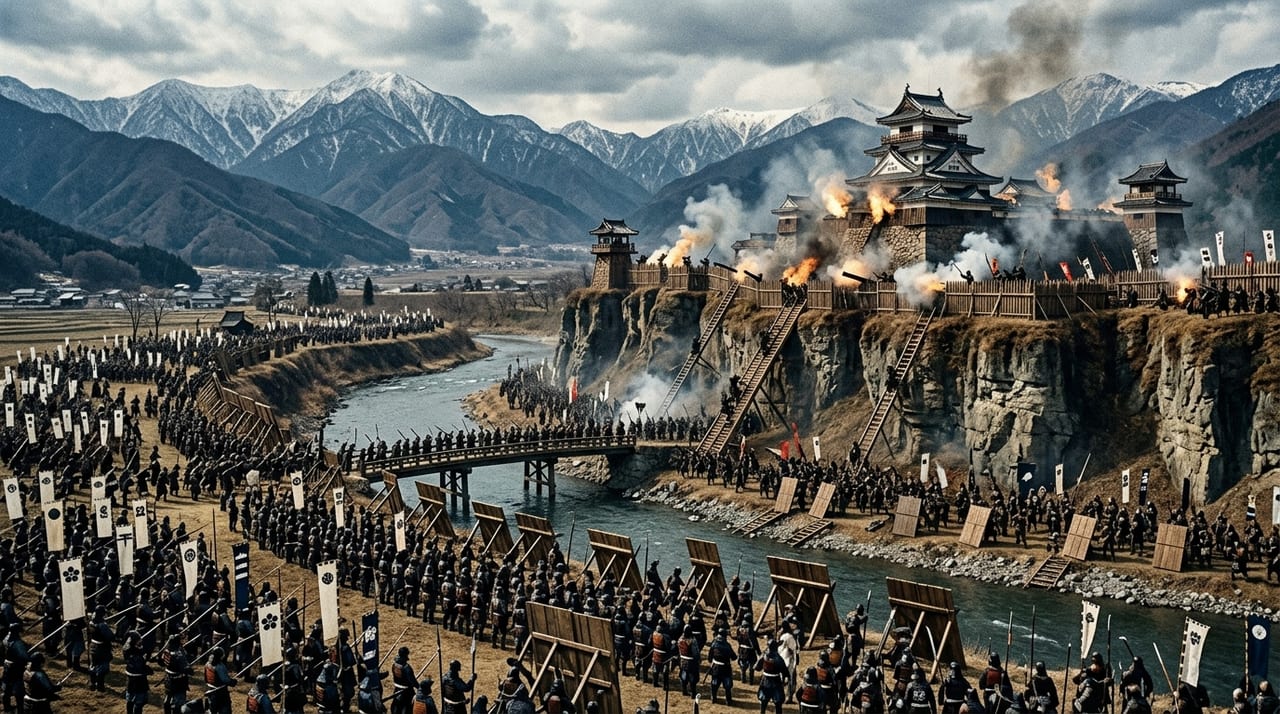
The lord of Takato Castle, Nishina Morinobu, is said to have been a son of Takeda Shingen and Katsuyori's half-brother. Takato Castle had originally been the seat of the Takato clan, a branch of the Suwa clan, but in Tenbun 14 (1545) Shingen defeated Takato Yoritsugu and incorporated it into Takeda territory, thereafter developing it as the key stronghold for controlling the Ina Valley. Built on a river terrace surrounded by the Mibu and Fujisawa rivers, this hirayamajiro (plains-mountain castle) boasted formidable natural defenses in the form of steep cliffs. In Tenshō 9 (1581), amid mounting pressure from Oda and Tokugawa, Katsuyori placed Morinobu in command of defending this crucial position. Before the assault, Nobutada sent a local monk as an emissary bearing gold and a letter urging surrender, but Morinobu flatly refused, reportedly cutting off the messenger's ears and nose before sending him back. This act, coming as neighboring castles collapsed one after another into Oda hands, signaled Morinobu's resolve to uphold the Takeda clan's honor to the last. By this time, Katsuyori's main force had already withdrawn to Shimpu Castle, leaving no hope of reinforcement for Takato. Even so, Morinobu chose to hold the castle with fewer than 3,000 troops, together with retainers including Oyamada Masashige, Oyamada Daigaku-no-suke, and Iijima Minbu-no-shō. Around the same time, the senior Takeda retainer Anayama Nobukimi (Baisetsu) had also secretly turned to the Tokugawa side and defected; Morinobu's stand at Takato was one of the rare exceptions amid a Takeda retainer corps that was abandoning its lord in droves.
On March 2, Oda's massive army—Nobutada's own force alone numbering more than 30,000, with the entire Kōshū Campaign said to have exceeded 50,000—launched an all-out assault on Takato Castle. Facing overwhelming odds, the defenders fought fiercely and are said to have inflicted no small losses on the Oda side at points during the battle, but sheer numbers could not be overcome, and the castle fell after just a single day of combat. Nishina Morinobu is said to have taken his own life by cutting his abdomen in a cross-shaped incision, a harrowing end at the age of 26. Around 500 retainers, including Oyamada Masashige and Oyamada Daigaku-no-suke, followed their lord in death. Morinobu's severed head was reportedly delivered to Nobutada and then displayed, by the hand of Hasegawa Sojin, at the Ichijo-dori crossroads in Kyoto alongside the heads of Takeda Katsuyori and his son Nobukatsu. Just nine days after Takato's fall, Katsuyori took his own life at Tenmokuzan, bringing the illustrious Kai Genji house of Takeda to its final end. The fierce fighting at Takato has been passed down as the last organized resistance of the Takeda clan, and as the single case in which a "fight-to-the-death siege" was carried through even as the surrounding castles fell one after another without bloodshed—an episode repeatedly retold in Edo-period war chronicles and storytelling traditions. Set against the backdrop of the Takeda retainer corps' successive defections, Morinobu's all-out resistance stood as both a final assertion of clan honor and a stark illustration that the Takeda daimyō's system of governance was already collapsing from within. For Nobutada too, this battle became a major military achievement since his first campaign, reported to Nobunaga as the decisive victory that sealed Oda success in the Kōshū Campaign.
Takato Castle and the surrounding Ina Valley had long been known as a production center for blades called "Shinshū-mono." Swordsmiths such as Shinano-no-kami Kunisada and Shinshū-jū Yukishige, working under the influence of the Sōshū and Mino traditions, continued to forge rugged, sturdy blades suited to the practical needs of mountain-region warriors. The swords wielded by Nishina Morinobu and his retainers in their final stand are presumed to embody this same tradition of practical, combat-oriented Takeda swordcraft. Shingen himself is known to have possessed the field sword "Rai Kuninaga," reflecting his own deep appreciation for blades—an ethos that carried through to the Takeda clan's final battle. After the fall of the Takeda, Takato Castle passed into the hands of Oda and then Tokugawa retainers before Hoshina Masayuki eventually became its lord. Masayuki, half-brother of the third shogun Tokugawa Iemitsu, rose from lord of Takato Domain through Yamagata Domain to become lord of Aizu Domain—a celebrated ruler said to have deeply respected the samurai culture of the Ina Valley connected to the Takeda clan and to have possessed a profound understanding of the martial arts and swordcraft. Aizu's sincere and disciplined sword culture and bushidō spirit are thus said to have inherited, via Takato, the robust ethos of the Takeda clan. Today, the Takato Town History Museum displays swords and armor connected to the Nishina, Takeda, and Hoshina clans, conveying to the present day the Takeda clan's final siege and the bushidō spirit behind it. The cliff-guarded terrain of the site, no less than its practical sword culture, reflects the utilitarian defensive thinking cultivated by the warriors of this mountainous region.
The battle for Takato Castle is recorded in detail in the Shinchō Kōki, the primary chronicle of Nobunaga's life compiled by his secretary Ōta Gyūichi. The chronicle documents the entire course of the Kōshū Campaign in vivid detail, preserving the dispatch of the emissary to Takato, Morinobu's refusal, the all-out assault, and even the inspection of the severed head after the castle's fall—making it an invaluable primary source. From the Edo period onward, the Battle of Takato Castle was retold again and again in war chronicles and oral storytelling as an episode symbolizing the loyalty of Takeda retainers, and Nishina Morinobu's name became widely known as the archetype of "the warrior who died for his lord."
The Kōshū Campaign was a lightning military operation that subdued the Takeda territories of Kai, Shinano, Suruga, and Kōzuke in barely a month. That the Takeda clan, which under Shingen and then Katsuyori had boasted the foremost military might in eastern Japan, could collapse so quickly stemmed from a combination of factors: the destruction of its cavalry corps at Nagashino, Katsuyori's waning authority, and the successive defections of his retainers. The Battle of Takato Castle stands out as nearly the only engagement in this lightning conquest in which organized, fierce resistance was mounted—evidence that Takeda military strength retained a measure of fighting capacity right to the very end. For Nobunaga, the completion of the Kōshū Campaign eliminated the greatest threat in eastern Japan and marked a landmark victory that propelled his project of unifying the realm forward. Sources vary on the size of the force that attacked Takato, with some accounts putting Nobutada's own army at roughly 30,000 and others placing the total strength of the entire Kōshū Campaign at anywhere from 50,000 to nearly 100,000. Whatever the true figure, the gap against Morinobu's force of fewer than 3,000 was hopeless, and it was precisely this disparity that drove his resistance toward its tragic, annihilating end.
The Battle of Takato Castle carries historical significance beyond the fall of a single fortress. It stands as a symbolic final chapter for the once-mighty Takeda military, and as an extreme expression of Sengoku-era bushidō—warriors fighting to the death rather than surrender their castle. That Takato alone held out to the last while the surrounding castles fell one after another without bloodshed came to be told among later generations of warriors as the ideal image of loyalty to one's lord. Today, the ruins of Takato Castle are designated a National Historic Site and celebrated as "the Number One Cherry Blossoms Under Heaven," a renowned destination where roughly 1,500 Kohigan cherry trees stain the stone walls pink in early April, drawing throngs of visitors every year. The saying "Takato Castle's blossoms are blood-dyed cherry blossoms" is said to derive from this fierce battle. Beneath the blossoming clouds of spring lies the memory of warriors who died alongside their lord, and the land of Takato continues to this day to convey the Takeda clan's final, unyielding resolve.