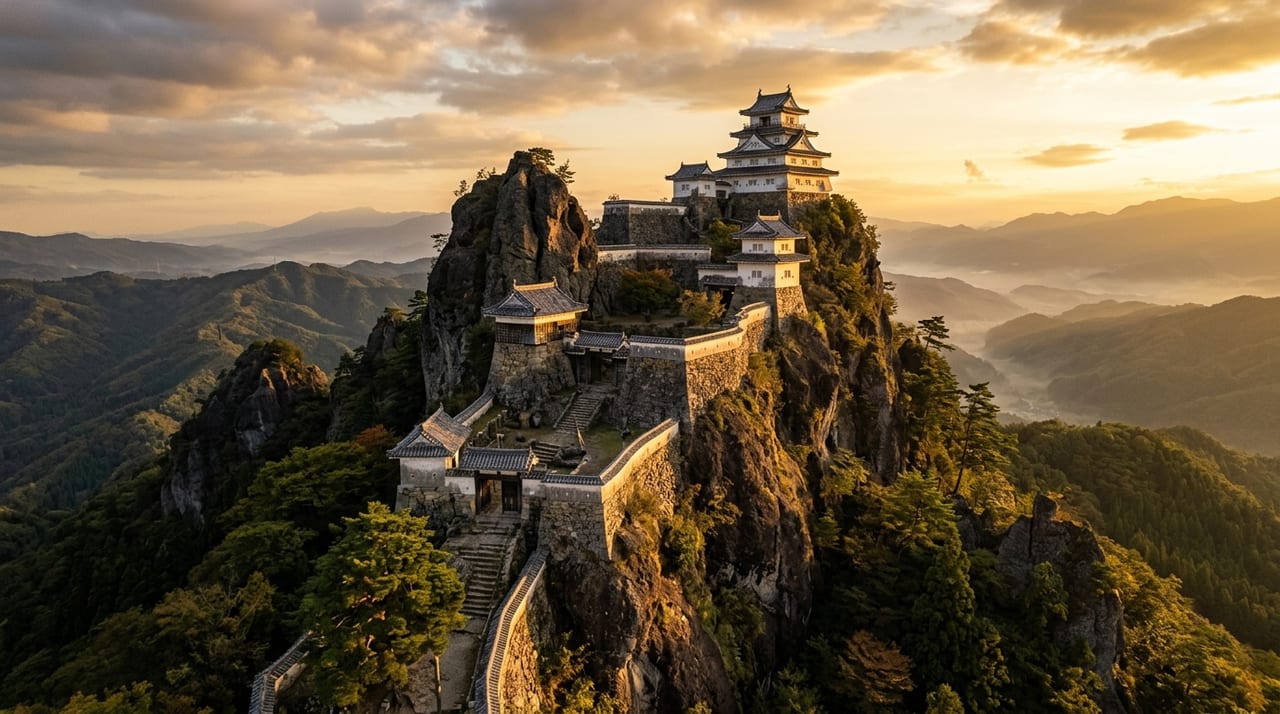
 * Image is for illustrative purposes only.
Iwabitsu Castle
岩櫃城
Iwabitsu Castle is a historic castle in the Kantō region (A mountain castle said to have been built in the Kamakura to Nanboku-chō periods (the construction date is unknown). In Eiroku 6 (1563), Sanada Yukitaka captured it on Takeda Shingen's orders. After that it became the most important base of Sanada clan rule in Kōzuke Province (Gunma)). Its lord was Saitō Norihiro (Uesugi side) → Takeda Shingen (captured it) → Sanada Yukitaka and Masayuki (the Sanada clan's base for controlling Kōzuke).
Overview
Iwabitsu Castle is a mountain castle located in Higashiagatsuma, Agatsuma District, Gunma Prefecture. It is known as an impregnable stronghold that makes maximum use of the steep rocky peak terrain of Mount Iwabitsu (802 m above sea level). It is counted among the Takeda clan's three strongholds (Takeda san-kenjō), which are Iwadono Castle in Kai Province, Kunō Castle in Suruga Province, and Iwabitsu Castle in Kōzuke Province.
The castle's history is said to go back to the Kamakura and Nanboku-chō periods, but it reached its peak in the Sengoku period after coming under Sanada clan control. In Eiroku 6 (1563), Takeda Shingen ordered Sanada Yukitaka, a master of stratagem later called Seme Danjō, to take Iwabitsu Castle. Yukitaka is said to have brought the castle down not by a frontal assault but through rōraku (winning people over) and naiō (inside turncoat schemes), stratagems that turned the castle's commanders to his side. This is passed down as the first great undertaking that showed the wisdom of the Sanada clan.
Under Sanada Masayuki, Iwabitsu Castle became the most important base of Sanada clan rule in Kōzuke Province (Gunma). After the fall of the Takeda clan in Tenshō 10 (1582), Masayuki made Iwabitsu Castle a stronghold for the Sanada clan's independence. Surrounded by the great powers on four sides, the Oda, Hōjō, Tokugawa and Uesugi, he protected the Sanada clan through hyōri hikyō (changeable and cunning) diplomacy, a flexible survival strategy of changing lords as circumstances required.
Iwabitsu Castle is said to have been a branch castle of Numata Castle, with the Sanada family's senior retainer Ideura Tsushima no Kami serving as its castellan. Iwabitsu Castle became the prologue setting of the NHK taiga drama Sanada Maru (2016) and came to be widely known as the Sanada castle.
Connection to Swords
Iwabitsu Castle is a Sengoku-period mountain castle over which the Saitō clan, on the Uesugi side, and the Sanada clan, on the Takeda side, fought. In Eiroku 6 (1563), Sanada Yukitaka captured it, partly with help from the inside defection of its retainers. In Tenshō 10 (1582), Sanada Masayuki built a residence (a goten, now the Senryūin site) on the southern face of Mount Iwabitsu to receive Takeda Katsuyori, who had been driven into a corner by Oda and Tokugawa forces. Katsuyori never came, and the Takeda clan fell.
Ideura Masasuke (Tsushima no Kami), the last castellan of Iwabitsu Castle, is said to have helped Mori Nagayoshi withdraw after the Honnōji Incident, and in return Nagayoshi gave him a wakizashi. Sanada Nobuyuki dismantled Iwabitsu Castle in the early Edo period and moved the castle town to present-day Haramachi.
Highlights
- Mount Iwabitsu (802 m above sea level) — a sheer rock peak rising behind the castle ruins, the natural stronghold of the Takeda san-kenjō
- Honmaru and Ninomaru ruins — a national designated historic site where enclosure remains, earthen ramparts and dry moats survive on the steep mountainside
- Sanada clan main castle site (Ueda) — the mountain castle ruins of the Sanada clan remaining in Ueda, Nagano Prefecture
- Kusatsu Onsen — one of Japan's leading hot spring resorts, in the same Agatsuma District as Iwabitsu Castle
- Sanada exhibits in Haramachi (Higashiagatsuma) — Sanada-themed content developed since the broadcast of Sanada Maru, and a stroll through the castle town
* Opening hours and admission fees are subject to change. Please check the official website before visiting.