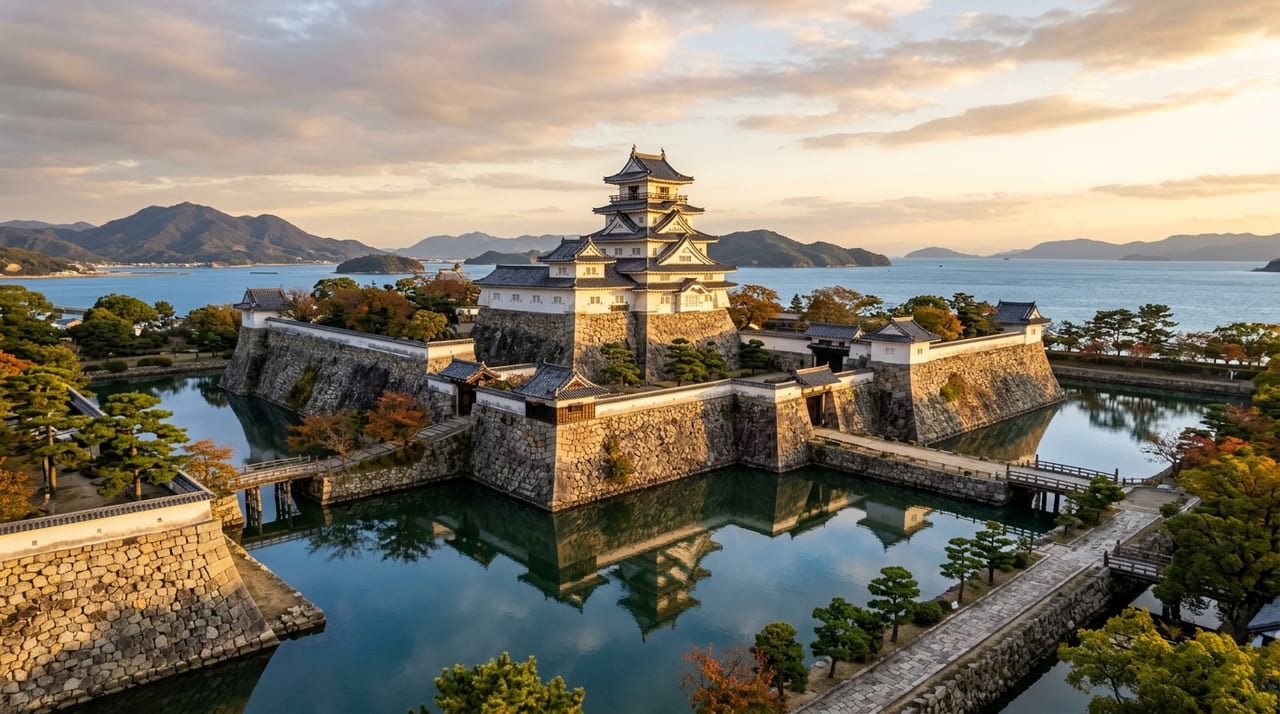
 * Image is for illustrative purposes only.
Tateyama Castle
館山城
Tateyama Castle is a historic castle in the Kantō region (Built in 1580 (Tenshō 8); abandoned in 1614 (Keichō 19)). Its lord was Satomi Yoshiyori, Satomi Yoshiyasu, Satomi Tadayoshi.
Overview
Overview
Tateyama Castle was a hilltop castle (hirayama-jiro) located in Tateyama, Tateyama City, Chiba Prefecture, and served as the final residence of the Satomi clan, the sengoku daimyo who governed the southern Bōsō Peninsula. Built on an isolated hill about 65.7 meters high, it used the steep natural cliffs on its east and north sides together with artificial moats for defense. It is protected as the Tateyama City Designated Historic Site "Tateyama Castle Ruins."
Construction and the Satomi Relocation
The castle is said to have been built in 1580 (Tenshō 8) by Satomi Yoshiyori. From the 6th to the 11th month of Tenshō 19 (1591–92), Satomi Yoshiyasu moved his base from Okamoto Castle to Tateyama Castle. From then on, as the main castle of the Satomi clan, development of the castle town proceeded. The formation of this castle town became the foundation of today's urban area of Tateyama City.
Structure
Built as a hirayama-jiro on an isolated hill about 65.7 meters high, the castle had steep natural cliffs on its east, west, and north sides serving as natural defenses, and artificial moats were installed from the east to the north. The castle followed a linked-bailey layout (renkaku-shiki) and was equipped with baileys, ditches (horikiri), and dry moats (including water moats). Some researchers have suggested that the castle may have had a harbor attached.
Abandonment and Aftermath
In 1614 (Keichō 19), the tenth Satomi lord, Tadayoshi, was ordered to be transferred to Hōki Province (present-day Tottori Prefecture) and stripped of his domain, mainly because he was implicated in the downfall of Ōkubo Tadachika. The Tateyama domain was abolished and Tateyama Castle was demolished. Even when Inaba Masaaki became lord of the Tateyama domain in 1781, the castle was not rebuilt, and only a government office (jin'ya) was set up at the foot of the castle. During World War II, an anti-aircraft gun position was placed on Shiroyama, and the summit was cut down by about 7 meters, seriously damaging the remains.
Present State and Access
Excavations conducted from 1978 to 1980 (Shōwa 53–55) confirmed the remains of a palace (goten) and the Kashima moat. In 1982 (Shōwa 57), a mock tenshu was built on the summit, which became an annex of the Tateyama City Museum (the Hakkenden Museum), and the castle ruins area was developed and opened as Shiroyama Park. About 10 minutes by JR Bus Kantō or Tateyama Nitto Bus from "Tateyama" Station on the JR Uchibō Line; get off at "Shiroyama Kōen-mae."
Highlights
- The final stronghold of the Satomi clan, sengoku daimyo of the Bōsō region (Satomi Yoshiyasu relocated here in 1591)
- A linear-bailey hirayama-jiro built on an isolated hill roughly 65.7 meters in elevation
- Abandoned and demolished in 1614 following the exile of Satomi Tadayoshi
- The mock tenshu built in 1982 now houses the Hakkenden Museum, an annex of the Tateyama City Museum
- The castle site is maintained as Shiroyama Park and designated a Tateyama City Historic Site
* Opening hours and admission fees are subject to change. Please check the official website before visiting.