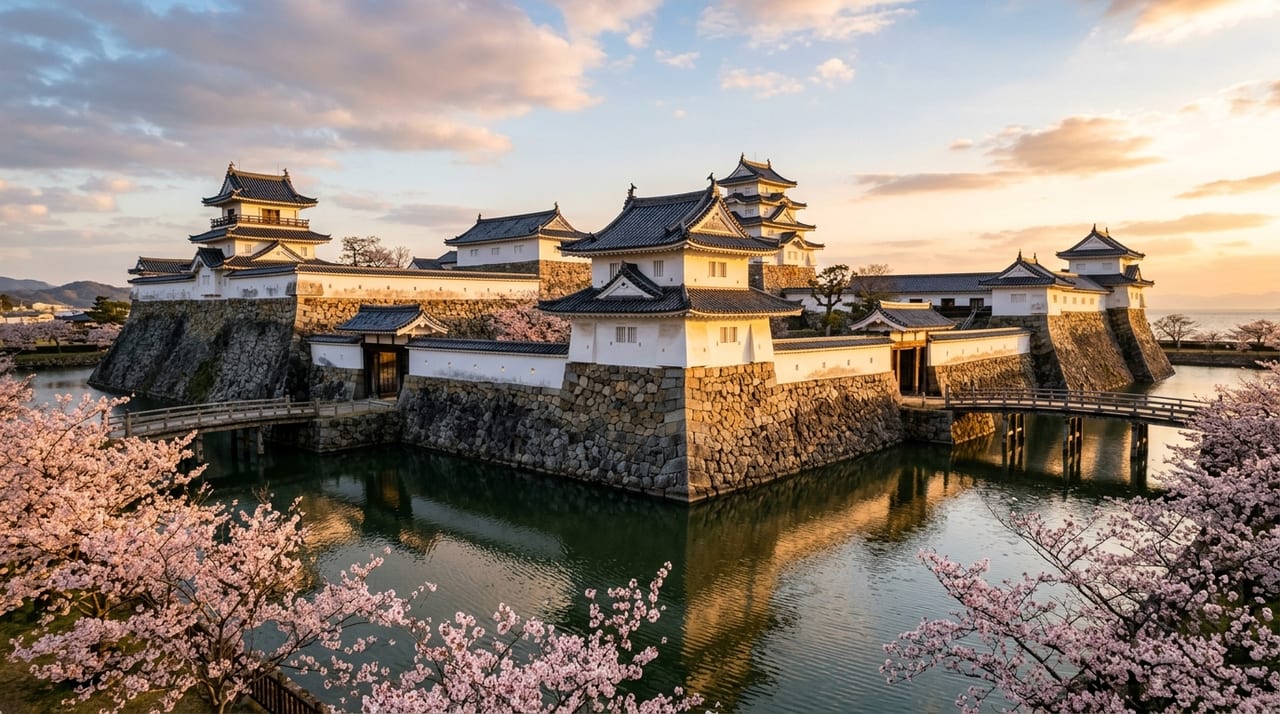
 * Image is for illustrative purposes only.
Yūki Castle
結城城
Yūki Castle is a historic castle in the Kantō region (Traditionally said to have been built in the early Kamakura period (late 12th century) by Yūki Tomomitsu, first generation of the Yūki clan. Site of the Yūki War (1440–1441). Survived until the Meiji Restoration). Its lord was Yūki clan (Shimousa Yūki family) → Tokugawa clan (Yūki Hideyasu) → Mizuno clan.
Overview
Yūki Castle is the ruin of a medieval castle located in Yūki City, Ibaraki Prefecture. It was the principal stronghold of the Yūki clan, who took root in Shimousa Province (present-day western Ibaraki Prefecture), from the Kamakura period into the early Edo period. Built at the northeastern tip of a plateau facing the Tagawa River to the north, the castle is now developed as a castle-ruin park where earthworks and moat traces remain. It is especially known in Japanese history as the stage of the "Yūki War (1440–1441)" that followed the "Eikyō Uprising (1438–1439)," and it stands as a symbol of the power struggles of the Kamakura kubō and the final resistance of eastern warriors.
Yūki Tomomitsu (1168–1254) was the son of Oyama Masamitsu, a powerful local family of Oyama in Shimotsuke Province whose ancestor was Fujiwara no Hidesato. Minamoto no Yoritomo placed his trust in Tomomitsu, and he became a prominent vassal of the Kamakura shogunate. Thereafter, the Yūki clan maintained its power centered on Yūki district of Shimousa Province, and remained a leading warrior house of the Kantō region through the Nanboku-chō and Muromachi periods.
The greatest moment in the castle's history was the "Yūki War (1440–1441)." When the Muromachi shogunate (Ashikaga Yoshinori) destroyed the Kamakura kubō, Ashikaga Mochiuji, in the Eikyō Uprising, Mochiuji's surviving sons Yasuōmaru and Haruōmaru were sheltered by Yūki Ujitomo, and the clan raised troops aiming to restore the Kamakura kubō. Yūki Ujitomo and his son Yūki Mochitomo took refuge in Yūki Castle with Haruōmaru and Yasuōmaru, but the castle was surrounded by the shogunate's massive forces. After about a year of siege, the castle fell. Yasuōmaru and Haruōmaru were captured by the shogunal forces and executed during their transport. The Yūki War is passed down to later generations as a symbolic conflict in which the contradictions between shogunal authority and the local warriors of the east erupted.
During the Sengoku period, the Yūki clan survived skillfully amid pressure from the Hōjō and Uesugi clans, and maintained relations with Oda Nobunaga and Toyotomi Hideyoshi during the Tenshō era. In Tenshō 18 (1590), Yūki Hideyasu, the second son of Tokugawa Ieyasu, succeeded the Yūki clan as adopted heir of Yūki Harutomo and became lord of Yūki Castle. After Sekigahara, he was transferred to the Echizen (Fukui) domain. The castle was temporarily abandoned after that, but the Mizuno clan was enfeoffed in Genroku 13 (1700), the castle was revived in Genroku 16 (1703), and it survived until the Meiji Restoration.
Today the Yūki Castle ruins are preserved as a castle-ruin park within the city, where earthworks and moat traces remain. Yūki City has been known since the Edo period as a production center of "Yūki-tsumugi" silk textiles. It is a distinctive city where the silk-weaving tradition, which is registered as a UNESCO Intangible Cultural Heritage, overlaps with the history of a medieval castle town.
Connection to Swords
The connection between Yūki Castle and Japanese swords can be understood from the warrior culture of the Yūki clan and the social function of swords in the warrior society of the Kantō region.
The Yūki clan began as a prominent vassal house of the Kamakura shogunate, and through the Nanboku-chō and Muromachi periods it served as the foremost warrior family among the eastern warriors. For a warrior family of such standing, swords were far more than weapons. They were among the most important objects representing family status, lord-vassal bonds, and authority.
Yūki Harutomo owned the great spear Otegine, a large-bladed spear made by the smith Yoshisuke of Shimada in Suruga, which is counted among the three famous spears of the realm. This spear was passed on to his adopted son, Yūki Hideyasu.
Highlights
- Yūki Castle ruins park — a castle-ruin park where earthworks and moat remains survive; walk among the traces of a castle that continued from the Kamakura period
- Site of the Yūki War — the 1440–1441 siege, the place of the final resistance of eastern warriors who aimed to restore the Kamakura kubō
- Yūki-tsumugi Museum Tsumugi-no-Yakata — a facility where visitors can tour and try weaving "Yūki-tsumugi," a UNESCO Intangible Cultural Heritage
- Takeda-Suga Shrine — originated as the Tennō-sha shrine enshrined by the Yūki clan, and was regarded as the sōja (general shrine) of Yūki district
- Yūki Hideyasu heritage site — a historic site where Tokugawa Ieyasu's second son became lord; historically significant as the forerunner of the Echizen Matsudaira house
- Plateau terrain overlooking the Tagawa River — a view from the castle ruins over the plateau landform that served as the castle's natural stronghold
* Opening hours and admission fees are subject to change. Please check the official website before visiting.