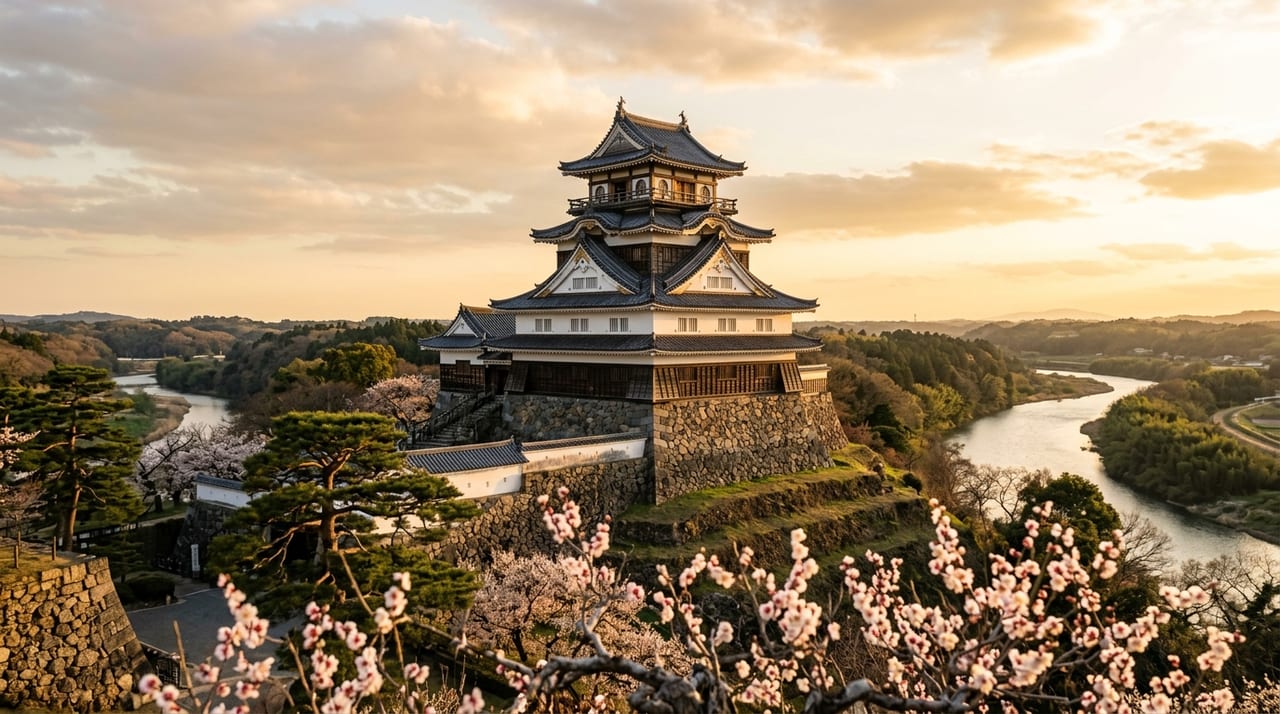
 * Image is for illustrative purposes only.
Mito Castle
水戸城
Mito Castle is a historic castle in the Kantō region (Built in the early Kamakura period (1190s); the castle of the Mito Tokugawa family from Keichō 14 (1609) onward). Its lord was Edo clan / Satake Yoshinobu / Mito Tokugawa clan.
Overview
About the Castle
Mito Castle is a renkaku-style hilltop castle built on a hilly plateau between the Naka River and the Sakura River in Mito City, Ibaraki Prefecture. It is said to have been built by the Baba clan in the early Kamakura period. In the Muromachi period, the Edo clan (the Mito Edo clan) served as castle lords, and throughout the Sengoku period they were active as a leading powerful family of Hitachi Province. In Keichō 8 (1603), Tokugawa Yorinobu, the tenth son of Tokugawa Ieyasu, was granted 200,000 koku in Mito (Yorinobu himself never entered the castle and was raised under Ieyasu's care). Later, Tokugawa Yorifusa (Ieyasu's eleventh son) became the first lord of the Mito domain. From then on, the Mito domain, as one of the Tokugawa Gosanke, spanned a 260-year history.
The Mito Tokugawa Family and Mito-gaku
The Mito domain was a center of historical research known for the compilation of the 'Dai Nihon-shi.' As the source of the Mito school of thought known as Mito-gaku, which advocated revering the emperor and expelling foreigners, it exerted immeasurable influence on Japan in the late Edo period. The second lord, Tokugawa Mitsukuni (known as Kōmon), began the compilation of the 'Dai Nihon-shi' and devoted himself to collecting historical materials from across the country and training historians. The ninth lord, Tokugawa Nariaki, brought Mito-gaku to its culmination as its foremost figure. He advocated 'revere the emperor, expel the barbarians' and 'enrich the nation, strengthen the military,' and had a great influence on politics in the late Edo period. Nariaki's son was Tokugawa Yoshinobu, who later became the 15th shogun.
Kairakuen and Mito's Culture
Kairakuen, developed by the ninth lord Nariaki, is counted among Japan's Three Great Gardens together with Kenrokuen in Kanazawa and Kōrakuen in Okayama. It is famous as a plum-blossom spot. During the plum festival from late February to March, some 100 varieties and 3,000 plum trees are in bloom, drawing many visitors from across the country. Mito Castle was abandoned after the Meiji Restoration, and the castle site retains the Kōdōkan (the domain school of the Mito domain), the Yakuimon gate, and earthen ramparts and dry moats. In recent years, the Ōte Gate, the Ninomaru corner turret, and other structures have been restored in wood, and the former appearance of Mito Castle is gradually being revived.
The Spirit of the Kōdōkan
The Kōdōkan was a domain school established in Tenpō 12 (1841) by Tokugawa Nariaki. It was one of the largest domain schools in Japan, comprehensively teaching Confucian studies, medicine, astronomy, and martial arts. The Kōdōkan's founding spirit of 'bunbu fuki (the civil and the martial are not divided)' embodies the ideal of samurai who, while wearing swords, polished their scholarship at the same time. It forms the foundation of Mito's samurai culture.
Connection to Swords
The Mito Tokugawa family is one of the daimyo houses that occupies the most important position in the history of Japanese swords. There are several reasons for this, but the most notable is the existence of the famous sword known as Shokudaikiri Mitsutada. This sword was originally the beloved sword of Date Masamune, but it later passed to the Tokugawa family and came to be held by the Mito Tokugawa family. For a long time it was thought to have been destroyed in the Great Kantō Earthquake. However, in 2015 it was rediscovered in a fire-damaged state in the storehouse of the Mito Tokugawa family (a holding of the Tokugawa Museum), and it is now housed and displayed at the Tokugawa Museum in Mito City. Shokudaikiri Mitsutada is a masterpiece by Mitsutada of Bizen Osafune from the mid-Kamakura period, and its rediscovery shook the sword world. Many swords were handed down through successive generations in the Mito Tokugawa family, but most of them were burned in the Great Kantō Earthquake. The ninth lord, Tokugawa Nariaki, placed 'martial strength' at the foundation of domain governance. At the Kōdōkan, he made swordsmanship, spearmanship, and gunnery the core of practical samurai education. When the shishi (activists) of the Mito domain acted under the banner of 'revere the emperor, expel the barbarians' in the late Edo period, the swords they carried became symbolic embodiments of the spirit of Mito-gaku. In the Sakuradamon Incident (1860), seventeen Mito ronin who had left their domain assassinated the tairō (chief councillor) Ii Naosuke. The swords used in this incident will be remembered forever as a historic event showing the role of swords in the political upheaval of the late Edo period. Some of the swords handed down in the Mito Tokugawa family are now held in the Tokugawa Museum.
Highlights
- Restored corner turret and Ōte Gate — Wooden structures of Mito Castle's gates and turrets, recently restored, bring back the dignified appearance of a samurai stronghold of the past
- Kōdōkan (Special National Historic Site and Important Cultural Property) — One of Japan's largest domain schools, a temple of the bunbu fuki spirit
- Kairakuen (one of Japan's Three Great Gardens) — Plum-blossom spot opened by Tokugawa Nariaki, famous for its February plum festival
- Tokugawa Museum — Houses and displays swords, armor, and furnishings handed down in the Mito Tokugawa family
- Ibaraki Prefectural Museum of History — Displays historical materials on Ibaraki, including those of the Mito domain
- Sites associated with the Sakuradamon Incident — A journey tracing the late-Edo-period events in which Mito ronin who had left their domains moved history
* Opening hours and admission fees are subject to change. Please check the official website before visiting.