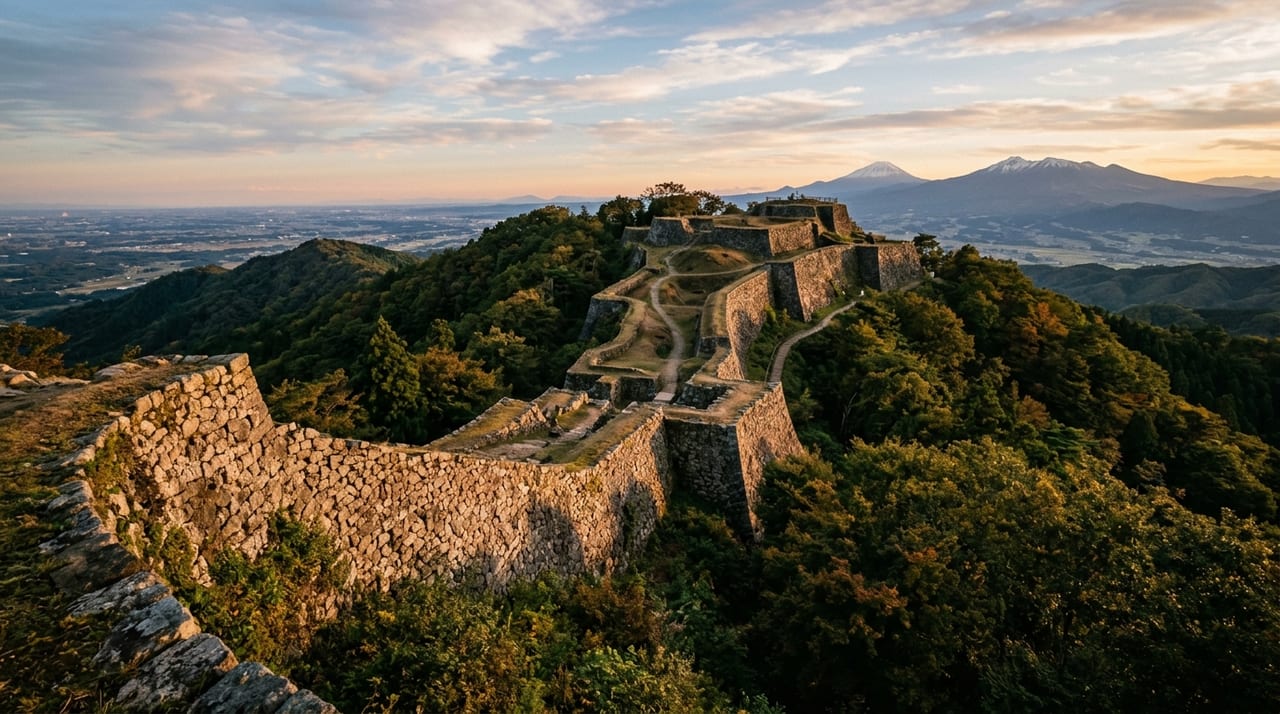
 * Image is for illustrative purposes only.
Kanayama Castle (Nitta Kanayama Castle)
金山城(新田金山城)
Kanayama Castle (Nitta Kanayama Castle) is a historic castle in the Kantō region (Built by Iwamatsu Iezumi in Bunmei 1 (1469). For roughly 120 years afterward, it functioned as one of the most formidable mountain castles in the Kantō region). Its lord was Iwamatsu clan of the Nitta family (15th century) → Yura clan (16th century) → Hōjō clan (abandoned in Tenshō 18).
Overview
Kanayama Castle (Kanayama-jō) is a Sengoku-period mountain castle built on the summit of Mount Kanayama (239 m above sea level) in Ōta City, Gunma Prefecture. It was constructed in Bunmei 1 (1469) by Iwamatsu Iezumi, a powerful local lord of Kōzuke Province. It stood on the site of the stronghold of Nitta Shō (Nitta no shō), the castle seat of the Nitta family (descendants of Minamoto no Yoshiie and members of the Nitta Yoshisada line). Built on a strategic site with a commanding view of the Kantō Plain, it earned its place in Sengoku history as 'a famed castle of the Kantō' and 'the impregnable Kanayama Castle.' It is also known as 'Ōta Kanayama Castle.'
The castle used a renkaku-shiki nawabari (layout of connected enclosures) that spread along the entire ridge from the summit of Mount Kanayama, with the Honmaru, Ninomaru, Sannomaru, Baba kuruwa, and Monomidai placed along the ridgeline. Notably, stone walls and stone paving are used extensively. The castle is valued as an important site that, through excavation, overturned the long-held view that Sengoku-period mountain castles in the Kantō had no full-fledged stone walls. Nozura-zumi stone walls coexist with earthen features such as horikiri (dry ditches) and dobashi (earthen bridges), making it a fine example of how the defensive system of mountain castles changed over time.
Control of the castle passed from the Iwamatsu family, who built it. Around Kyōroku 1 (1528), retainers Yokose Yasushige and his son Narishige killed their lord Iwamatsu Masazumi and seized power (the Kyōroku Disturbance). Around Eiroku 8 (1565), Narishige changed his surname to Yura, and the castle became a castle of the Yura family. During the Yura period, Kanayama Castle functioned as a political base in Kōzuke Province while the Yura repeatedly fought, allied with, and broke from the Later Hōjō. In Tenshō 2 (1574), it also fought against the forces of Uesugi Kenshin. In Tenshō 12 (1584), the brothers Yura Kunishige and Nagao Akinaga were called to account by the Hōjō. Their mother, Myōin-ni, along with clan members and retainers, held out in Kanayama Castle, but it is thought they surrendered the castle and submitted to the Hōjō by spring of that same year.
Kanayama Castle had been handed over to the Hōjō in Tenshō 13 (1585). During Toyotomi Hideyoshi's attack on Odawara in Tenshō 18 (1590), it was seized as a castle in Hōjō territory and was abandoned thereafter. Meanwhile, Yura Kunishige was detained at Odawara Castle, but because his mother Myōin-ni and others sided with Hideyoshi, the Yura family survived the war and was granted domains in Ushiku, Hitachi. After its abandonment, many remains such as stone walls were left in place. Today, as 'Kanayama Castle Ruins,' it is a nationally designated historic site and is counted among the Nihon Hyakumeijō (100 Famous Castles of Japan). It has been developed as a historic park maintained by Ōta City. Another attraction is the magnificent view from the castle ruins, which overlooks the Kantō Plain, Mount Asama, Mount Akagi, Mount Haruna, and others.
Connection to Swords
Kanayama Castle was located in Kōzuke Province (present-day Gunma Prefecture) and was a castle at the forefront of the turmoil in the Kantō during the Sengoku period.
The Yura family, the castle's lords, were a powerful local lord house in Kōzuke Province and a major clan that employed many warriors. Maintaining such a large warrior band required large quantities of arms such as swords, spears, and naginata. It is presumed that the lords of Kanayama Castle had close ties with the armorers and swordsmiths of the castle town.
Kōzuke Province, including Kanayama Castle, was an area where the three major powers of Takeda Shingen, Uesugi Kenshin, and the Hōjō clashed in the late Sengoku period. The number and variety of swords used on the battlefield were enormous. As a castle positioned at the forefront of this struggle for supremacy in the Kantō, Kanayama Castle can be described as a site that embodies the historical context of Japanese sword use on the battlefield and the circulation of swords.
Highlights
- Hi no Ike and Tsuki no Ike — stone-built reservoirs constructed within the mountain castle
- Honmaru and Ōte kōguchi — the main defensive line where nozura-zumi stone walls and masugata kōguchi gateways survive in good condition
- Minami kuruwa stone walls — stone wall remains that overturned the long-held view that Kantō mountain castles had no full-fledged stone walls
- Views of the Kantō Plain and the Jōmō Sanzan — panoramic views of Mount Akagi, Mount Haruna, Mount Myōgi, and Mount Asama from the Honmaru site
- Historic Site Kanayama Castle Ruins Guidance Facility (southern foot of Mount Kanayama) — a facility that introduces the Kanayama Castle ruins in detail
- Ikushina Shrine (Ōta City), associated with Nitta Yoshisada — a historic site of the Nitta family
* Opening hours and admission fees are subject to change. Please check the official website before visiting.