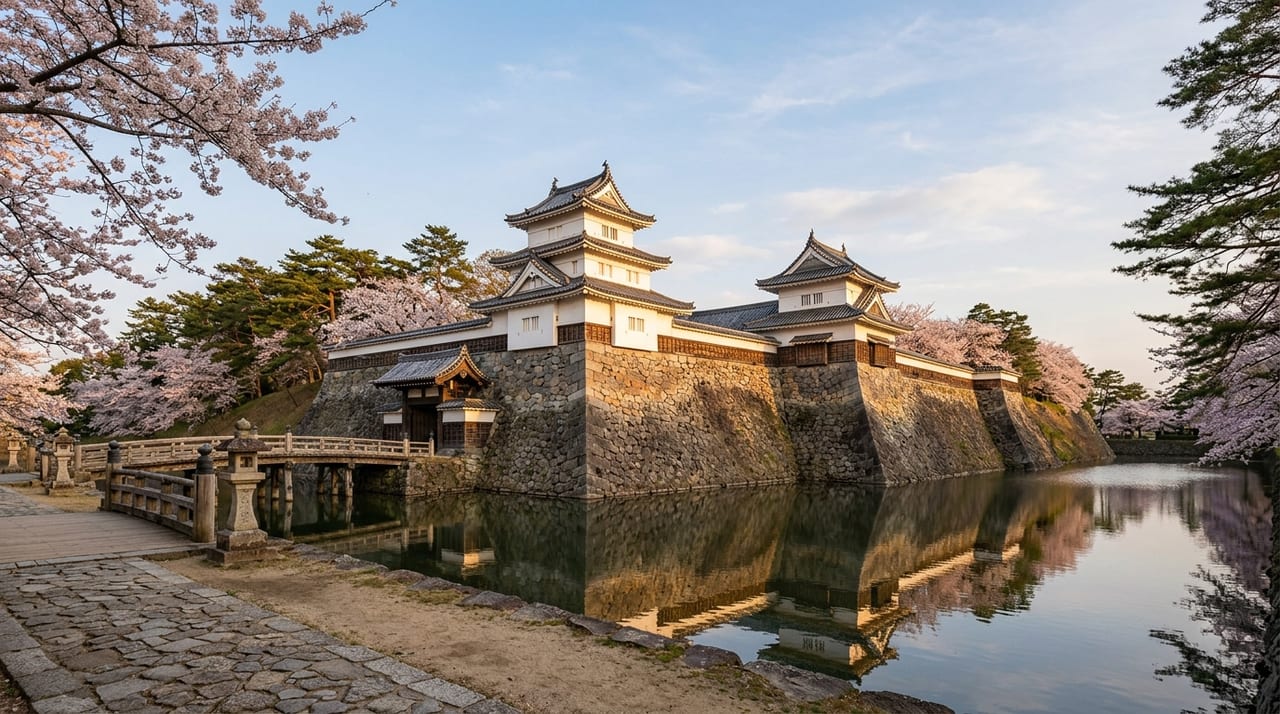
 * Image is for illustrative purposes only.
Utsunomiya Castle
宇都宮城
Utsunomiya Castle is a historic castle in the Kantō region (Origins in the late Heian period (c. 11th century); repeatedly expanded through Sengoku and Edo periods). Its lord was Utsunomiya clan / Okudaira clan / Honda clan.
Overview
Utsunomiya Castle is a hirajiro (flatland castle) in the central part of Utsunomiya City, Tochigi Prefecture. It is also called Kamegaoka Castle. Its origins go back to the late Heian period, when the Utsunomiya clan developed it as their base. It was a key stronghold guarding the northern approaches to the Kantō region. During the Sengoku period it became the stage for a complex shift of power among the Hōjō, Uesugi, Toyotomi, and Tokugawa clans.
The Utsunomiya clan was a prestigious family descended from the Fujiwara Hokke line. As the largest power in Shimotsuke Province (present-day Tochigi Prefecture), it endured for about 500 years, from the 11th century to the end of the 16th century. Utsunomiya Yoritsuna maintained close ties with the Kamakura shogunate and was also known as a man of culture. Through his exchanges with Fujiwara no Teika, he brought the culture of Kyōto to Shimotsuke.
In the late Sengoku period, the Utsunomiya clan survived by taking part in Toyotomi Hideyoshi's campaign against Odawara. However, in Keichō 2 (1597), it was suddenly stripped of its domains and destroyed. Afterward, following the Battle of Sekigahara, the Okudaira and Honda clans became lords of the castle. Throughout the Edo period, it functioned as the main castle of the Utsunomiya Domain.
Utsunomiya prospered as a post town on the Nikkō Kaidō and was a key stop for pilgrims visiting Nikkō Tōshōgū. When the shogun's family made pilgrimages to Nikkō, a gohonjin (lodging) was set up within the castle. During the Boshin War, the castle became a fierce battleground between the former shogunate forces and the new government forces (Utsunomiya Castle Battle, 1868), and most of its structures were burned.
Today the site is maintained as Utsunomiya Castle Ruins Park, where two corner turrets, Seimeidai and Fujimi-yagura, and part of the earthen ramparts have been reconstructed. Remains that echo the castle's layout in its heyday survive within the city center, and they form a core part of Utsunomiya's historical identity.
Connection to Swords
Utsunomiya Castle's connection to the Japanese sword is told through the warrior history of the Utsunomiya clan and through its history as the castle of hereditary (fudai) daimyō in the Edo period. Since Fujiwara no Sōen established a residence south of Mount Futara in the Heian period, the Utsunomiya clan held sway in Shimotsuke Province for about 500 years, and in the early Sengoku period the 17th head, Utsunomiya Shigetsuna, seized control of the house after the internal conflict known as the Utsunomiya Disturbance. Okudaira Iemasa, who became lord of the Utsunomiya Domain in Keichō 6 (1601), was the son of Okudaira Nobumasa, defender of Nagashino Castle, and Kamehime, eldest daughter of Tokugawa Ieyasu. For his service at Nagashino, Nobumasa had received from Ieyasu the celebrated sword Daihannya Nagamitsu (National Treasure, Tokyo National Museum), so the Okudaira family also left its mark on sword history. Many Edo-period lords of Utsunomiya were fudai daimyō who held senior shogunate posts, such as Toda Tadazane, who served as a senior councillor (rōjū). Most of the castle was destroyed by fire in the Boshin War in Keiō 4 (1868), but part of the honmaru was reconstructed in 2007 and is open to the public as Utsunomiya Castle Ruins Park.
Highlights
- Reconstructed Seimei-dai and Fujimi turrets — restored corner towers evoking the castle's former silhouette
- Reconstructed earthworks and moat — defensive landscape of this flatland fortification
- Utsunomiya Castle Ruins Park — historic green space at the city's heart
- 1868 Battle of Utsunomiya site — major Boshin War engagement on these grounds
- Nikkō Kaidō post-town — shogunal pilgrimage rest stop on the road to Nikkō Tōshōgū
- Utsunomiya City Museum — collections on the history of Utsunomiya
* Opening hours and admission fees are subject to change. Please check the official website before visiting.