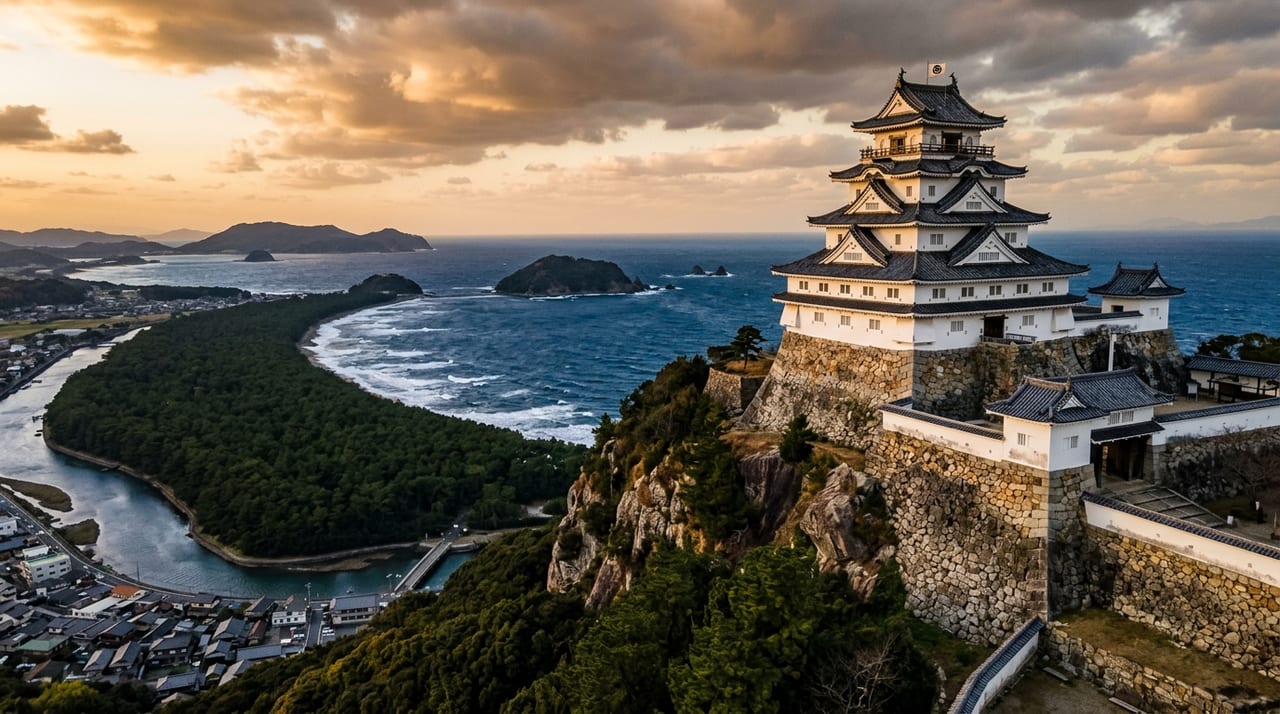
 * Image is for illustrative purposes only.
Yōgaisan Castle (Mount Yōgai Castle)
要害山城
Yōgaisan Castle (Mount Yōgai Castle) is a historic castle in the Chūbu region (Sengoku period (built in 1520) to 1600, when it was abandoned after the Battle of Sekigahara). Its lord was Takeda Nobutora (builder); Takeda Shingen; castellans including Komai Masanao and Mutō Yamashiro; under Toyotomi rule, Katō Mitsuyasu, lord of Kōfu Castle, who renovated it.
Overview
Founding
Yōgaisan Castle was built in June 1520 by Takeda Nobutora on Maruyama, a hill northeast of his residence, Tsutsujigasaki-yakata, to serve as its detsuru-jō (refuge/rear fortress). It formed a key point in the defense of the Kōfu Basin against incursions by the Imagawa clan and forces from the Kantō region.
Tradition of Shingen's Birth
The following year, 1521, when Kunizane Masanari and other retainers of the Imagawa of Suruga invaded Kai Province, Nobutora's principal wife, Lady Ōi, is said to have taken refuge at Yōgaisan Castle while pregnant and given birth there to their eldest son, Tarō, who would later become Takeda Shingen. A stone monument inscribed "Birthplace of Lord Takeda Shingen," in calligraphy by Tōgō Heihachirō, stands in the main bailey at the summit.
Succession of Lords
Under Takeda rule, castellans including Komai Masanao and Mutō Yamashiro were stationed there. After Oda Nobunaga's conquest of the Takeda in 1582, the castle passed through Tokugawa control before Toyotomi-affiliated daimyo took over; during the Bunroku era, Katō Mitsuyasu, lord of Kōfu Castle, is said to have renovated it. It was abolished in 1600, after the Battle of Sekigahara.
Structure
Gates and baileys accompanied by masugata (box-shaped) gate approaches line the mountain path from the hillside up to the main bailey, with vertical moats (tategori) and cut-throughs (horikiri) reinforcing key points. The main bailey measures roughly 73 meters east-west and 22 meters north-south and is enclosed by earthworks. Portions of anō-zumi stone walling, believed to date from Katō Mitsuyasu's renovation, can also be seen, and the satellite fortress Kuma-jō guards the eastern approach.
Present State
As a detsuru-jō built by the Sengoku daimyo Takeda clan, and as an example of the residential and defensive form of medieval regional lords, the site is regarded as historically important and was designated a National Historic Site as "Yōgaisan" on March 30, 1991. In 2017 it was selected among the Continuation of Japan's Top 100 Castles (No. 128).
Connection to Swords
Highlights
- Mountain castle built by Takeda Nobutora as the detsuru-jō for Tsutsujigasaki-yakata
- Traditionally the birthplace of Takeda Shingen; a monument inscribed by Tōgō Heihachirō marks the spot at the summit
- Well-preserved remains spanning the medieval-to-early-modern transition, including vertical moats, cut-throughs, and anō-zumi stone walls
- Designated National Historic Site "Yōgaisan" in 1991; selected among the Continuation of Japan's Top 100 Castles (No. 128) in 2017
* Opening hours and admission fees are subject to change. Please check the official website before visiting.