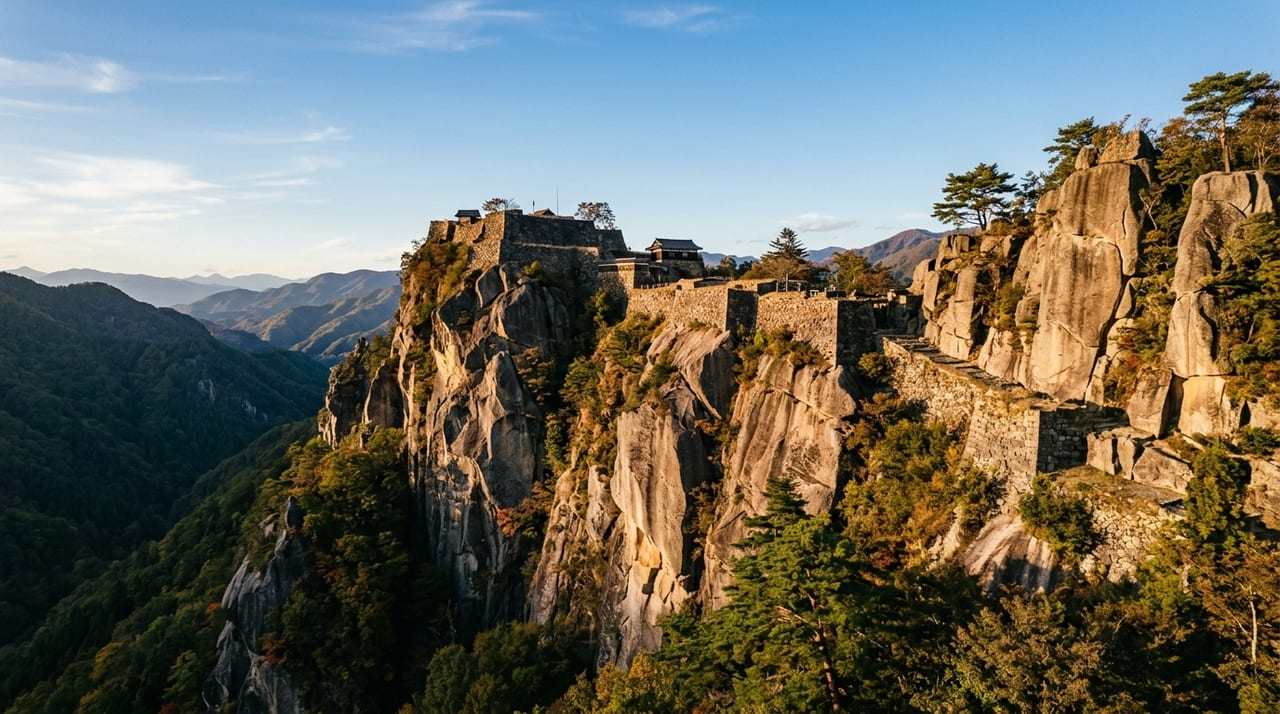
 * Image is for illustrative purposes only.
Iwadono Castle
岩殿城
Iwadono Castle is a historic castle in the Chūbu region (Sengoku Period (15th–16th century)). Its lord was Oyamada clan (Takeda retainers) → Oyamada Nobushige.
Overview
Iwadono Castle (Iwadono-jō) is a mountain castle from the Sengoku period located in Ōtsuki City, Yamanashi Prefecture, known as an impregnable natural fortress that makes use of the steep cliffs of Mt. Iwadono, at an elevation of 634 m. It is said to have been the stronghold of the Oyamada clan, a powerful retainer family of the Takeda clan (there is also a theory that the Takeda clan built it as a castle guarding the boundary with Sagami), and its last lord was Oyamada Nobushige. When the Takeda clan fell in Tenshō 10 (1582), their lord Takeda Katsuyori attempted to flee to Iwadono Castle, but Nobushige betrayed Katsuyori and refused to admit him, so the tragedy occurred in which Katsuyori took his own life at Mt. Tenmoku (Keitokuin). Nobushige himself was subsequently executed by Oda Nobutada, and the Oyamada clan of Gunnai was destroyed. The vertical rock faces and surviving remains convey the formidable defenses of the castle's heyday to the present day, and the site is also renowned as a symbolic landscape of Ōtsuki City.
Connection to Swords
Iwadono Castle was a castle deeply bound up with the Takeda clan, and the relationship between the Takeda family and Japanese swords occupies an important place in the history of swords in the Sengoku period. Iwadono Castle, defended by Oyamada Nobushige, was located on the boundary between Takeda territory and Sagami and Musashi, and is a ruin that embodies the turning point of Sengoku history marked by the fall of the Takeda.
Highlights
- Steep cliffs of Mt. Iwadono — a vertical rock face at an elevation of 634 m forms a natural fortress; the castle ruins and views of Mt. Fuji are spectacular
- Site associated with Takeda Katsuyori — the tragic place where Katsuyori attempted to flee, tracing the history of the fall of the Takeda clan
- Mt. Iwadono Hiking Course — within walking distance from Ōtsuki Station to the trailhead; also popular as a Mt. Fuji viewing spot
- Keitokuin (Kōshū City) — a temple founded at the site of Takeda Katsuyori's suicide, by order of Tokugawa Ieyasu, to memorialize Katsuyori, his son, and their retainers
* Opening hours and admission fees are subject to change. Please check the official website before visiting.