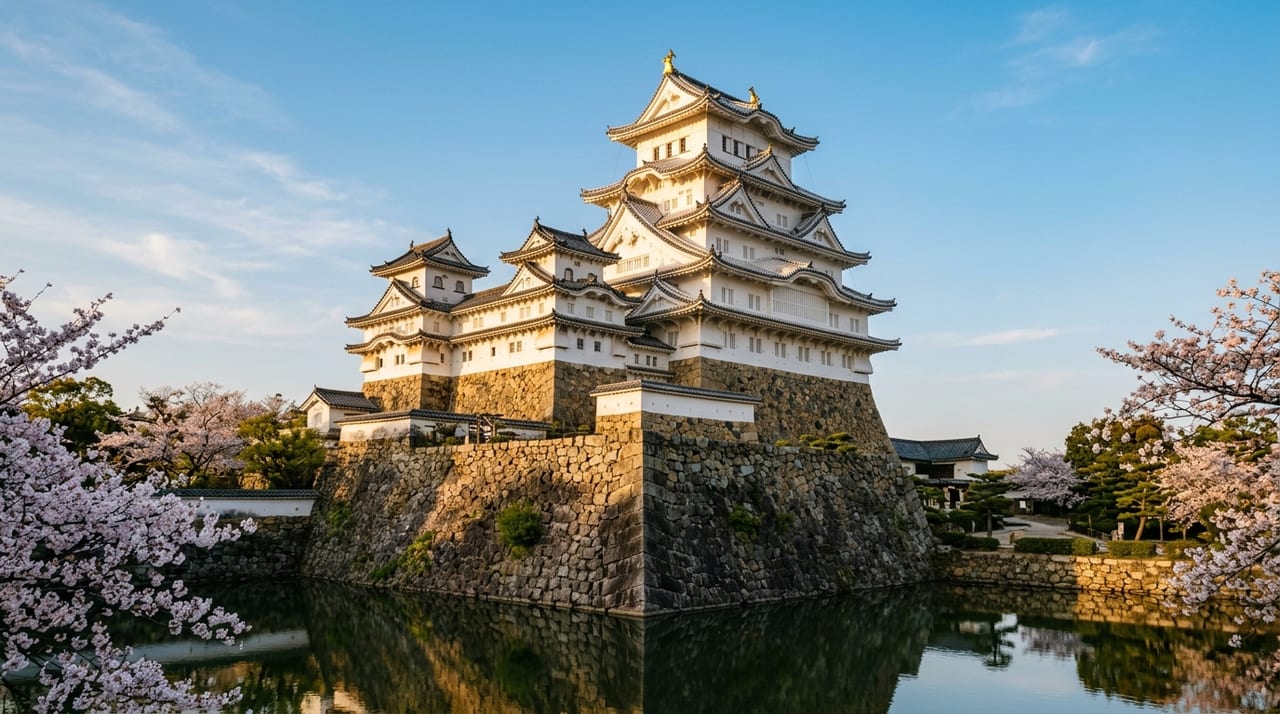
 * Image is for illustrative purposes only.
Naguya Castle
那古野城
Naguya Castle is a historic castle in the Chūbu region (Built around 1521 by Imagawa Ujichika; seized by Oda Nobuhide in 1538). Its lord was Imagawa Ujichika / Oda Nobuhide / Oda Nobunaga.
Overview
Naguya Castle was a medieval castle that stood on the site of today's Ninomaru of Nagoya Castle, and it is a historic site deeply connected to the origin of Nagoya's place name. The castle now called 'Nagoya Castle' was built by Tokugawa Ieyasu in the early Edo period. Naguya Castle was a different castle that stood on the same site earlier, in the Sengoku period.
The castle's origins are traced to the Taiei era (around 1521) of the late Muromachi period, and it is said to have been built by Imagawa Ujichika (head of the Imagawa family of Suruga) in an effort to expand his influence into Owari. Naguya (那古野) is an older way of writing the name, read 'Nagoya' just like today's Nagoya (名古屋). There are various theories about its etymology, and no scholarly consensus.
In Tenbun 7 (1538), Oda Nobuhide, a Sengoku daimyo of Owari, seized this castle from the Imagawa and made it the base for his control of Owari. Nobuhide was a warlord who consolidated his economic foundation by bringing Tsushima and Atsuta, key commercial and transport hubs of the Tōkai region, under his control. His child was Oda Nobunaga, who later became the ruler of the realm, born in Tenbun 3 (1534). Regarding his birthplace, there are theories that he was born at Naguya Castle and at Shobata Castle; in recent years the Shobata Castle theory is considered the more likely. Nobuhide handed Naguya Castle to the young Nobunaga, who spent his boyhood in this castle, and Nobunaga then advanced toward the unification of Owari, his entry into Kyoto (jōraku), and the 'Tenka Fubu' (rule of the realm by force).
After Nobunaga moved his base to Kiyosu Castle in Kōji 1 (1555), Oda Nobumitsu, Hayashi Hidesada, and others temporarily occupied Naguya Castle, but it was eventually abandoned. By around Keichō 14 (1609), when Tokugawa Ieyasu decided to build Nagoya Castle on this site, the former site of Naguya Castle is said to have become wilderness of the kind used for falconry.
Today, remains of Naguya Castle can hardly be confirmed, but the area around the Ninomaru of Nagoya Castle is said to correspond to its castle precinct, and it holds historical significance as the birthplace of Nagoya's place name. A stone monument for Naguya Castle stands on the former Ninomaru of Nagoya Castle, and research continues among local historians and castle scholars.
The major historical significance of Naguya Castle lies in the fact that it was the castle where Oda Nobunaga spent his boyhood (some theories hold that it was his birthplace). As the place where Nobunaga, who laid the foundations for the unification of the realm, spent his youth, it occupies a special position in Japanese history, and it is also indispensable when discussing the origin of the place name 'Nagoya'.
Connection to Swords
The connection between Naguya Castle and swords begins with the castle's lord, Oda Nobuhide, and with Nobunaga's views on swords. Nobuhide held Atsuta, the approach town of Atsuta Shrine, under his influence. Atsuta Shrine enshrines the Kusanagi no Tsurugi (Ame no Murakumo no Tsurugi) as its sacred object, and his control of this place, a holy site of swords and faith, shows Nobuhide's deep contact with sword culture.
Later, under the banner of 'Tenka Fubu', Nobunaga acquired many famous swords known as meibutsu. Numerous swords associated with Nobunaga exist, including 'Heshikiri Hasebe' (transmitted by the Kuroda family, a National Treasure held by the Fukuoka City Museum) and 'Yagen Tōshirō' (now lost; only anecdotes survive). The attachment to swords of this warlord, who spent his boyhood at Naguya Castle, is deeply inscribed in the history of Japanese sword culture.
In addition, in Owari in the early Edo period, swordsmiths including Sagami no Kami Masatsune, who became a retained smith of the Owari Tokugawa family, were active in Nagoya.
Highlights
- Castle connected to Oda Nobunaga — the castle handed down by his father Nobuhide, where the young Nobunaga spent his boyhood (some theories hold it was his birthplace)
- 'Naguya' (那古野) and 'Nagoya' (名古屋) — the castle name Naguya (那古野) is read 'Nagoya', the same as Nagoya (名古屋)
- Stage of the Imagawa–Oda struggle — the center of the power contest over Owari in the early Sengoku period
- Ties to Atsuta Shrine — a base of the father and son Nobuhide and Nobunaga, who controlled Atsuta, where the Kusanagi sword is enshrined
- Overlap with Nagoya Castle's Ninomaru — the castle precinct was inherited as the predecessor of the present Nagoya Castle
- Naguya Castle monument — a historic marker stone installed within Nagoya Castle, where visitors can recall the bygone days
* Opening hours and admission fees are subject to change. Please check the official website before visiting.