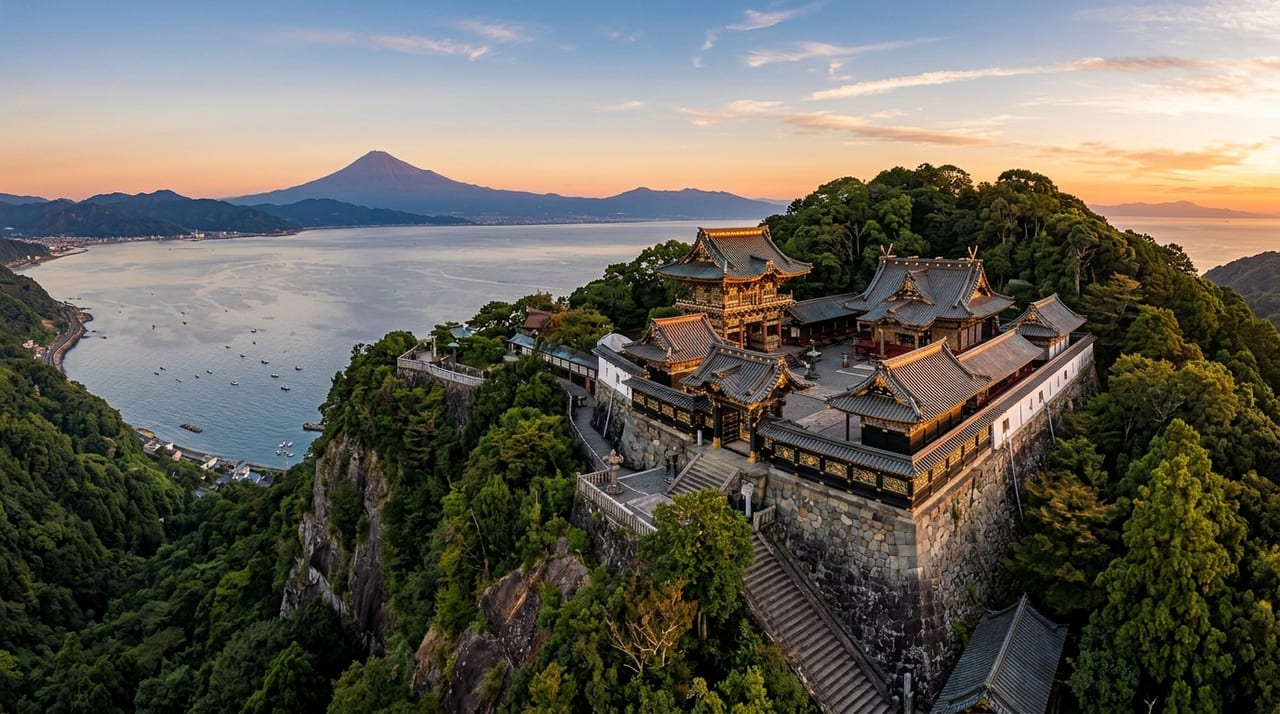
 * Image is for illustrative purposes only.
Kunozan Castle (Kunozan Tōshōgū)
久能山城(久能山東照宮)
Kunozan Castle (Kunozan Tōshōgū) is a historic castle in the Chūbu region (Renovated by Takeda Shingen in 1568 (Eiroku 11)). Its lord was Imagawa clan / Takeda Shingen / Tokugawa Ieyasu.
Overview
About the Castle
Kunōzan Castle is a mountain castle built on the summit of Mount Kunōzan, a 216-meter peak in southern Shizuoka City overlooking Suruga Bay. It was a fortress renowned as one of Japan's most formidable natural strongholds. Surrounded on three sides by sheer cliffs and Suruga Bay, Mount Kunōzan had a topographical advantage that made a frontal attack nearly impossible, and Sengoku-period warlords feared it as a famously 'impregnable' castle. The castle's origins are ancient; it is said to have begun in the reign of Empress Suiko (6th–7th century), when Kuno Tadahito founded Kunō-ji temple. In the Sengoku period the Imagawa clan fortified it, and in 1568 (Eiroku 11) Takeda Shingen captured and renovated the castle during his invasion of Suruga, making it a formidable mountain fortress.
A Deep Bond with Tokugawa Ieyasu
Kunōzan Castle holds its greatest presence in Japanese history because it is deeply tied to the end of Tokugawa Ieyasu, who founded the Edo shogunate. On the 17th day of the 4th month of 1616 (Genna 2), Ieyasu died at Sunpu Castle at the age of 75. In accordance with Ieyasu's will, his remains were first interred at Kunōzan, and in the following year, 1617 (Genna 3), Kunōzan Tōshōgū was built to enshrine him as 'Tōshō Daigongen.' Kunōzan Tōshōgū stands on the site where Ieyasu's remains were first buried. As a sacred site that Ieyasu himself designated, preceding Nikkō Tōshōgū, it holds a special dignity.
The Splendor of Kunōzan Tōshōgū
The main shrine building of Kunōzan Tōshōgū is designated a National Treasure, and its dazzling, opulent Momoyama-style design boasts an intricacy that rivals or even matches that of Nikkō Tōshōgū. There are two routes to Kunōzan: climbing the 1,159 stone steps from the foot of the mountain, or crossing by ropeway from Nihondaira. As you climb the steps and reflect on the solemn feelings that worshippers of times past must have felt, you can sense the depth of the spiritual power this sacred site holds. The lavish carvings, lacquerwork, and metal fittings inside the shrine building represent the pinnacle of craftsmanship, and they are an architectural declaration of the Tokugawa shogunal house's prestige to the realm.
The Historical Landscape of Suruga
Kunōzan is a scenic spot offering a panoramic view of Suruga Bay, and the vista across the bay toward the Izu Peninsula and Mount Fuji is known as one of Japan's finest scenic views. Ieyasu's choice of this place as his final resting place is said to be related to the deep attachment he held toward Sunpu (present-day Shizuoka City) throughout his life. Ieyasu spent his childhood as a hostage in Sunpu, and the hardships of his days under the Imagawa clan had a major influence on the formation of his character. Later, after the fall of the Imagawa clan, he came to rule Sunpu himself, and even after handing the shogunate to Hidetada, he spent his later years at Sunpu Castle as ōgosho, the retired shogun. Suruga was Ieyasu's second home, and his burial at Kunōzan is proof of that deep bond.
The Treasure Hall and Ieyasu's Legacy
The treasure hall of Kunōzan Tōshōgū houses numerous relics used by Ieyasu, including armor, swords, firearms, and clocks, forming one of the largest collections of Ieyasu-related artifacts in Japan. Part of Ieyasu's sword collection is preserved here, and it greets visitors as treasures that convey to today the aesthetic sense and strategic thinking of the warlord who unified the realm. Kunōzan transcends a mere tourist destination; it is a spiritual sacred site of Japanese history, a place where one can deeply experience, through the figure of Ieyasu, Japan's historical turning point from the Sengoku to the Edo period.
Connection to Swords
The relationship between Kunōzan Castle and swords cannot be discussed without the direct connection to Tokugawa Ieyasu, Japan's greatest sword enthusiast and collector. It is said that the number of swords Ieyasu collected over his lifetime reached several hundred, and his discerning eye and knowledge were said to be unrivaled in his era. At the heart of Ieyasu's sword collection were the famous blades handed down through the shogunal house, and among them the most renowned are top-tier ancient swords such as 'Monoyoshi Sadamune' and 'Taikō Samonji.' Monoyoshi Sadamune is a wakizashi said to be the work of Sadamune, a disciple of Sōshū Masamune, and a celebrated blade that Ieyasu is said to have cherished and never parted with. The name 'Monoyoshi' is also said to derive from a good-luck superstition: that battles fought while wearing this sword always brought auspicious outcomes. The treasure hall of Kunōzan Tōshōgū displays Ieyasu's swords and armor, and in particular his favored armor, embodying the highest standard of armor craftsmanship, moves visitors as a treasure. Kunōzan Tōshōgū has many swords that have been handed down, including the National Treasure tachi signed Sanetsune and blades designated as Important Cultural Properties. Ieyasu's legacy resting at Kunōzan is a wellspring that everyone seeking a deep understanding of the world of Japanese swords should visit in person at least once and experience for themselves.
Highlights
- Kunōzan Tōshōgū main hall (National Treasure) — main shrine building in gongen-zukuri style from the early Edo period, enshrining Tokugawa Ieyasu
- Treasure hall — houses treasures including Ieyasu's favored armor, swords, firearms, and Western clocks
- 1,159-step stone staircase — a solemn approach from the foot of the mountain to the sacred precincts, calling to mind the worshippers of times past
- Nihondaira Ropeway — spectacular views of Suruga Bay, Mount Fuji, and the Izu Peninsula
- Kunōzan strawberry picking — 'Kunōzan strawberries,' famed nationwide, grown on the terraced fields of the castle mountain
- Ieyasu's mausoleum — sacred site where the ruler who laid the foundations of the Edo shogunate rests
* Opening hours and admission fees are subject to change. Please check the official website before visiting.