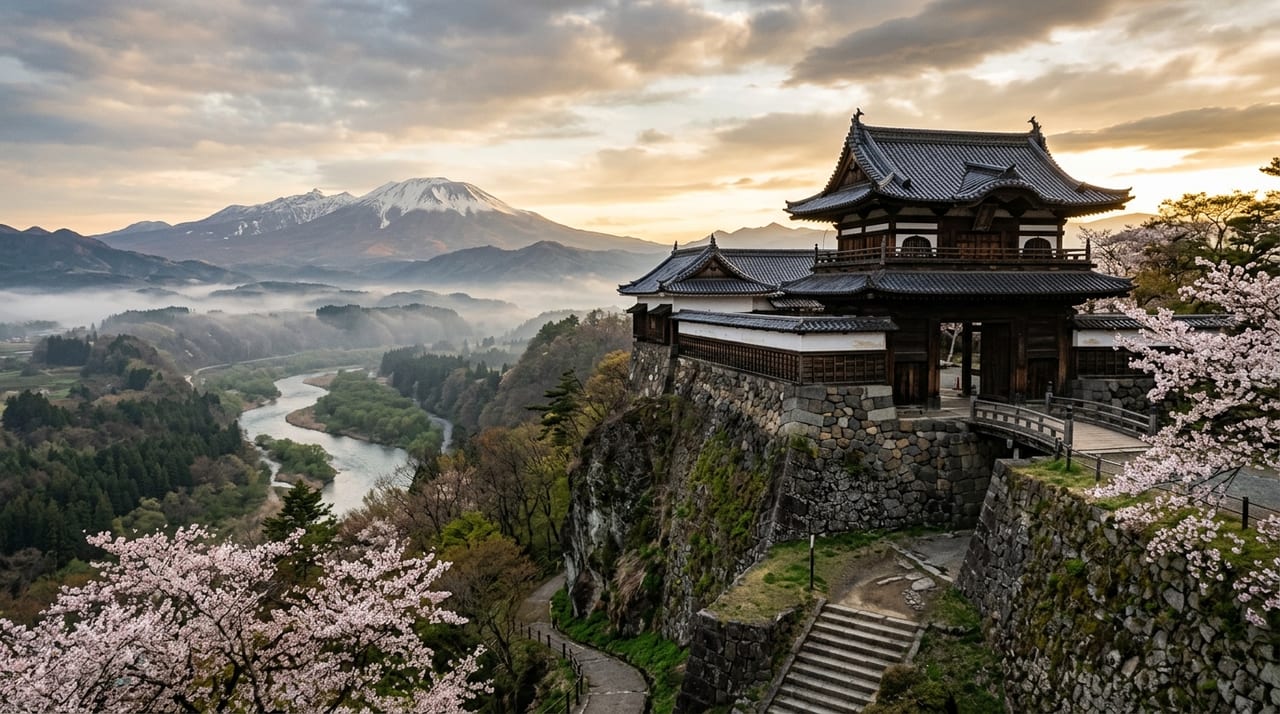
 * Image is for illustrative purposes only.
Komoro Castle
小諸城
Komoro Castle is a historic castle in the Chūbu region (The Takeda clan laid out the castle's nawabari in Tenbun 23 (1554), and after Tenshō 18 (1590), Sengoku Hidehisa developed it into an early-modern castle). Its lord was Takeda clan / Sengoku Hidehisa / Matsudaira (Ōkyū) clan.
Overview
Komoro Castle is a hirayama-jō (平山城) located in the Tōshin region of Nagano Prefecture. It is known as an 'anajiro' (穴城) built atop the cliffs of the Chikuma River, a structure rare in Japan. Because the castle sits at a lower elevation than the castle town, it is called the 'anajiro,' and its nawabari (縄張り) layout, which skillfully makes use of the distinctive terrain, is highly regarded among castle researchers.
Its origins are said to date to the mid-Muromachi period, but full-scale development took place under Takeda Shingen. Yamamoto Kansuke is also said to have designed the nawabari on Shingen's orders. Embodying the finest of Takeda-style castle-building techniques, the castle became a key stronghold of the Tōshin region throughout the Sengoku period. After the fall of the Takeda clan in Tenshō 10 (1582), the castle came under Oda clan control. After the Honnō-ji Incident, it fell within the sphere of influence of Tokugawa Ieyasu.
Sengoku Hidehisa, who entered the domain in Tenshō 18 (1590), carried out a large-scale renovation of the castle into an early-modern castle. He laid the foundations for the main structures that remain today, including the Sannomon, Ninomon, and Kuromon-bashi. The castle was then held in turn by the Aoyama, Sakai, Nishio, and Matsudaira (Ōgyū) families. In Genroku 15 (1702), the Makino clan was enfeoffed here, and the castle functioned as the main castle of the Komoro domain until the end of the Edo period.
The tenshudai (天守台) survives, but the main keep itself was lost early on. In its place, after the Meiji period the site was developed as Kaiko-en and became known as a cherry-blossom spot. It was also sung about in Shimazaki Tōson's masterpiece 'Chikumagawa Ryojō no Uta' (Song of Travel Sentiment on the Chikuma River), making it an important site in literary history.
The Sannomon (National Important Cultural Property), which remains within the castle, is a dignified structure. It was rebuilt in Meiwa 3 (1766) after being swept away by flooding in Kanpō 2 (1742), and it is a valuable surviving relic on the castle site. In addition, Kaiko Shrine, the Komoro City Koyama Keizō Art Museum, and the Tōson Memorial Hall are scattered across the castle grounds. The whole site is beloved by residents and tourists alike as a cultural space.
From Komoro Castle, located on a plateau about 700 meters above sea level, one can see the majestic form of Mount Asama and the peaks of the Southern Alps on clear days. Visitors today can thus experience the same magnificent views enjoyed by the castle lords of the past.
Connection to Swords
The connection between Komoro Castle and swords originates in the military culture of Takeda Shingen. Under the 'Fūrinkazan' banner, the Takeda clan led elite mounted troops and was one of the strongest warlord houses of the Sengoku period. Its military power was underpinned by high-quality weapons and formidable soldiers.
The Takeda clan, based in Kōshū (Yamanashi), is said to have sought quality armor and weapons to support its strong military power. This martial culture is thought to have spread to the Shinshū region through Komoro Castle.
Sengoku Hidehisa was a samurai retainer of Toyotomi Hideyoshi, and he had distinguished himself in construction work at Hizen Nagoya Castle and Fushimi Castle.
The Chōkokan within Kaiko-en houses weapons and historical materials related to the Komoro domain, preserving the martial culture of Shinshū to this day.
Highlights
- Sannomon (National Important Cultural Property) — a dignified gate rebuilt in Meiwa 3 (1766), a symbol of Kaiko-en
- Tenshudai (main keep base) — the main keep was lost, but the surviving stone walls convey the castle's former grandeur
- Cherry blossoms of Kaiko-en — about 500 Somei Yoshino trees in full bloom, Shinshū's foremost hanami spot
- Views of Mount Asama and the Southern Alps — a majestic mountain panorama seen from 700 m above sea level
- Associated with Shimazaki Tōson — setting of 'Chikumagawa Ryojō no Uta' (Song of Travel Sentiment on the Chikuma River), with the Tōson Memorial Hall also within the castle grounds
- Kaiko Shrine — a historic sacred precinct serving as the guardian shrine of Komoro Castle
* Opening hours and admission fees are subject to change. Please check the official website before visiting.