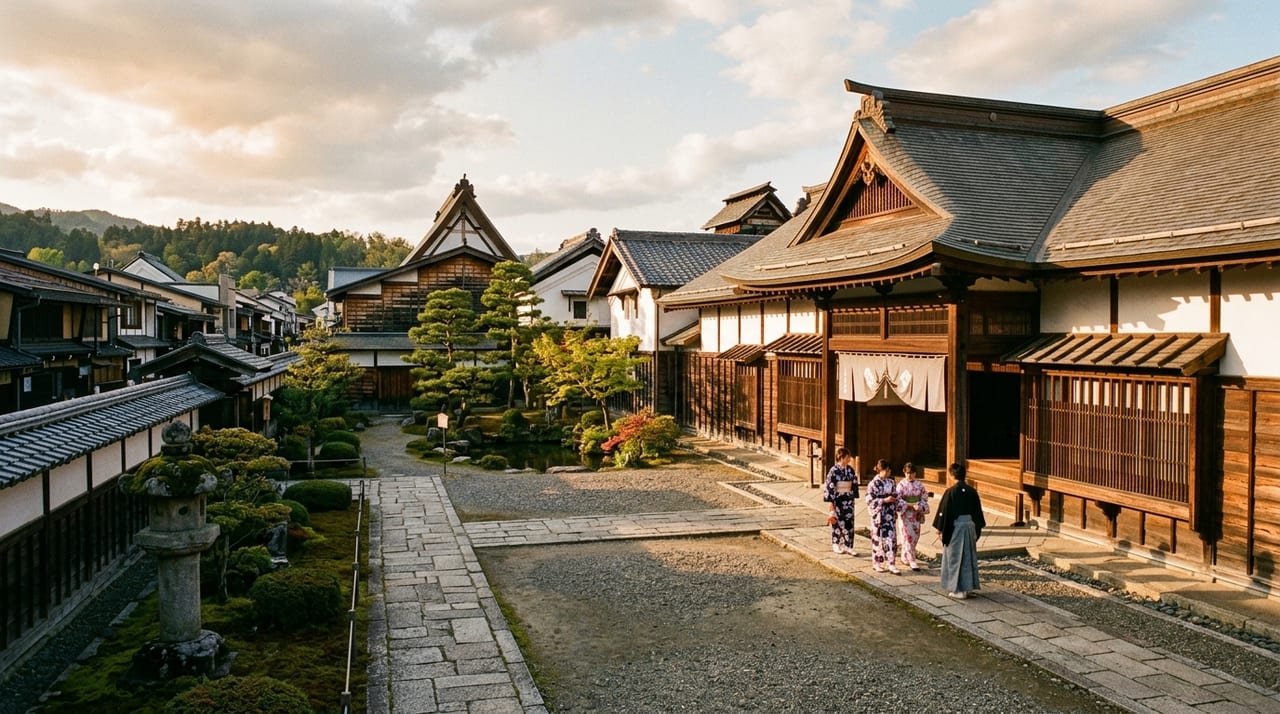
 * Image is for illustrative purposes only.
Hida Takayama Jinya
飛騨高山陣屋
Hida Takayama Jinya is a historic castle in the Chūbu region (Originally a secondary residence (shimo-yashiki) of the Kanamori clan; developed as the shogunate's jinya after Hida became shogunal territory in 1692 (Genroku 5)). Its lord was Hida Kanamori clan → Tokugawa Shogunate (tenryō direct domain).
Overview
Hida Takayama Jinya, located in the heart of Takayama City, Gifu Prefecture, is an administrative complex surviving from the period when Hida served as a shogunal direct domain (tenryō) during the Edo period. Among the numerous jinya established throughout Japan by the shogunate, it possesses exceptional historical value as the sole jinya whose original buildings remain in existence.
The predecessor of the jinya was a subsidiary residence of the Kanamori clan, which ruled Hida as a domain. It was formally developed as a jinya following Hida's conversion to direct shogunal rule in Genroku 5 (1692). When the Kanamori clan of Hida was transferred to Dewa Kaminoyama in Genroku 5 (1692), Hida became tenryō—direct shogunal territory—and daikan and gundai administrators were dispatched to govern this region for 25 successive generations. It served as the core of shogunal administration in Hida for over 170 years until the late Edo period.
The jinya's buildings have undergone reconstruction in Bunka 13 (1816) and recent restoration work. The principal structures—the magistrate's office (o-yakusho), granary, and official residence—preserve their Edo-period configuration, while the gate structure, garden, and shoin-style rooms convey their original appearance to the present day. The "Jinya-mae Morning Market," held daily in front of the jinya's main gate, has become a signature feature of castle-town Takayama, drawing numerous visitors.
Takayama's castle town is called the "Little Kyoto of Hida," and the three historic preservation districts of Kami-Sannomachi, Shimo-Sannomachi, and Ichinomachi are designated as nationally Important Preservation Districts for Groups of Historic Buildings. The landscape centered on the jinya conveys the highly integrated state of merchant and samurai culture from the Edo period to the present day.
Connection to Swords
The Kanamori family governed Hida from 1586 to 1692, with Takayama Castle as their base. Kanamori Nagachika was a daimyō who carried out Toyotomi Hideyoshi's sword hunt, and during the invasions of Korea he was stationed at Nagoya in Hizen Province together with his adopted son Arishige.
In present-day Takayama, Hida Kokubunji temple preserves a tachi traditionally said to be the Kogarasumaru, donated by Kanamori Arishige in 1602 (Keichō 7), a National Important Cultural Property, offering a glimpse of one facet of the region's sword culture.
Highlights
- O-yakusho (magistrate's office) — Japan's only surviving shogunal jinya office building, shoin reception rooms open to visitors
- O-kura (storehouse) — the jinya's earthen granary, illustrating Edo-era domain revenue management
- Jinya-mae Morning Market — daily open-air market before the jinya, a Takayama tradition of centuries
- Sannomachi historic districts — nationally designated streets of intact Edo-period merchant townhouses
- Hida Kokubunji temple — Nara-period foundation, preserving a tachi traditionally said to be the Kogarasumaru, donated by Kanamori Arishige (National Important Cultural Property)
* Opening hours and admission fees are subject to change. Please check the official website before visiting.