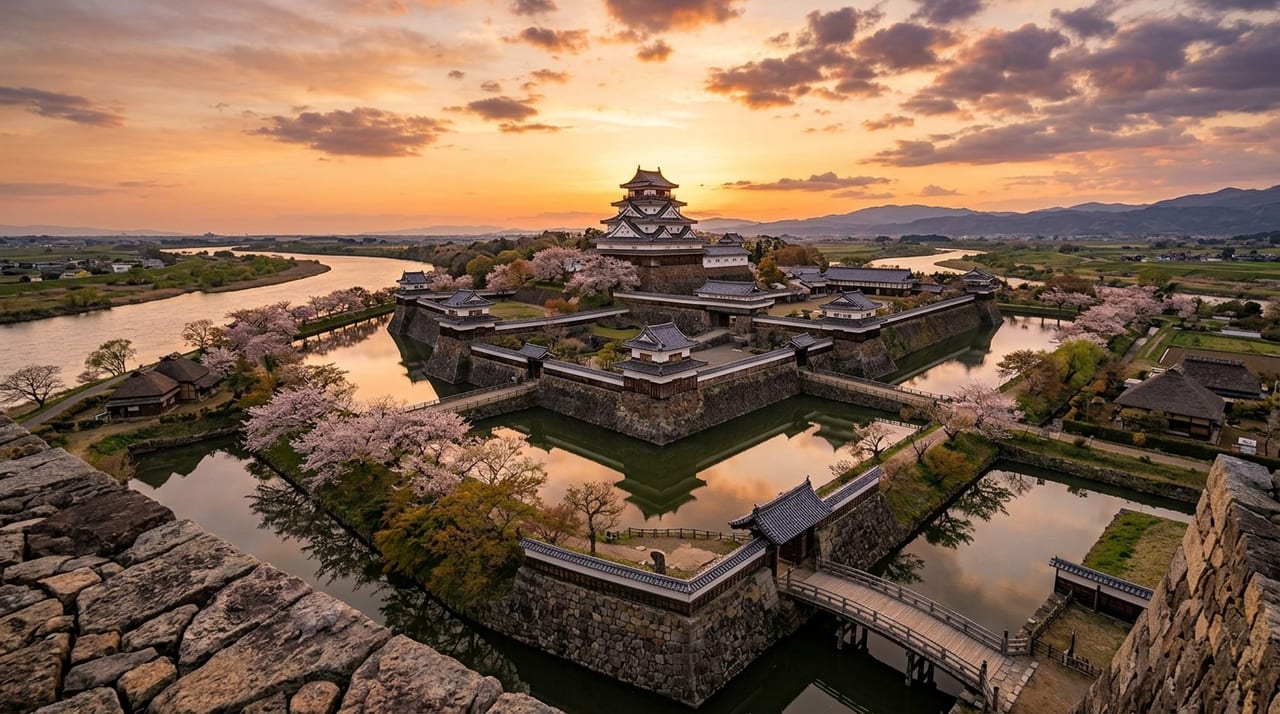
 * Image is for illustrative purposes only.
Nagaoka Castle
長岡城
Nagaoka Castle is a historic castle in the Chūbu region (Construction begun by Hori Naoyori in the early Edo period and completed under the Makino; Makino Tadanari entered as lord in 1618 (Genna 4), and the Makino clan held 74,000 koku through the Meiji Restoration). Its lord was Hori clan (Hori Naoyori) → Makino clan.
Overview
Nagaoka Castle was a flatland castle (hirajiro) located in the central part of Nagaoka City, Niigata Prefecture. As the political, military and economic hub of Echigo Province (today's Chūetsu region of Niigata Prefecture), it functioned as a castle throughout the Edo period. Built east of the Shinano River, it was a water castle (mizushiro). Its layout, in which multiple layers of water moats encircle the castle, is a typical defensive design that made the fullest use of Echigo's abundant water resources.
The castle's predecessor was Zaōdō Castle, held by the Koshi Nagao clan during the Sengoku period. In Genna 2 (1616), Hori Naoyori, replacing the flood-prone Zaōdō Castle, began developing a new castle and castle town at Nagaoka, a key strategic point in Chūetsu. It was later completed in the era of the Makino clan. Hori rule was relatively brief, and in Genna 4 (1618) Hori Naoyori was transferred to Murakami in Echigo.
Makino Tadanari, who entered the domain in Genna 4 (1618), established a stable foundation for the Nagaoka Domain. The Makino clan descended from Makino Yasunari, a senior retainer of Tokugawa Ieyasu, and served the bakufu for generations as loyal fudai daimyō. Thereafter, the Makino family ruled the Nagaoka lands as lords of the 74,000-koku Nagaoka Domain for 13 generations until the Meiji Restoration.
In the Edo period, the castle town of Nagaoka developed as a commercial city that leveraged Shinano River water transport. The castle was a flatland castle of the tekkaku (ladder-enclosure) type, with the ni-no-maru to the southwest of the honmaru and the san-no-maru to the north. The castle town contained samurai residences, merchant quarters and artisan quarters.
In the late Edo period, the Nagaoka Domain was known as a prestigious domain that produced rōjū (senior councillors). At the same time, it produced an outstanding domain administrator, Kawai Tsuginosuke. Kawai introduced Western modern weapons (Gatling guns) early on to modernize the domain's military. In the Boshin War (Hokuetsu War) of Meiji 1 (1868), the domain joined the Ōuetsu Reppan Dōmei and fought fierce battles with the imperial forces. This 'Nagaoka War' is recorded in history as one of the most violent battles of the Boshin War. Despite Kawai's valiant fighting, Nagaoka Castle fell. Kawai, who had been seriously wounded by a bullet in the left knee during the battle to retake the castle, died of the worsening wound at Shiozawa (Tadami, Fukushima Prefecture) on the way to Aizu.
The castle was almost entirely burned in the Boshin War, and Nagaoka Station opened on the honmaru site in Meiji 31 (1898). Today, only the honmaru site monument at the Ōte exit of Nagaoka Station and the ni-no-maru site monument next to Aore Nagaoka remain, and no remains survive. The Kawai Tsuginosuke Memorial Hall (Nagaoka City) displays Kawai's belongings and letters, conveying Nagaoka's samurai culture to the present. Nagaoka City today is still known for the spirit of Kome Hyappyō (the historical episode of diverting rice meant as food to education during the domain's hardship) and for the Nagaoka fireworks festival (one of Japan's three great fireworks displays), and it carries on its pride as a castle town.
Connection to Swords
The connection between Nagaoka Castle and Japanese swords can be discussed from two pillars: the sword culture of the samurai centered on the Makino clan, and the use of swords in the turmoil of the late Edo period.
In the samurai culture of the Nagaoka Domain (Makino clan), swords were valued both as the soul of domain retainers and as practical weapons. The Makino clan was incorporated into the bakufu's military system as fudai daimyō. In particular, the Nagaoka Domain was a prestigious domain that produced rōjū (for example, Makino Tadakiyo, who was contemporary with Mizuno Tadakuni). For upper-ranking retainers, wearing a sword was not merely a weapon but a cultural expression embodying family status, ceremony and aesthetic sense.
The Hokuetsu War (1868) of the late Edo period was one of the last large-scale battles in which Japanese swords clashed with modern weapons. The Gatling guns and Western-style rifles introduced by Kawai Tsuginosuke caused trouble for the imperial forces. Kawai's personal belongings are on display at the Kawai Tsuginosuke Memorial Hall, conveying the last glow of Echigo's sword culture to the present day.
Highlights
- Honmaru Site Monument (in front of Nagaoka Station) — Honmaru site monument standing in the station plaza at the Ōte exit of JR Nagaoka Station
- Kawai Tsuginosuke Memorial Hall — Displays the personal belongings and letters of Kawai Tsuginosuke, chief retainer (karō) of the Nagaoka Domain
- Nagaoka Festival Grand Fireworks Display — One of Japan's three great fireworks displays; carries on the spirit of remembrance for the air raid on Nagaoka (1945) and of recovery
- Spirit of Kome Hyappyō (A Hundred Bales of Rice) — The historical episode of converting food rice into education funding during a period of domain financial hardship; symbolizes Nagaoka's resolve
- Ni-no-maru Site Monument of Nagaoka Castle — The monument reading 'Nagaoka Castle Site' standing next to Aore Nagaoka
* Opening hours and admission fees are subject to change. Please check the official website before visiting.