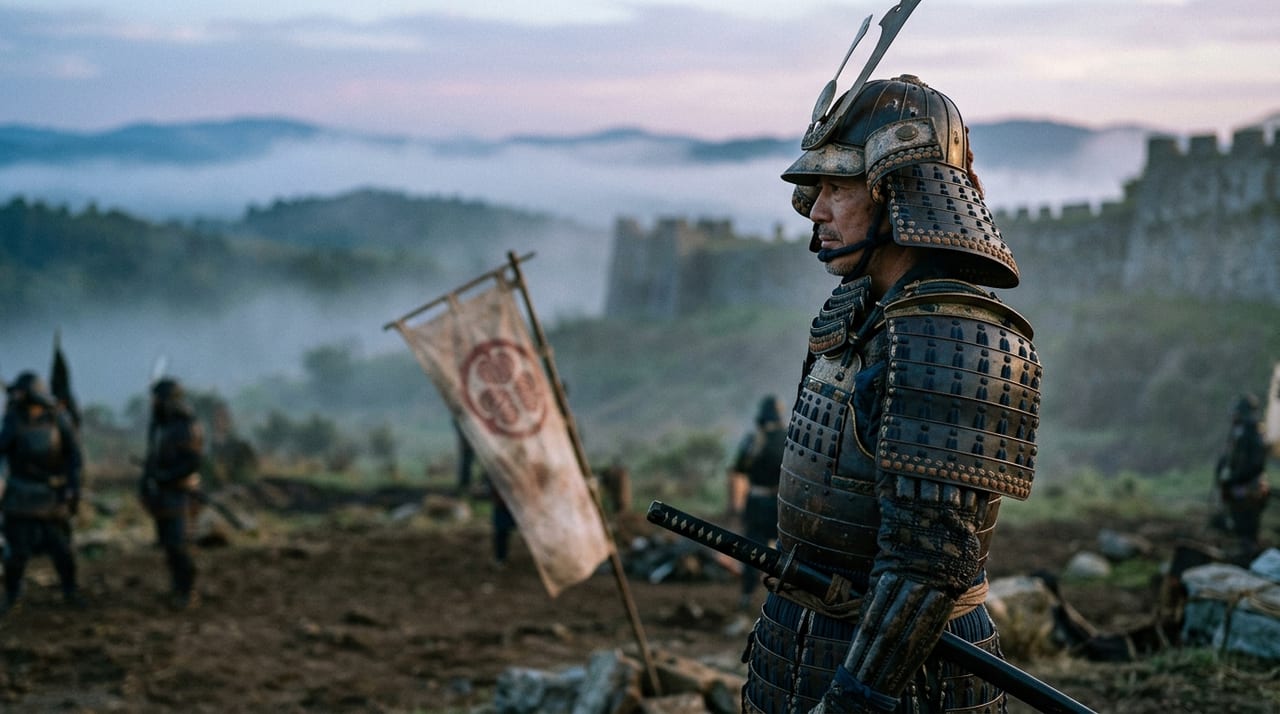
 * Image is for illustrative purposes only.
Sanada Masayuki
真田昌幸
The Peerless Schemer of Sengoku
Description
The Birth of a Master Strategist
Sanada Masayuki, born in Chiisagata District, Shinano Province, in Tenbun 16 (1547), is a figure who left a deep mark on the history of the Sengoku period as a rare master strategist who twice defeated the forces of Tokugawa Ieyasu. His father, Sanada Yukitaka, served as a senior retainer of Takeda Shingen and was a renowned general counted among the Twenty-Four Generals of Takeda. Masayuki was the third son of Yukitaka. From an early age he served the Takeda house as a hostage, and within the formidable military culture of the Takeda house he mastered all of the martial arts, military strategy, and stratagems. This man, whom a document of the Toyotomi regime described as 'hyōri hikyō no mono' (a wily, slippery fellow), showed his true mettle in an indomitable spirit: he never yielded to any powerful opponent, and he forged a path forward through wisdom and daring.
The Fall of the Takeda and Masayuki's Independence
The fall of the Takeda house in Tenshō 10 (1582) was both the greatest trial for Masayuki and a turning point toward independence. Having lost his lord's house, Masayuki had to secure the survival of the Sanada house amid the powerful forces surrounding it on all sides: Oda Nobunaga, Uesugi Kagekatsu, Hōjō Ujimasa, and Tokugawa Ieyasu. The way Masayuki survived this situation was, in modern terms, a skillful use of 'strategic ambiguity.' Showing a posture of submission to the great powers as the need arose, while in practice preserving real independence, he continued to protect the interests of the Sanada house, never allowing himself to be at the mercy of any single power. This diplomacy of Masayuki astonished the observers of the time and also outmaneuvered powerful daimyō such as Ieyasu.
First Battle of Ueda—Defeating the Tokugawa Army
In Tenshō 13 (1585), Tokugawa Ieyasu ordered an invasion of Sanada territory. Against roughly 7,000 Tokugawa troops, Masayuki held Ueda Castle with about 2,000 soldiers. Masayuki is said to have driven back the enemy who pressed into the second bailey (ni-no-maru) with a counterattack, and to have pursued the retreating Tokugawa army, drowning large numbers in the Kangawa River, thereby inflicting about 1,300 dead on the Tokugawa army. The victory in the 'First Battle of Ueda' made Masayuki's name known throughout the land, in that he defeated the Tokugawa army, said to be the strongest of its era, with a small force. Following this victory, the Sanada clan came to be recognized as an independent power in Shinano.
Second Battle of Ueda—Forcing Tokugawa Hidetada to Arrive Late at Sekigahara
In the Second Battle of Ueda (Keichō 5, 1600), a prelude to the Battle of Sekigahara, Masayuki once again drew the great army of Tokugawa Hidetada to Ueda Castle. Hidetada, leading a great army of 38,000, was outmaneuvered by Masayuki's roughly 2,000 soldiers, failed to take the castle, and did not make it in time for the main battle of Sekigahara. (The late arrival of the envoy from Ieyasu ordering him to proceed to Kyoto is also said to have been the main cause of the delay.) In these two battles, Masayuki completely neutralized the mighty armies of the realm not through military strength but through pure military intelligence: 'reading the terrain,' 'manipulating the enemy's psychology,' and 'the art of ambush and enticement.'
Exile and an Unbroken Will in Old Age
Masayuki, who had sided with the Western Army (Toyotomi side) at the Battle of Sekigahara, was exiled to Kudoyama at the foot of Mount Kōya after the Eastern Army (Tokugawa side) won. He escaped execution thanks to pleas for clemency from his eldest son Nobuyuki (later written with a different character, same reading), who had sided with the Eastern Army, and from Nobuyuki's father-in-law, Honda Tadakatsu; but for Masayuki, exile was tantamount to death as a warrior. Confined at Kudoyama, however, Masayuki did not lose his warrior's spirit even in old age and poverty, and for the rest of his life he never gave up on siding with Toyotomi Hideyori at Osaka Castle. In Keichō 16 (1611), Masayuki died at Kudoyama at the age of sixty-five. Upon his death, the Meishō Genkōroku records that Masayuki left his second son, Nobushige (Yukimura), a bequest concerning the strategy of the Osaka side should a war between the Tokugawa and Toyotomi houses break out.
Foundations of the Sanada House
Masayuki's eldest son, Nobuyuki (later renamed, same reading, different character), who protected the Sanada house as Masayuki's successor, served the Tokugawa as lord of Ueda Domain and of Matsushiro Domain, and secured the continuation of the Sanada house. His second son, Nobushige (Yukimura), showed remarkable service in the Winter and Summer Campaigns of Osaka, earning praise as 'the finest warrior in Japan,' and made the Sanada name immortal. The reason the Sanada house is celebrated by later generations as an emblem of Japan's warrior ethos is that at its foundation stood Masayuki, a genius master strategist.