New Arrivals — Browse our catalog for the latest authentic Japanese sword arrivals. Browse →
April 19, 1578 (Tenshō 6, 3rd month, 13th day)
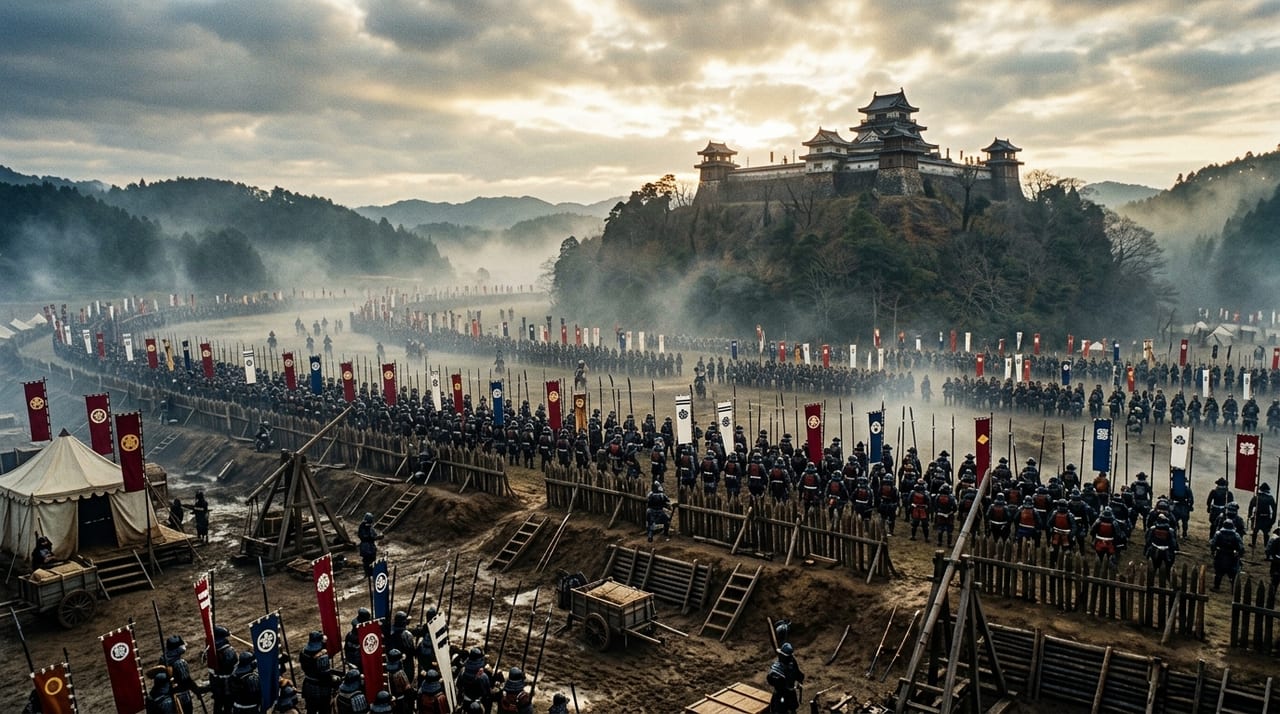
Kasugayama Castle (present-day Jōetsu City, Niigata Prefecture)
Forces
Uesugi Forces (Campaign Muster)
Otate no Ran — Rival Factions
About 8 min read
In the ninth month of 1577 (Tenshō 5), Uesugi Kenshin, daimyo of Echigo, defeated the forces of Oda Nobunaga's general Shibata Katsuie at the Battle of Tedorigawa in Kaga Province. Revered as the "Dragon of Echigo" and the "God of War," and a lifelong devotee of the Buddhist deity Bishamonten, Kenshin regarded the victory as a major foothold in his contest with Oda Nobunaga. In the first month of 1578 (Tenshō 6), Kenshin issued a call to arms for a campaign into the Kantō region, and he is reported to have planned to depart on the fifteenth day of the third month. Some speculate that after invading the Kantō he intended to march on the capital, but the details are unknown.
Around the ninth day of the third month, just days before his planned departure, Kenshin collapsed suddenly in a private chamber (kansho) of the castle—later interpreted as the privy—and fell into a coma. He never regained consciousness, and died several days later, on the thirteenth day of the third month, Tenshō 6 (April 19, 1578), at the age of forty-nine. The suddenness of his death, coming on the very eve of a major military campaign, dealt a profound shock to his entire domain.
The precise cause of Kenshin's death remains unresolved. The long-accepted traditional view attributes his collapse to a hypertensive cerebral hemorrhage, brought on by his renowned heavy drinking and a diet high in salt. However, because Kenshin's death poem survives, some argue that it is unlikely he collapsed from a stroke in the privy. Theories of assassination also circulate, but lack solid documentary support; the prevailing scholarly consensus remains that Kenshin died of natural causes.
Kenshin never married and had no biological children, leaving two of his adopted sons as potential successors: his nephew Uesugi Kagekatsu, and Uesugi Kagetora, who had come to Echigo from the Later Hōjō clan of Sagami Province under circumstances resembling a hostage exchange. Kenshin had never clearly designated which of the two would inherit the clan, and this unresolved question ignited a severe internal conflict almost immediately after his death.
Shortly after Kenshin's death, Kagekatsu seized the inner citadel of Kasugayama Castle while Kagetora based himself at the nearby Otate residence, and the two rivals plunged Echigo into a civil war known as the Otate no Ran, which raged from the fifth month of 1578 through the third month of 1579 (Tenshō 7). Kagetora initially held the advantage, but failed to secure sufficient reinforcement from his birth family, the Later Hōjō, while Kagekatsu came to terms with Takeda Katsuyori, who had marched into Echigo in support of Kagetora (the Kō-Etsu alliance). Kagekatsu ultimately prevailed; in the third month of 1579, Kagetora took his own life at Same-ga-o Castle, which decided the conflict (the suppression of his remaining supporters continued until 1580).
A devoted worshipper of Bishamonten, Kenshin was also renowned as a collector of celebrated swords. Among the swords handed down in the Uesugi family were the National Treasure tachi known as Sanchōmō (also read Yamatorige), attributed to the Fukuoka Ichimonji school of Bizen Province, and the National Treasure tantō known as Kenshin Kagemitsu, forged by the Bizen Osafune smith Kagemitsu and engraved with the characters "Chichibu Daibosatsu" and a Sanskrit seed syllable. Today Sanchōmō is owned by Setouchi City in Okayama Prefecture, and Kenshin Kagemitsu is held by the Saitama Prefectural Museum of History and Folklore.
The internal strife of the Otate no Ran severely drained Echigo's military strength and administrative cohesion. Although Kagekatsu emerged victorious and inherited leadership of the Uesugi clan, the war-weakened domain was no longer in a position to independently contest Oda Nobunaga's expanding power. Kenshin's ambition of marching on the capital died with him, and the Uesugi clan was thereafter relegated to the status of a regional power within the successive hegemonies of Oda, Toyotomi, and Tokugawa. The sudden death of one of the Sengoku period's most celebrated commanders, and the succession crisis that followed, marked a decisive shift in the balance of power across eastern Japan.