New Arrivals — Browse our catalog for the latest authentic Japanese sword arrivals. Browse →
6th month, Tenshō 7 (1579)
Yagami Castle (present-day Tanba-Sasayama City, Hyōgo Prefecture) and across Tanba Province
Forces
Akechi Forces (Oda Alliance)
Hatano Forces (Yagami Castle garrison)
About 9 min read
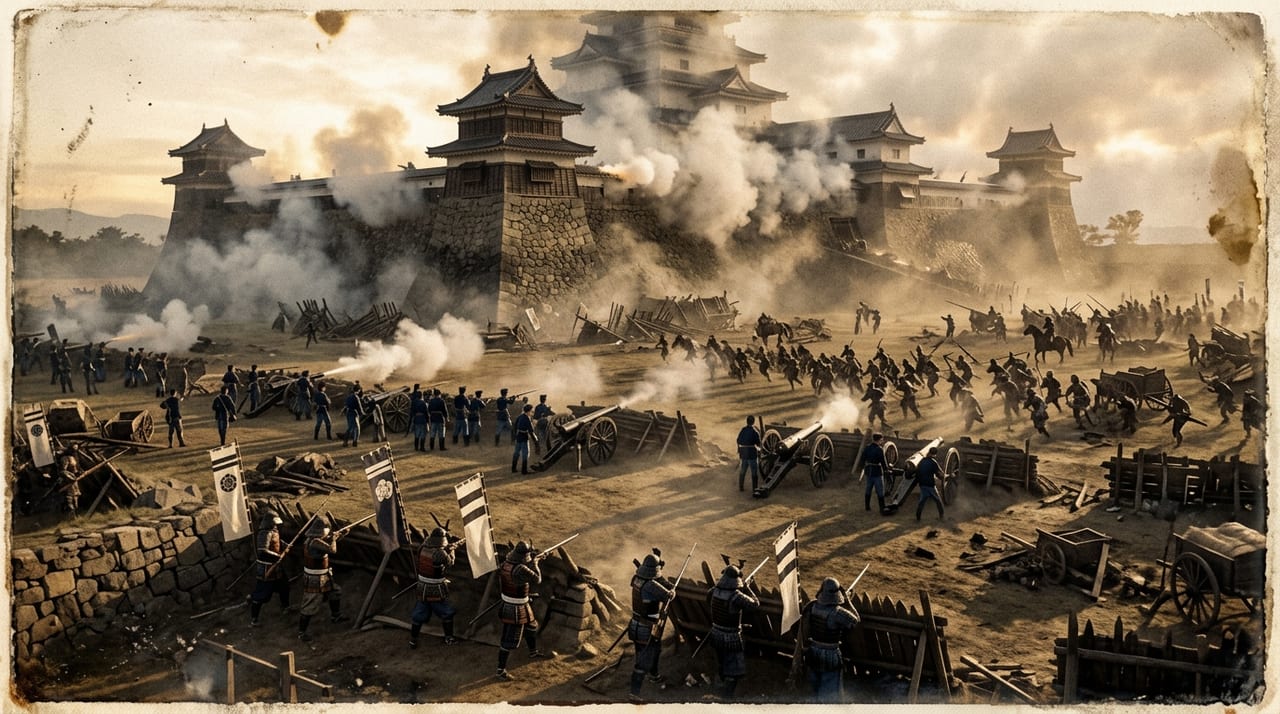
In the 6th month of Tenshō 7 (1579), Akechi Mitsuhide completed the capture of the impregnable Yagami Castle (present-day Tanba-Sasayama City, Hyōgo Prefecture) after several years of effort. After the capture of Kuroi Castle in the 8th month of the same year, he achieved the pacification of all of Tanba Province. This "pacification of Tanba and the fall of the Hatano clan" was both the greatest achievement of Mitsuhide's career as a warrior and a historical event that gave rise to numerous legends in connection with the later Honnō-ji Incident (Tenshō 10, 1582).
Tanba Province (present-day central Kyoto Prefecture and eastern Hyōgo Prefecture) lay adjacent to the northwest of Kyoto, but its mountainous terrain was steep. Since the medieval period, it had been a difficult region in which local magnates and kokujin held their own domains. The principal forces in Tanba during the Sengoku period were the Akai clan (Ogino clan), the Hatano clan, the Naitō clan, and others.
The Hatano clan based itself in the Tanba-Sasayama Basin (present-day Tanba-Sasayama City, Hyōgo Prefecture), with Yagami Castle as its main stronghold. Yagami Castle was a typical mountain castle built on Mount Takashiro at an elevation of about 460 meters, a natural fortress protected on three sides by steep ridges and valleys. The capture of this castle, known as "impregnable," was the greatest obstacle in Mitsuhide's pacification of Tanba.
Oda Nobunaga ordered Akechi Mitsuhide to subdue Tanba around Tenshō 3 (1575). Initially, a majority of the Tanba kokujin, led by Hatano Hideharu, sided with Mitsuhide. However, in the 1st month of Tenshō 4 (1576), Hatano Hideharu suddenly attacked from behind Mitsuhide's army, which was besieging Kuroi Castle of the Akai and Ogino clans, and Mitsuhide was forced to withdraw from Tanba.
Mitsuhide later resumed his campaign in Tanba. In the 3rd month of Tenshō 6 (1578), Akai Naomasa (Ogino Naomasa), a formidable general known as the "Red Demon of Tanba," died of illness. The Akai clan continued to resist Mitsuhide in alliance with the Hatano clan.
It was Yagami Castle, held by Hatano Hideharu and his brothers, that resisted most stubbornly. Mitsuhide avoided a frontal assault and deployed a "tsukejiro strategy," constructing numerous tsukejiro (siege forts) around the castle to completely isolate it. Through a prolonged starvation siege, the castle's food supplies ran out, and the morale of the defending garrison reached its limit.
In the surrender negotiations, Mitsuhide is said to have promised Hatano Hideharu that "his life would be guaranteed." It is also transmitted that, as a guarantee of this promise, Mitsuhide's mother (or possibly his aunt) was sent to Yagami Castle as a hostage. However, this story appears in later texts such as the "Sōken-ki" and is considered not to be historical fact.
On the 1st day of the 6th month of Tenshō 7 (1579), Yagami Castle surrendered, and the brothers Hatano Hideharu, Hidenao, and Hidetaka were captured. The brothers were sent to Azuchi, and on the 8th day of the 6th month, they were executed on Nobunaga's orders.
According to tradition, former retainers of the Hatano clan, enraged by this execution, took revenge by executing Mitsuhide's mother (aunt), who had remained at Yagami Castle as a hostage. The theory that this tragedy deepened Mitsuhide's resentment toward Nobunaga and became one of the remote causes of the Honnō-ji Incident in Tenshō 10 spread from the Edo period onward. However, modern historical research holds that it has little documentary support.
After pacifying Tanba, Mitsuhide developed and expanded Tanba Kameyama Castle (present-day Kameoka City, Kyoto Prefecture) and Fukuchiyama Castle (present-day Fukuchiyama City, Kyoto Prefecture) as bases of control. Mitsuhide is known in Tanba for good governance, and is said to have carried out rational administration, including the implementation of land surveys.
On the 2nd day of the 6th month of Tenshō 10 (1582), Akechi Mitsuhide learned that Nobunaga was staying at Honnō-ji in Kyoto. He turned his army against Nobunaga and drove him to take his own life. This came only three years after the pacification of Tanba. Regarding the motive for the Honnō-ji Incident, theories such as the "grudge theory" and the "ambition theory" have been debated. However, modern research tends to understand it as the result of multiple factors intertwined, including complex power relations with Nobunaga, dissatisfaction over his treatment, and the accidental convergence of circumstances.
The ruins of Yagami Castle (Tanba-Sasayama City, Hyōgo Prefecture) still retain remains on the mountaintop, and it is known as a hiking course starting from the castle town of Sasayama Castle. In Kameoka City and Fukuchiyama City, which have deep ties to Akechi Mitsuhide, historic sites and museums honoring Mitsuhide have each been developed, and sites related to the campaign in Tanba still remain today.