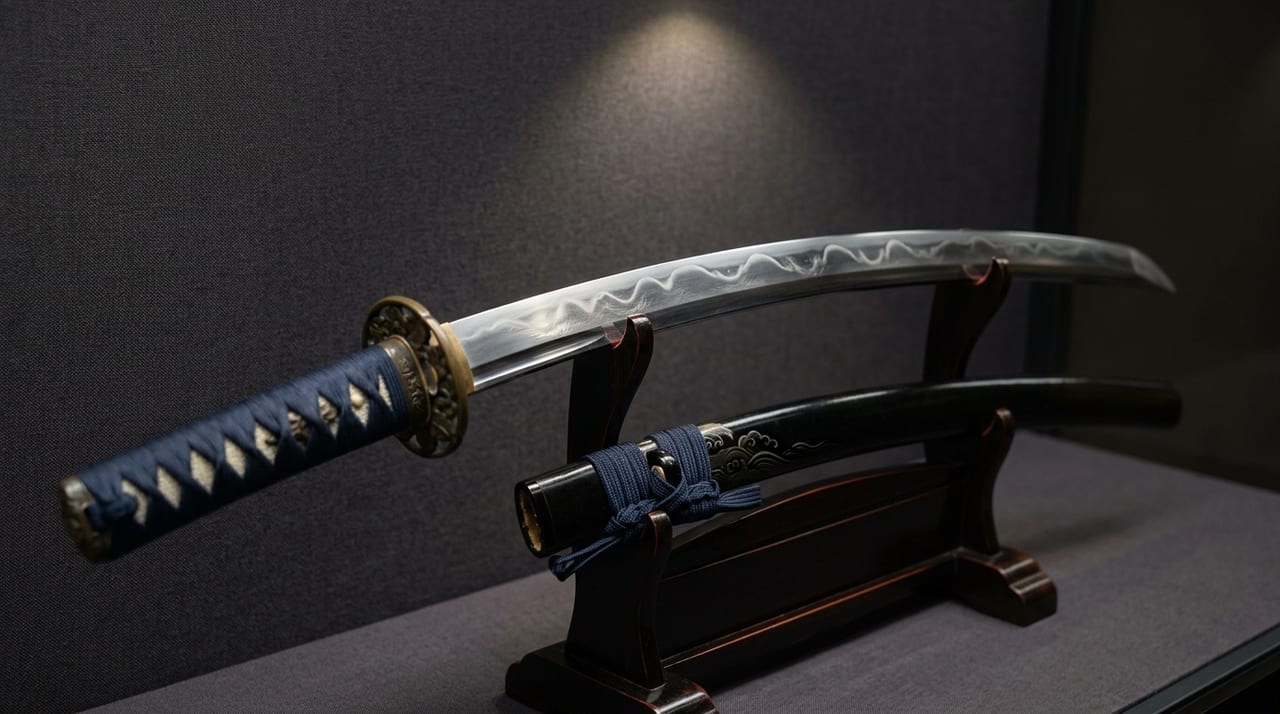
 * Image is for illustrative purposes only.
Sanchōmō
山鳥毛
Also known as: Sanchōmō Ichimonji (also read Yamatorige) / One of Uesugi Kagekatsu's Thirty-Five Selected Swords / The Uesugi Family's Supreme Treasure
Description
Overview of the Sword
Sanchōmō (also read Yamatorige) is an unsigned tachi said to have been made in the mid-Kamakura period, at the height of the Fukuoka Ichimonji school. It was handed down in the Uesugi family and is renowned as one of the thirty-five treasured blades that Uesugi Kagekatsu personally selected. The elegant name "Sanchōmō" is presumed to compare the splendid chōji-midare of the hamon to the beautiful feathers of the yamadori (copper pheasant), a bird native to Japan, or to mountains at sunset. According to the Uesugi family's sword register, Nagao Norikage, lord of Shiroi Castle in Kōzuke, presented it to Uesugi Kenshin in the 10th month of Kōji 2 (1556). Even in modern times, from 2018 to 2020, crowdfunding and furusato nōzei (hometown tax donation) run by Setouchi City in Okayama Prefecture drew donations exceeding the target amount, and the sword went through the dramatic process of returning home to its birthplace in Bizen. It is one of the famous blades that drew the most attention in modern Japan.
Fukuoka Ichimonji School — The Masterpiece Born in Bizen in the Mid-Kamakura Period
Because Sanchōmō has survived with its ubu-nakago and never bore a signature, the individual swordsmith is not known. The sword researcher Fukunaga Suiken notes that it is considered a work of Bizen Ichimonji, and states that its style differs from signed Ichimonji works such as those of Yoshifusa, Norifusa, and Sukezane. He also mentions that the Uesugi family's registers and other records once considered it a work of Osafune Kanemitsu. The Fukuoka Ichimonji school was a group of swordsmiths based in Fukuoka in Bizen Province (present-day Osafune Town, Setouchi City, Okayama Prefecture), known for its splendid chōji-midare hamon. Sanchōmō is regarded as the greatest masterpiece of Bizen Ichimonji in the mid-Kamakura period, and is a sword representing the culture of a great Japanese sword production center that was later called the Bizen tradition.
Details of the Blade — The Marvel of the Ō-Chōji-Midare
The hamon of Sanchōmō is an ō-chōji-midare with the characteristics of jūka-chōji, one of the chōji hamon forms of the Ichimonji school, and it grows into a large pattern that reaches up to the shinogi. Within the hamon, countless ashi and yō function in many places, and kinsuji shine here and there. The jigane is itame-hada with clearly visible forging patterns, and fine ji-nie appears on it. The shape is shinogi-zukuri with iori-mune, with a high koshi-zori, and the kissaki is an ikubi-kissaki, a feature of the mid-Kamakura period. The nakago is ubu-nakago and unsigned. The splendor of the hamon is said to be a happy accident of the hardening process, which combined hadakayaki and tsuchioki, and it is judged to have the most magnificent hamon of any Ichimonji school blade. The grandeur of the hamon corresponds wonderfully with the natural beauty embodied in the name "copper pheasant feathers."
Kenshin's Death and the Uesugi Family's Guardianship
Uesugi Kenshin collapsed at Kasugayama Castle on the 9th day of the 3rd month of Tenshō 6 (1578) while preparing for a Kantō campaign, and died on the 13th. After the succession struggle known as the Otate Disturbance (1578–1579), Uesugi Kagekatsu inherited Kenshin's estate, including Sanchōmō. In the Koshimono Mokuroku that Kagekatsu recorded, Sanchōmō is designated as jō-hizō (most treasured). After the Battle of Sekigahara (1600), when the Uesugi family was drastically reduced from 1.2 million koku in Aizu to 300,000 koku in Yonezawa, Sanchōmō was also moved to Yonezawa. After the end of World War II, Sanchōmō passed from the Uesugi family into the hands of a sword enthusiast in Okayama Prefecture, and from 1997 it was deposited with the Okayama Prefectural Museum.
Reiwa-era Crowdfunding — The Miracle of Citizens Bringing Back a Famous Sword
In 2018, Setouchi City in Okayama Prefecture received an inquiry from the owner about a purchase, and launched the project "Bringing Bizen's famous sword back to Bizen." To raise about 500 million yen, an amount the city budget alone could not cover, it carried out crowdfunding aimed at the whole country and furusato nōzei. The donations that came in from across Japan far exceeded the target. This drew great attention as a fundraising effort for the protection of cultural properties in Japan, and it showed the world the high level of public interest in Sanchōmō and the passion of citizens who wanted to protect cultural assets. The story of Jōetsu City in Niigata Prefecture, connected to Kenshin, also tried to buy the sword but gave up, and the sword finally returned to Bizen, its birthplace. This course of events is also being passed down as part of the story of this famous sword. Sanchōmō is currently managed by Setouchi City and is displayed and open to the public at the Bizen Osafune Sword Museum.
Copper Pheasant Feathers and Japanese Poetry
The yamadori (copper pheasant) is a beautiful bird that lives in Japan's mountains and fields, and the male has long, grand tail feathers. It is also recited in the Hyakunin Isshu by Kakinomoto no Hitomaro: "Ashibiki no / yamadori no o no / shidario no / naganagashi yo o / hitori ka mo nemu." The long tail feathers of the copper pheasant are deeply rooted in Japanese culture as symbols of solitude, elegance, and the length of the night. The name Sanchōmō, which likens the beauty of the hamon to these poetic feathers, is one of the most beautiful examples of naming that shows the aesthetic resonance between swords and the tradition of waka poetry.
Legends & Stories
Kenshin's Death and Sanchōmō
In the 3rd month of Tenshō 6 (1578), Uesugi Kenshin died suddenly at Kasugayama Castle while preparing for a campaign into Kantō. His sudden death at the age of 49 (48 by one account) plunged the Uesugi family into chaos and triggered an internal conflict known as the Otate Disturbance. The Uesugi family's registers record that Sanchōmō was presented to Kenshin by Nagao Norikage in Kōji 2 (1556). After Kenshin's death it passed to Kagekatsu, and it was counted among the thirty-five swords that Kagekatsu himself selected as his jō-hizō (most treasured) collection.
The Miracle of Reiwa——The Day Citizens Brought the Sword Back
In 2018, Setouchi City in Okayama Prefecture received an offer from the owner to purchase Sanchōmō and launched a project titled "Returning a Famous Bizen Sword to the Land of Bizen." Because the sum required was far beyond what the city's budget could possibly cover, the city used crowdfunding to call for support across the country. As a result, donations far exceeding the target amount (about 500 million yen) came in, and Sanchōmō became city property and returned to the Bizen region. Massive donations from individuals and companies across the country gathered for a single tachi——this event showed the world the Japanese people's deep affection for their sword culture and the strength of their spirit in trying to protect regional pride. Rather than Echigo, a place tied to the Uesugi family, the sword ultimately came back to the land of Bizen (Okayama); yet this "homecoming" too can be said to be proof of the magnetic appeal of the tachi known as Sanchōmō.
The Beauty of Copper Pheasant Feathers and Hamon
The yamadori (copper pheasant), which inhabits the mountains and fields of Japan, is known for the males' long, beautiful tail feathers, and since ancient times it has appeared in Japanese poetry, literature, and art as an elegant bird. The Hyakunin Isshu also includes the poem "Ashibiki no / yamadori no o no / shidario no / naganagashi yo o / hitori ka mo nemu" (Kakinomoto no Hitomaro), in which the yamadori's long tail feathers are deeply rooted in Japanese culture as symbols of solitude, elegance, and length. The fact that the hamon of tachi forged by the Fukuoka Ichimonji school were likened to these copper pheasant feathers shows an aesthetic resonance between nihontō and waka poetry culture.