New Arrivals — Browse our catalog for the latest authentic Japanese sword arrivals. Browse →
Erupted in the 9th month of Eiroku 6 (1563); a truce followed the Battle of Batōga-hara on the 15th day of the 1st month of Eiroku 7 (1564)
Mikawa Province (present-day Okazaki City and environs, Aichi Prefecture, centered on the "Three Temples of Mikawa" — Honshōji, Jōgūji, and Shōmanji)
Forces
Matsudaira Ieyasu's forces
The Ikkō rebels (Hongan-ji followers and the Three Temples of Mikawa)
About 10 min read
Mikawa Province was home to three prominent temples affiliated with the Hongan-ji order — Honshōji, Jōgūji, and Shōmanji — collectively known as the "Three Temples of Mikawa." These temples had held a privilege of immunity from provincial governor intervention (shugoshi-fuiri) since the time of Matsudaira Hirotada, Ieyasu's father, functioning as a kind of extraterritorial zone beyond the lord's direct authority. After Imagawa Yoshimoto was killed at the Battle of Okehazama in 1560 and Matsudaira Ieyasu achieved independence from Imagawa rule, Ieyasu moved quickly to consolidate unified control over Mikawa Province — a process in which the privileges of the Three Temples emerged as an obstacle to his ambition of unifying the province under his own authority.
In 1563 (Eiroku 6), Ieyasu's retainer Suganuma Sadaaki forcibly requisitioned rice stores from Jōgūji to secure provisions, an incident that rapidly escalated tensions between the temples and the Matsudaira side. As rallying points for Hongan-ji followers, the Three Temples strongly resisted Ieyasu's push to tighten his grip, and the conflict soon erupted into armed struggle.
In the 9th month of 1563, Hongan-ji followers centered on the Three Temples rose in rebellion, and the Mikawa Ikkō Uprising began in earnest. Kūsei, the abbot of Honshōji and reportedly a great-grandson of Rennyo, the revered restorer of the Hongan-ji order, became the spiritual pillar of the rebel forces, rallying the temple congregations and pressing toward Ieyasu's stronghold at Okazaki Castle.
What made this uprising especially grave for Ieyasu was that it went beyond a simple confrontation with a religious faction: a considerable number of his own retainers, for reasons of faith, defected to the rebel side. Among them was Honda Masanobu, who would later serve as one of the most influential advisors of the Tokugawa house, along with Hachiya Sadatsugu and Natsume Yoshinobu, who also temporarily joined the rebels. This internal split — forcing retainers to choose between loyalty to their lord and loyalty to their faith — posed a crisis that threatened to shake the very foundations of Ieyasu's power. At the same time, retainers such as Sakai Masachika and Ishikawa Kazumasa, though themselves followers of Jōdo Shinshū, converted away from the faith and remained on Ieyasu's side, maintaining their loyalty to their lord.
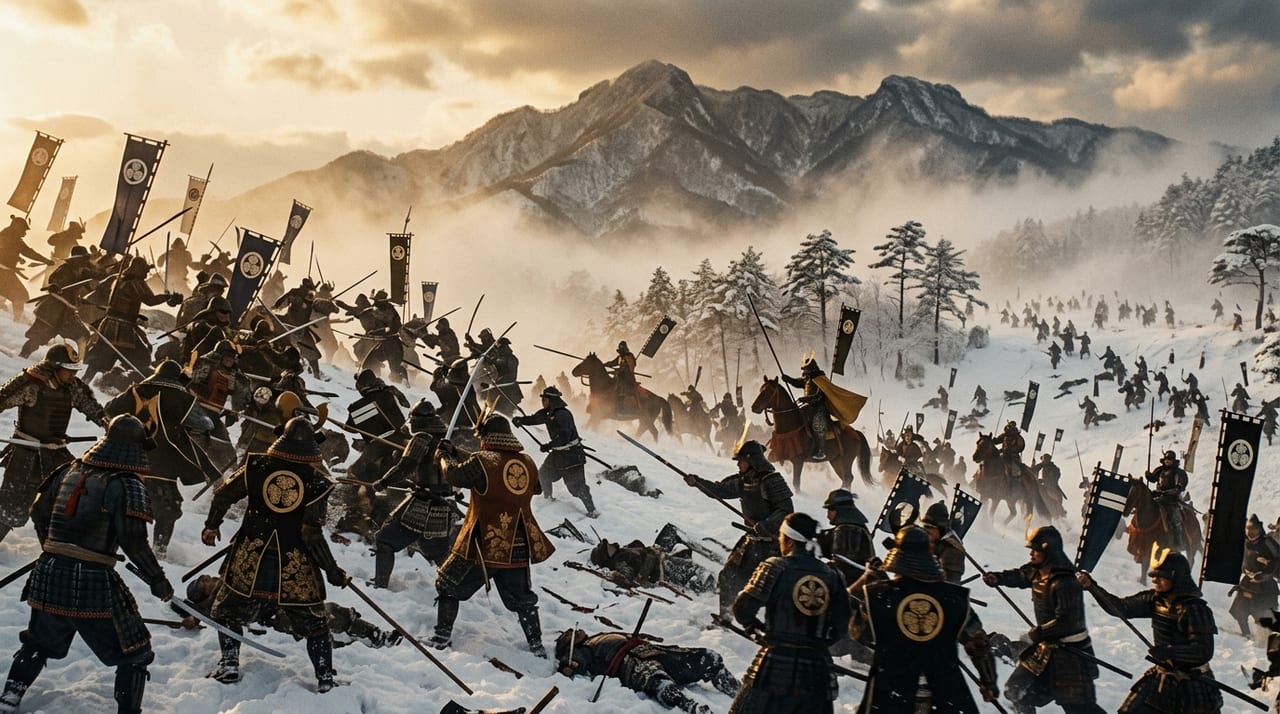
Ieyasu worked to hold together his shaken retainer band while continuing to defend against the rebels' advances. Suganuma Sadaaki built fortifications to counter the rebel forces, and Ieyasu himself campaigned across the region in an effort to chip away at rebel strength. After nearly half a year of seesawing struggle, the two sides met in a decisive engagement at Batōga-hara (in what is now central Okazaki) on the 15th day of the 1st month of 1564, which Ieyasu's forces won. This victory rapidly sapped the momentum of the rebel forces, and the momentum shifted toward negotiating a truce.
Following their defeat at Batōga-hara, the rebels entered truce negotiations with Ieyasu. Ieyasu is said to have declared that the faith of the temple followers was understandable in itself, and pardoned those who had joined the uprising with considerable leniency, keeping retaliatory punishment to a minimum. This truce brought the roughly six-month Mikawa Ikkō Uprising to a close.
After the truce, however, Ieyasu ordered the Three Temples and other Hongan-ji-affiliated temples in Mikawa either demolished or converted to other sects, effectively banning Hongan-ji activity in the province. This prohibition would remain in force for nearly twenty years, until 1583. Some retainers who had temporarily defected during the uprising were later permitted to return to Ieyasu's service, and Honda Masanobu in particular would go on to become one of Ieyasu's most trusted inner advisors in later years.
The Mikawa Ikkō Uprising is frequently cited as one of the few episodes in Ieyasu's career in which his retainer band split apart. That so many of his retainers, despite being caught between loyalty to their lord and loyalty to their faith, ultimately returned to Ieyasu and restored unity is regarded as evidence both of Ieyasu's own capacity to command loyalty and of his skill in resolving crises through flexible, restrained clemency rather than harsh reprisal. This experience is thought to have shaped Ieyasu's later, cautious approach to managing relations with religious institutions during his years under Toyotomi rule and as shogun.
Having overcome the Mikawa Ikkō Uprising, Ieyasu finally secured firm control over Mikawa Province, and thereafter began in earnest to extend his power into Tōtōmi and Suruga. Alongside the Kaga Ikkō Uprising and the Nagashima Ikkō Uprising, the Mikawa Ikkō Uprising stands as one of the defining episodes symbolizing the tension between the Hongan-ji order and daimyo authority during the Sengoku period, and remains an important case study in the history of Ikkō uprisings in early modern Japan.
The temple compounds of Honshōji, Jōgūji, and Shōmanji, the stages of the Mikawa Ikkō Uprising, still stand in and around present-day Okazaki City, Aichi Prefecture, preserving the memory of this conflict. Honshōji in particular retains the moats and earthen ramparts of its fortress-temple structure, offering a valuable historical site that illustrates how temples of this era could double as military strongholds.