New Arrivals — Browse our catalog for the latest authentic Japanese sword arrivals. Browse →
Tenshō 5–6 (1577–1578)
Kōzuki Castle, Harima Province (present-day Sayō, Sayō District, Hyōgo Prefecture)
Forces
Amago Restoration Army (Oda/Hashiba side)
Mōri allied army
About 10 min read
The Amago clan, a Sengoku daimyo of Izumo, had effectively been destroyed when Gassan Toda Castle was captured by Mōri Motonari in Eiroku 9 (1566). However, Yamanaka Yukimori (nickname: Shikanosuke), a former retainer of the Amago, refused to abandon hopes of restoring his lord's house. He installed Katsuhisa, who carried the blood of Amago Tsunehisa, and organized the Amago Restoration Army while fighting across various territories. In Tenshō 5 (1577), when Oda Nobunaga dispatched Hashiba Hideyoshi to conquer the Chūgoku region, the Amago Restoration Army joined forces with him, serving as the vanguard of the Oda forces and taking part in the invasion of Mōri territories. When Hideyoshi's army advanced into Harima and conquered Kozuki Castle, which was on the side of Ukita Naoie, he entrusted the castle to the Amago Restoration Army. Kozuki Castle was a strategic point located at the western edge of Harima Province, on the border with Bizen and Mimasaka, and Amago Katsuhisa, Yamanaka Yukimori, and others designated it as the base of their restoration movement.
In April of Tenshō 6 (1578), the Mōri allied forces, numbering approximately 30,000 in total and led by Mōri Terumoto as supreme commander with Kikkawa Motoharu and Kobayakawa Takakage, completely surrounded Kozuki Castle. The Amago Restoration Army inside the castle is said to have numbered only about 2300 to 3000, and the difference in military strength was overwhelming. Hashiba Hideyoshi initially attempted to march to relieve Kozuki Castle, but at the same time, at Miki Castle in Harima, Bessho Nagaharu defected from the Oda side, and a situation arose in which Hideyoshi's rear was threatened. It is said that Nobunaga ordered Hideyoshi to abandon Kozuki Castle and concentrate on attacking Miki Castle, and Hideyoshi, after a painful decision, chose to withdraw from Kozuki Castle. The isolated Kozuki Castle held out against the Mōri's vast army for about 70 days from the start of the siege, but its provisions ran out, and in July of that year, Amago Katsuhisa finally offered surrender, on the condition that the castle garrison be spared in exchange for his own life.
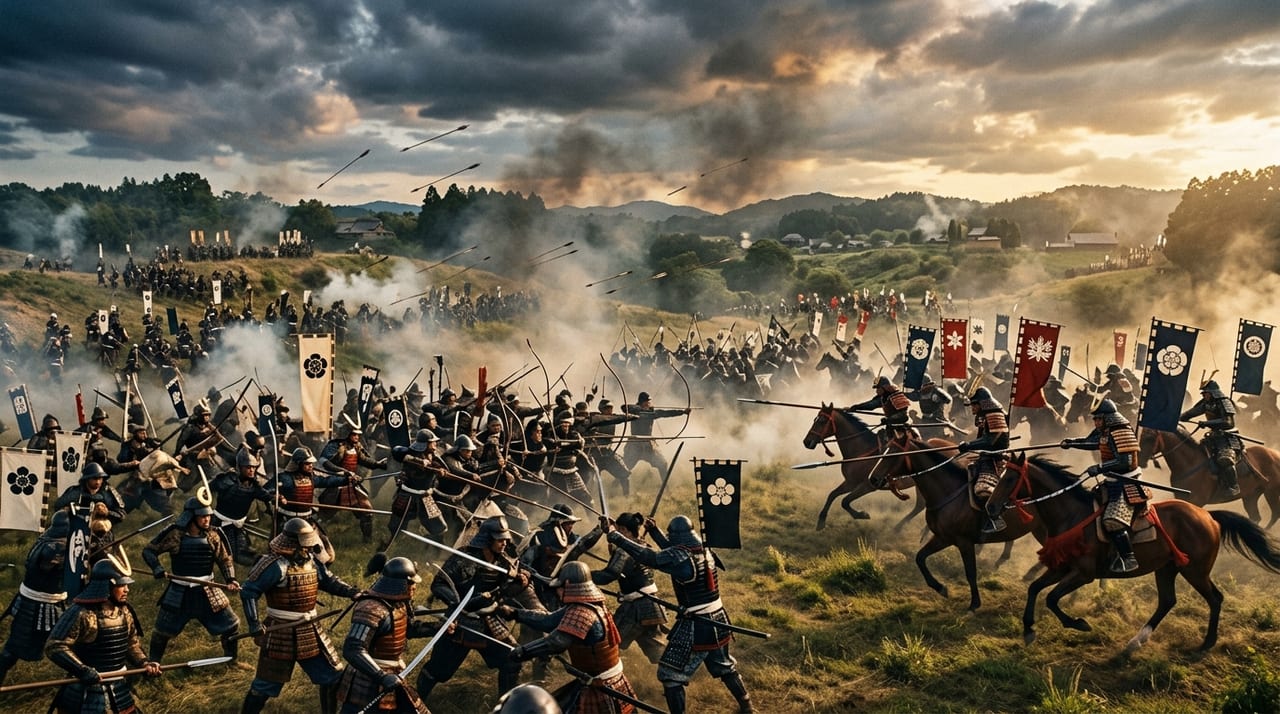
No primary historical sources have been confirmed that directly record the provenance of any specific famous sword with respect to the Battle of Kozuki Castle itself. However, Yamanaka Yukimori (Shikanosuke), who made his name in this battle, is widely known in later times through the anecdote: "Praying to the crescent moon, he said, 'I beseech thee, grant me seven hardships and eight sufferings.'" From the Edo period onward, he has been repeatedly depicted in war chronicles, ukiyo-e prints, and kōdan storytelling as the ideal image of a samurai clad in armor and wearing a tachi. That the officers and men of the Amago Restoration Army fought wearing tachi and uchigatana in actual battle was a natural matter as the equipment of samurai of this era, and the fighting at Kozuki Castle, a mountain castle located on the border of Harima, Bizen, and Mimasaka, can indeed be described as one of the typical examples of late Sengoku battles in which swords were used in real combat. While reliable records of individual transmitted swords are scarce, the story of Yamanaka Shikanosuke's loyalty became a subject repeatedly taken up within the bushidō-oriented sword culture and martial equipment enthusiasm of the early modern period and later.
On July 3 of Tenshō 6 (1578), Amago Katsuhisa took his own life in exchange for the sparing of the castle garrison, and Kozuki Castle was opened. He was 26 years old. It is said that his relatives Ujihisa and Michihisa, who were holding the castle, as well as Katsuhisa's eldest son Toyowakamaru, shared his fate. Yamanaka Yukimori was captured by the Mōri side and, while being escorted toward the Bitchū area, was assassinated on July 17 of the same year at the Ai River crossing in Bitchū Province (present-day area near Takahashi City, Okayama Prefecture). He was 34 years old. With this, the hopes for the restoration of the Amago clan, which had continued since the fall of Gassan Toda Castle in Eiroku 9, were completely dashed, and the Amago clan disappeared from the main stage of history.
The Battle of Kozuki Castle is positioned as an incident in which a local power's restoration movement was swallowed by the torrent of the great strategy of Oda Nobunaga's campaign against the Chūgoku region and ended. Nobunaga's decision to have Hideyoshi abandon the relief effort is often recounted as an anecdote symbolizing the rationalism of the Oda regime, which prioritized overall strategy over local obligations. On the other hand, the life of Yamanaka Shikanosuke, who continued to raise the banner of restoration for more than a decade after his lord's house was destroyed, has been honored from the early modern period onward as the ideal image of a "loyal retainer," and shrines enshrining him and monuments commemorating him still remain today in Takahashi City, Okayama Prefecture, as well as in Tottori Prefecture and Shimane Prefecture. The Battle of Kozuki Castle is still passed down today as a battle in which two contrasting narratives intersect: the ruthless strategic judgments made between daimyo in the late Sengoku period, and the loyalty of a samurai who died in service to his doomed clan.