New Arrivals — Browse our catalog for the latest authentic Japanese sword arrivals. Browse →
21st day of the 10th month of Tenshō 6 (1578) – 9th month of Tenshō 7 (1579)
Itami Castle, Settsu Province (present-day Itami City, Hyogo Prefecture); also Hanakuma and Amagasaki Castles
Forces
Araki Murashige's Forces (Garrison)
Oda Nobunaga's Forces (Besieging Army)
About 13 min read
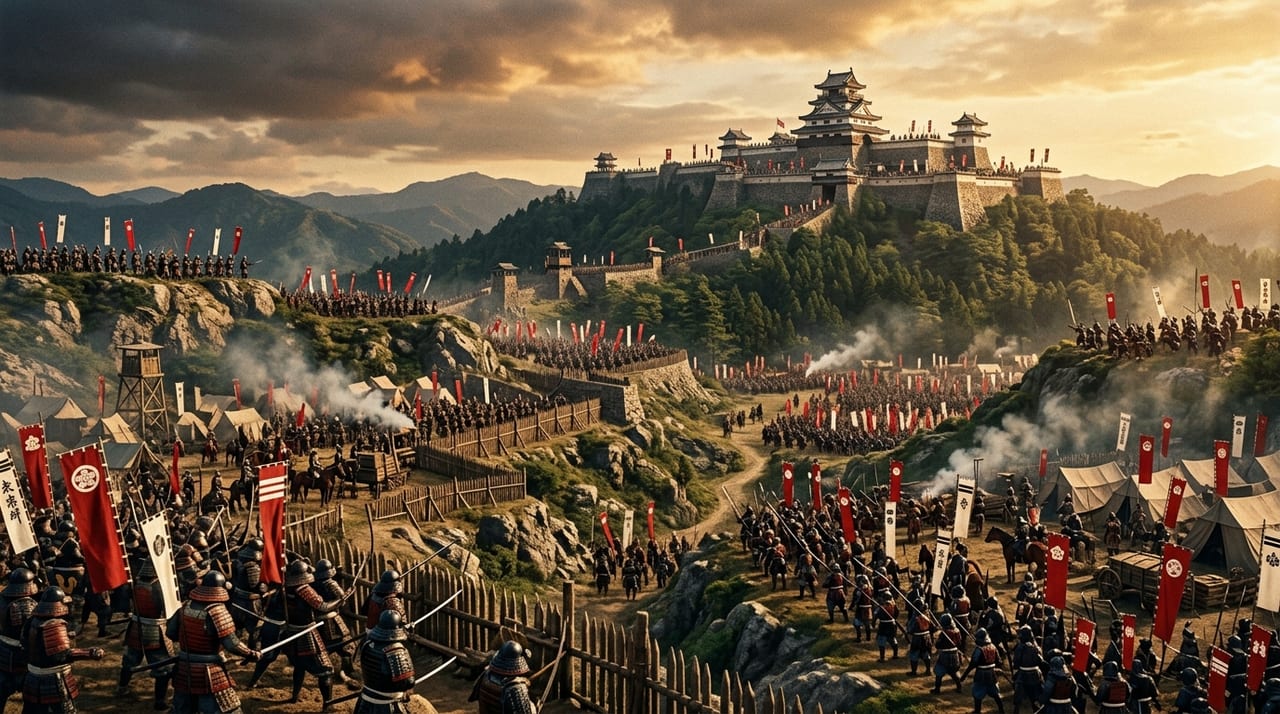
In the 10th month of Tenshō 6 (1578), Araki Murashige, a senior vassal of Oda Nobunaga, suddenly turned against Nobunaga (word of the rebellion reached Nobunaga on the 21st day of that month) and holed up in Itami Castle in Settsu Province (present-day Itami, Hyōgo Prefecture). At that time Murashige was a powerful daimyo who controlled all of Settsu Province and was a key pillar of Nobunaga's campaign to conquer the western provinces. Why did this man, who had been favored by Nobunaga and granted control of Settsu, suddenly rebel? The truth behind it remains unclear to this day.
Araki Murashige's rebellion is one of the most inexplicable incidents in Nobunaga's rule. Nobunaga responded with an unusually persistent effort at "persuasion." He sent Akechi Mitsuhide, Matsui Yūkan, and Manmi Shigemoto as envoys to urge Murashige to change his mind, and Kuroda Kanbei, who went as Hashiba Hideyoshi's envoy, was held captive for nearly a year. Murashige once set out for Azuchi to explain himself but turned back partway and refused to comply to the end. Then, in the 9th month of Tenshō 7 (1579), Murashige abandoned Itami Castle, leaving his wife, children, and more than 600 retainers behind, and never returned.
Araki Murashige originally came from the Araki clan, a local landowning family of Settsu Province, and first rose to prominence as a retainer of the Ikeda clan. He later served the Miyoshi, but in Tenshō 1 (1573) he entered the service of Oda Nobunaga. In Tenshō 2 (1574) he captured Itami Castle, made it his stronghold, and was entrusted with all of Settsu Province.
Murashige also had a deep appreciation for the tea ceremony and was on friendly terms with Sen no Rikyū. As a leading warrior of the Nobunaga era, he embodied the ideal of "bunbu ryōdō" (the dual way of letters and arms), and Nobunaga's trust in him was thought to be unshakable.
Multiple theories about Araki Murashige's motives for rebelling still coexist today. The main theories are:
First is the "collusion with Ishiyama Hongan-ji" theory. The year Murashige rebelled, 1578, fell in the midst of the Ishiyama War between Nobunaga and Ishiyama Hongan-ji. This theory holds that the Hongan-ji side induced Murashige to defect from within. It is true that Murashige is said to have had ties with Ikkō sect followers in Settsu.
Second is the "discontent and fear of Nobunaga" theory. This holds that Murashige, aware of Nobunaga's severity, grew anxious about his own future and rebelled preemptively. (In Tenshō 8, the senior vassal Sakuma Nobumori was also expelled.)
Third is the theory of Mōri clan maneuvering. This holds that the Mōri clan diplomatically drew Murashige in, which is consistent with Murashige later fleeing into Mōri territory.
Fourth, there is a conspiracy theory that the plan was to lure Nobunaga out and kill him in consultation with Kuroda Kanbei (then Kodera Yoshitaka), but there is little historical evidence for it.
The truth cannot be determined with certainty, and the rebellion of Araki Murashige remains a "mystery of the Sengoku period."
Nobunaga's initial response to Araki Murashige's rebellion differed from his usual quick decisiveness. Nobunaga gave priority to demands for surrender over forceful suppression. The reasons include the following: Murashige controlled the administration of Settsu, and if he fully sided with the Mōri, the campaign to conquer the western provinces could collapse; and Murashige's rebellion could influence other commanders.
Kuroda Kanbei (Yoshitaka) went as Hashiba Hideyoshi's envoy to persuade Murashige. Kanbei entered Itami Castle to persuade Murashige, but was instead imprisoned in an earthen dungeon. Kanbei, who was rescued about a year later, is said to have been left with a lasting leg injury from his long confinement. This captivity of Kanbei has been passed down as a symbol of "absolute loyalty to one's lord and hardship."
In the 9th month of Tenshō 7 (1579), Murashige escaped from Itami Castle. He moved to Amagasaki Castle and then Hanakuma Castle before ultimately fleeing into Mōri territory. His remaining wife, Dashi (also called Araki Dashi), along with the family and retainers, more than 600 people in all, were executed on Nobunaga's orders. This mass execution deeply shocked people of the time as a demonstration of Nobunaga's attitude of "no mercy whatsoever for rebellion."
Araki Murashige's rebellion and his life after fleeing hold an interesting connection to Japan's culture of swords and the tea ceremony. Murashige fled to Mōri territory, and after the Honnō-ji Incident he moved to Sakai, adopted the name "Dōkun," and spent his later years as a tea master. He interacted with Sen no Rikyū and Oda Urakusai and lived in the world of the tea ceremony until the end.
In the Sengoku period, the tea ceremony and swords functioned as two sides of the same coin. It is well known that Nobunaga engaged in the political use of the tea ceremony, called "ochanoyu goseidō," using famous tea utensils and swords as rewards and gifts, and Murashige was also a central figure in this cultural sphere.
Murashige's choice to live as a cultured tea man after fleeing is sometimes viewed critically, as a choice of "a life as a man of letters" over "a death as a warrior." From the perspective of bushidō, which values a clean death, a man who fled and left his wife and children behind to spend his later years peacefully in the world of tea was an act that was hard to overlook.
From another perspective, however, Murashige's "survival" was also one answer to Nobunaga's harsh rule. Within Nobunaga's values, even death was at risk of being forced upon retainers as proof of submission to their lord. Murashige's flight and his life as a tea master can also be read as the choice of one person trying to escape that compulsion.
Araki Murashige's rebellion highlights two aspects of Nobunaga's regime. First, the organizational vulnerability: no matter how generously a senior vassal was treated, rebellion could not be completely prevented. Second, the intimidating effect on other commanders of the harshness of Nobunaga's response to rebellion, a process of "persuasion, then encirclement, then mass execution."
In the following month (the 11th month of Tenshō 6), Nobunaga defeated the Mōri navy in the Second Battle of Kizugawaguchi and cut off food supplies to Ishiyama Hongan-ji. The following year, Araki Murashige was also effectively defeated. This also showed Nobunaga's strong ability to strategically handle multiple fronts at once.
Viewed from the perspective of swords, in this era a sword bestowed by one's lord was proof of the lord-retainer bond, and rebelling against one's lord meant breaking that oath. Araki Murashige's rebellion can be placed in the history of sword culture as an event that, paradoxically, illuminates the meaning of the sword as a "symbol of the oath between lord and retainer."
Araki Murashige
Araki Murashige — Nobunaga's trusted retainer whose rebellion remains one of history's great unexplained mysteries
Oda Nobunaga
Oda Nobunaga — who showed extraordinary patience in attempting to negotiate Murashige's surrender before ordering mass executions
Kuroda Kanbei
Kuroda Kanbei — sent as a negotiation envoy into Itami Castle, imprisoned for nearly a year with lasting physical consequences
Akechi Mitsuhide
Akechi Mitsuhide — one of Nobunaga's commanders in the forces besieging Murashige, himself later a rebel
Takigawa Kazumasu
Takigawa Kazumasu — senior Oda commander involved in the containment of Murashige's rebellion