New Arrivals — Browse our catalog for the latest authentic Japanese sword arrivals. Browse →
18 July 1866 (Keiō 2/6/7) to 10 October 1866 (Keiō 2/9/2); the Kokura front continued until the peace agreement in the 1st month of Keiō 3 (1867)
Four fronts surrounding Chōshū domain (present-day Yamaguchi Prefecture): Kokura, Iwami, Ōshima, and Geishū fronts
Forces
Shogunate Expeditionary Force (coalition of domains)
Chōshū domain forces
About 13 min read
In the summer of 1866 (Keiō 2), Japanese history reached a major turning point. The “Second Chōshū Expedition,” in which the Tokugawa shogunate called on more than thirty domains across the country to subjugate Chōshū, ended in a complete military defeat for the shogunate and became the decisive turning point toward the Meiji Restoration the following year.
In 1864 (Genji 1), Chōshū domain turned its troops against the imperial court in the Kinmon Incident (Hamaguri Gate Incident) and became an enemy of the imperial court. In the First Chōshū Expedition that same year, Chōshū submitted under pressure from the domains, and the matter was nominally resolved. Within Chōshū domain, however, the Seigi-ha (reformist faction) (hardline anti-shogunate group) regained power, defeated the Zokuron-ha (conservative faction) that had led the submission during the First Expedition, seized actual control, and unified the domain's policy under buhi kyōjun (armed deference) (the Chōshū domain internal war).
Alarmed by this situation, the shogunate again planned a campaign against Chōshū. But the circumstances this time were entirely different. In the 1st month of Keiō 2 (1866), Satsuma and Chōshū concluded the “Satchō Alliance” through the mediation of Sakamoto Ryōma and Nakaoka Shintarō. Satsuma promised not to cooperate with the shogunate's punitive campaign against Chōshū, and earlier had also helped Chōshū purchase weapons (such as Minié rifles) under the name of Satsuma domain. This confirmed the shogunate's isolation.
The core of Chōshū's military power was the shotai (irregular units), beginning with the Kiheitai organized by Takasugi Shinsaku (1839–1867). In 1863 (Bunkyū 3), the Kiheitai founded by Takasugi overturned the military system previously limited to the samurai class and recruited capable men regardless of status, including farmers, merchants, and rōnin. This was a groundbreaking reform in the history of Japan's military system and paved the way for the universal military conscription system (Conscription Ordinance) after the Meiji period.
The Kiheitai was not a mere mixed unit; it was the seed of a modern army that placed emphasis on discipline and practical training. Equipped with Western-style rifles (Minié rifles and Enfield rifles), it also mastered bayonet fighting and artillery, in addition to the traditional combat centered on Japanese swords and spears. Takasugi Shinsaku's revolutionary military reform gave them a qualitative edge in strength over the shogunal army.
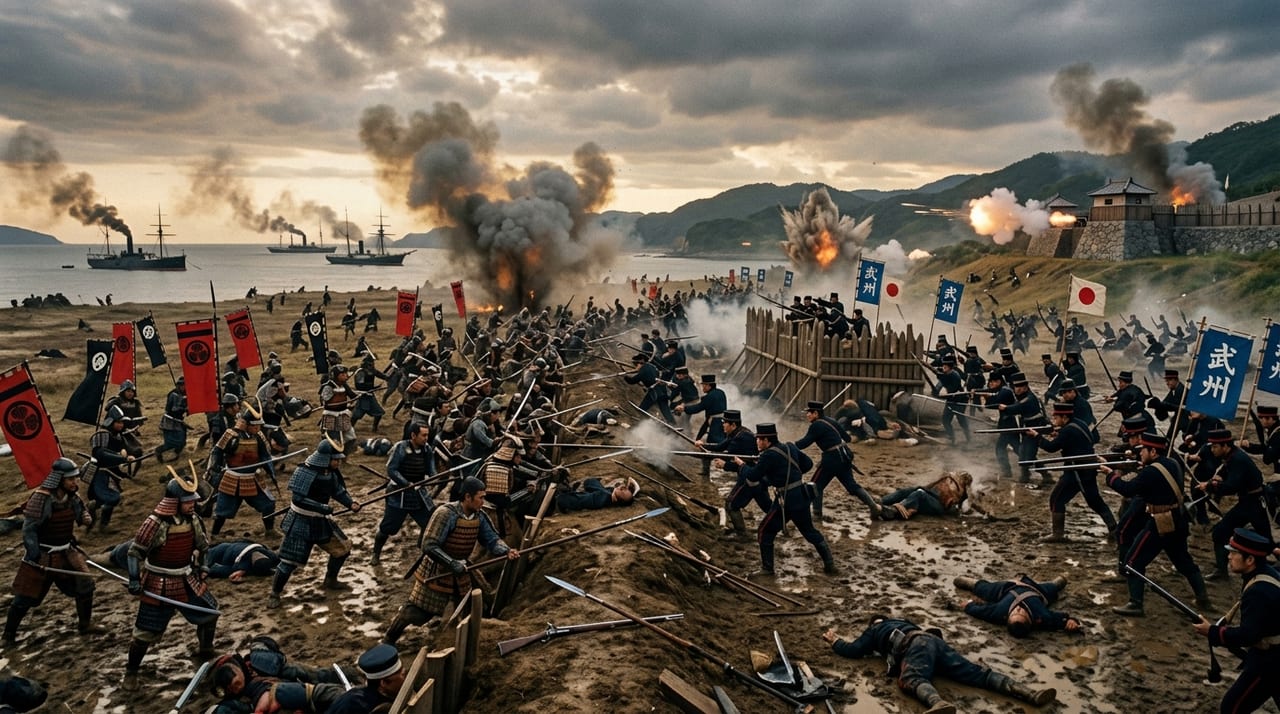
Beginning with the shogunal fleet's bombardment of Suō-Ōshima on 18 July 1866 (Keiō 2/6/7), the shogunal forces attacked Chōshū from four directions.
On the Ōshima front (Seto Inland Sea, Suō-Ōshima), after the shogunal fleet's bombardment, shogunal troops and Matsuyama domain forces landed and occupied Ōshima. However, Takasugi Shinsaku fired on the shogunal fleet at night from the steamship Heiin Maru, and then the shotai, including the Second Kiheitai, landed and retook Ōshima on 28 July 1866 (Keiō 2/6/17).
On the Geishū front (present-day Hiroshima area), at the Oze River they repulsed the forces of Hikone domain and Takada domain. However, the shogunal infantry and Kishū domain troops who took over the fighting fell into a stalemate.
On the Iwami (Sekishū) front (present-day Shimane area), the Chōshū army commanded by Ōmura Masujirō marched through the territory of Tsuwano domain, which had remained neutral, and invaded Hamada domain. On 27 August 1866 (Keiō 2/7/18), they captured Hamada Castle and also seized the Iwami Ginzan silver mine, which was shogunal territory.
The greatest battle was on the Kokura front (near Moji, Kitakyūshū). Kokura domain (on the shogunal side) and Chōshū clashed across the Kanmon Strait, and on 28 July 1866 (Keiō 2/6/17) Chōshū forces landed at Tanoura and seized the initiative. In the Battle of Akasaka and Torigoe on 5 September 1866 (Keiō 2/7/27), Higo domain overwhelmed the Chōshū forces, but afterward the domains withdrew their troops all at once, and Ogasawara Nagamichi, the commander-in-chief, also left the front. The isolated Kokura domain set fire to Kokura Castle and withdrew on 9 September 1866 (Keiō 2/8/1), and continued to resist afterward.
On 29 August 1866 (Keiō 2/7/20), a decisive blow struck the shogunate, which was already in difficulty on all four fronts. Shogun Tokugawa Iemochi, who had been directing affairs at Osaka Castle, died suddenly of beriberi heart failure (kakke shōshin) (heart disease). Aged 21 by traditional Japanese reckoning.
The shogun's death removed the pretext for continuing the war. His successor, Hitotsubashi Yoshinobu (Tokugawa Yoshinobu), petitioned the imperial court and obtained an imperial order for a truce. On 10 October 1866 (Keiō 2/9/2), Katsu Kaishū and the Chōshū side agreed to a ceasefire at Miyajima. But the military facts were clear: the shogunate had suffered a complete defeat at the hands of Chōshū domain alone.
The Second Chōshū Expedition was also an event that marked a turning point in the cultural history of the Japanese sword. Through the fighting of the Kiheitai, the position of the Japanese sword changed to that of an auxiliary weapon to the modern rifle. The main armament of the Kiheitai was Western-style rifles, and Japanese swords and bayonets were used in close-quarters combat, but firepower was the decisive force.
At the same time, however, the Chōshū leaders such as Takasugi Shinsaku, Yamagata Aritomo, and Katsura Kogorō were all men who had undertaken martial arts training. Yamagata Aritomo is known as a master of the spear technique of the Hōzōin-ryū, and later became the core of the Meiji army.
The swords worn at the waist by the Kiheitai warriors were changing in meaning, from the “soul of the samurai” to something symbolizing the fighting spirit of ordinary people. This was also a period of cultural preparation for the Haitōrei (Sword Abolishment Edict) of 1876.
The failure of the Second Chōshū Expedition symbolized the end of the shogunate's capacity to govern. After the defeat, the new shogun, Tokugawa Yoshinobu, attempted reforms of the shogunal administration, but could not change the tide of the times. On 9 November 1867 (Keiō 3/10/14), Yoshinobu submitted a memorial proposing the Taisei Hōkan (return of governing authority to the emperor), and on 3 January 1868 (Keiō 3/12/9), the Proclamation of the Restoration of Imperial Rule (Ōsei Fukko) ended the Tokugawa shogunate in name and in fact.
The Satchō Alliance, mediated by Sakamoto Ryōma, is part of the chain that includes the Second Chōshū Expedition. As a large-scale military clash in an era when swords of the late Tokugawa period expressed political will, the Second Chōshū Expedition was a historical event situated between the Japanese sword and modernity.
Takasugi Shinsaku
Chōshū commander who led the kiheitai to victory against the shogunate forces
Katsura Kogorō
Chōshū political leader who leveraged the Satchō Alliance diplomatically during the expedition
Sakamoto Ryōma
Mediator of the Satchō Alliance that enabled Chōshū to resist the expedition
Yamagata Aritomo
Kiheitai officer in the expedition who later founded the Meiji army
Saigō Takamori
Satsuma leader whose alliance with Chōshū backed the resistance to the shogunate expedition