New Arrivals — Browse our catalog for the latest authentic Japanese sword arrivals. Browse →
15th day of the 11th month, Keiō 3 (1867)
Ōmiya, Kawaramachi-dōri near Takoyakushi, Nakagyō-ku, Kyoto
Forces
Victims
Assassins (identity disputed)
About 13 min read
On the 15th day of the 11th month of Keiō 3 (1867), barely a month after the success of the Taisei Hōkan on the 14th day of the 10th month, Sakamoto Ryōma was assassinated on the second floor of the Ōmiya, a soy sauce merchant in Kawaramachi, Kyoto. He was 33 years old. Rising from a rōnin who had deserted the Tosa domain to become a central figure in the Satchō Alliance, this unrivaled strategist envisioned a 'bloodless revolution' rather than overthrowing the shogunate by armed force, and he died without witnessing the dawn of the new era he had imagined.
Sakamoto Ryōma was born on the 15th day of the 11th month of Tenpō 6 (January 3, 1836) into a gōshi family in Tosa Province (present-day Kōchi Prefecture). In Edo he studied the Hokushin Ittō-ryū, and in Ansei 5 (1858) he was granted the 'Hokushin Ittō-ryū Chōtō Heihō Mokuroku' by his teacher Chiba Sadakichi (it is also said that he served as head student of the same dojo). In Bunkyū 2 (1862), Ryōma deserted the Tosa domain, became a disciple of Katsu Kaishū, and worked tirelessly to establish the Kobe Naval Training Center.
Ryōma's greatest achievement, which came from his activities as a go-between among the Satsuma, Chōshū, and Tosa domains, was the formation of the Satchō Alliance on the 21st day of the 1st month of Keiō 2 (1866). This alliance joined Satsuma (Saigō Takamori, Ōkubo Toshimichi) and Chōshū (Kido Takayoshi, Takasugi Shinsaku), which had been opposed to each other like oil and water, and it became the political foundation that would decisively shape the later Meiji Restoration.
Furthermore, in the 6th month of Keiō 3 (1867), Ryōma is said to have drafted the 'Senchū Hassaku' (Eight-Point Plan Aboard Ship). The original has not been found, and some researchers consider it a later fabrication. It was a blueprint for political reform that included the Taisei Hōkan, the establishment of a legislature, revision of the unequal treaties, and the establishment of a new currency system, and it is also said to have influenced the later Gokajō no Goseimon (Charter Oath in Five Articles). On the 14th day of the 10th month of the same year, the 15th shōgun Tokugawa Yoshinobu decided to carry out the Taisei Hōkan, and the shōgun returned his governing power to the Imperial Court.
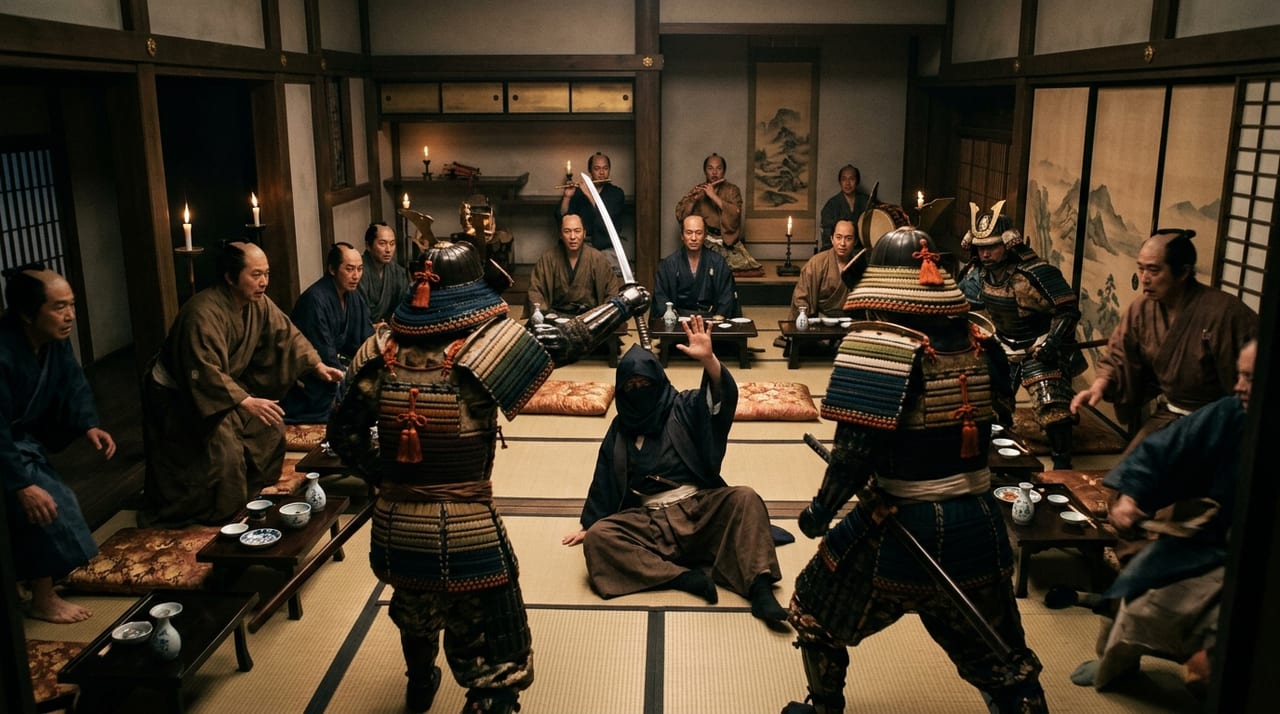
On the night of the 15th day of the 11th month of Keiō 3 (December 10, 1867), Sakamoto Ryōma, who had moved to the second floor of the Ōmiya because of a cold, was talking with Nakaoka Shintarō, who had come to visit. Men who claimed to be Totsukawa gōshi arrived, cut down the attendant Yamada Tōkichi, forced their way into the second-floor room, and attacked the two men with swords. Ryōma suffered serious wounds to the top of his head and his back and died shortly afterward. Nakaoka Shintarō was also seriously wounded and died two days later, on the 17th day of the 11th month of Keiō 3 (1867).
Even at the time of the assassination, Ryōma carried a pistol (S&W), but he was cut down as he turned to grab the sword in the tokonoma without firing it. It is also recorded that the blow to Ryōma's head was of extremely high swordsmanship.
Various analyses have been made of the swords used in the assassination, based on the shape of the wounds at the scene, eyewitness testimony, and other evidence. At the scene, a sword scabbard believed to belong to the assassins was left behind.
Various theories about the identity of the culprits are still disputed today.
The first leading theory is the 'Kyoto Mimawarigumi theory.' In the Meiji period, Imai Nobuo, a former member of the Mimawarigumi, testified that 'we assassinated him,' and Watanabe Kichitarō, Takahashi Yasujirō, Katsura Hayanosuke, and Imai Nobuo have since been regarded as the perpetrators. However, Imai's testimony contains many contradictions, and it has not been fully proven.
The second theory is the 'Shinsengumi theory.' Based on testimony that the scabbard left at the scene belonged to Harada Sanosuke of the Shinsengumi, the Tosa domain judged immediately after the incident that the Shinsengumi had committed the crime, and at that time this was considered the leading theory. However, Kondō Isami, the commander (kyokuchō), has denied any involvement.
The third theory is the 'Satsuma domain theory.' It holds that hardline Satsuma factions, dissatisfied that the armed overthrow of the shogunate had been temporarily halted by the Taisei Hōkan, eliminated Ryōma as an obstacle. However, in historical scholarship this view is often considered to overemphasize the opposition between the policy of the Taisei Hōkan and the policy of armed overthrow.
The fourth theory is the 'Kishū domain theory.' It holds that this was retaliation for the Irohamaru Incident, in which Ryōma's Kaientai ship Irohamaru collided with a Kishū domain vessel and sank in the 4th month of Keiō 3 (1867), and in which Ryōma forced the Kishū domain to agree to pay compensation (more than 83,000 ryō, later reduced to 70,000 ryō). The truth remains shrouded in mystery to this day.
Sakamoto Ryōma was a practitioner of the Hokushin Ittō-ryū, yet he is also known as a figure who actively carried Western pistols during the turbulent Bakumatsu period. In the Teradaya Incident of Keiō 2 (1866), he fought back with a pistol given to him by Takasugi Shinsaku and escaped from the officers sent to arrest him, and he continued to carry an S&W pistol afterward. An anecdote is also handed down that Ryōma said, 'Swords are no use against guns,' but since this account comes from later biographies, its truth is uncertain. For this very reason, the fact that he was cut down by a sword at the Ōmiya before he had any time to draw his pistol is, one must say, an irony of fate.
Sakamoto Ryōma's name spread far more widely after his death than during his lifetime. From the Meiji period onward he was honored as a 'hero of the Restoration,' and from the Shōwa period onward, through Shiba Ryōtarō's novel Ryōma ga Yuku (1962–1966), his status as a national hero became firmly established. The Ryōma statue at Katsurahama in Kōchi Prefecture (erected in 1928) still attracts many tourists.
The day he was assassinated, the 15th day of the 11th month, coincidentally was also his birthday (he was born on the 15th day of the 11th month of Tenpō 6). This coincidence has left a deep impression on later generations and has heightened the mystique of the Ryōma legend.
From the perspective of the history of the Japanese sword, Ryōma's assassination symbolizes the 'dual nature' of the sword in the Bakumatsu period. A pioneer who dreamed of the Restoration took up a gun, yet in the end his life was taken by a sword. This was a microcosm of the Bakumatsu era, in which swords and firearms coexisted, and it was also an event that foreshadowed the historical inevitability leading to the Haitōrei (Sword Abolition Edict) of the Meiji period.