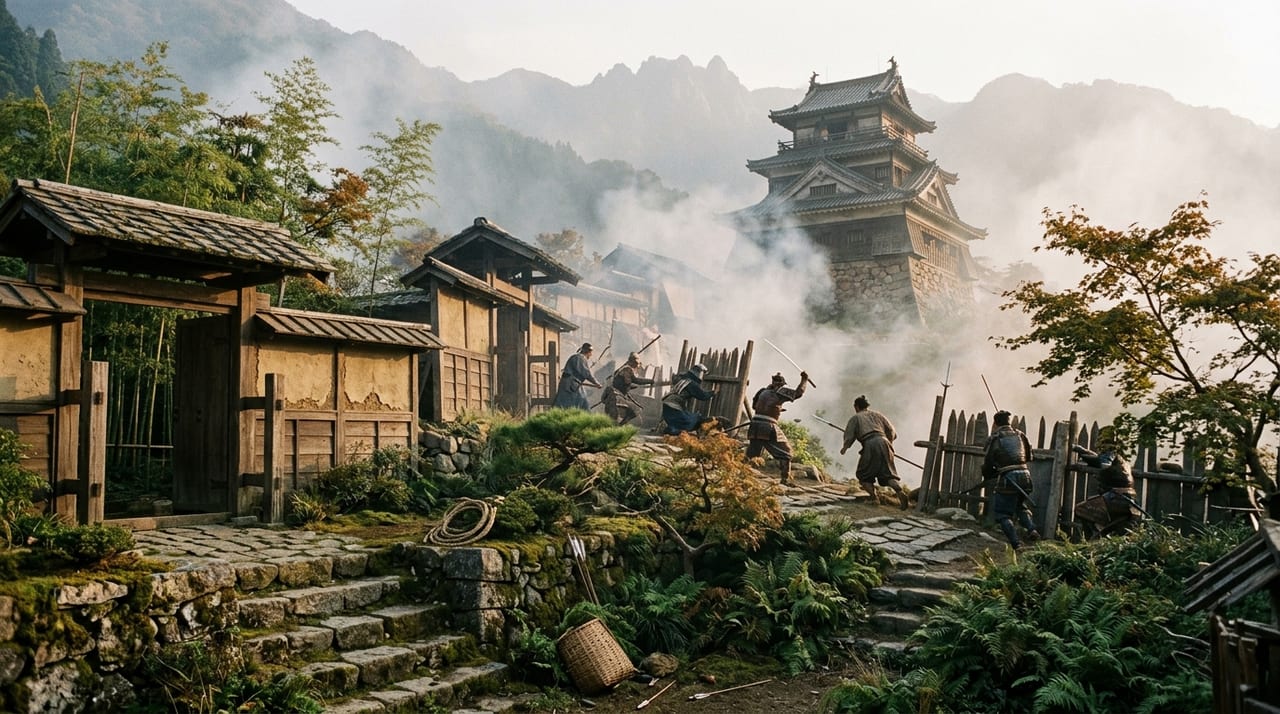
 * Image is for illustrative purposes only.
The Boshin War and the Japanese Sword
戊辰戦争と刀剣
From the Ōsei Fukko no Daigōrei (Imperial Restoration decree) to the Battle of Hakodate (1868–1869), the Boshin War, in which former shogunate forces and New Government forces clashed, became a turning point in Japan's sword history. It details how the first modern civil war, in which Western-style firearms and swords coexisted, paved the way to the Meiji Haitō-rei.
Description
The Boshin War (Boshin Sensō, Keiō 4 – Meiji 2, 1868–1869) was a civil war fought across Japan between the New Government forces, which rallied around the Meiji Emperor and were centered on the domains of Satsuma, Chōshū, Tosa, and Hizen, a coalition of powerful domains in western Japan, and the forces of the former Tokugawa shogunate, including the former shogunate army and the Ōu-Etsu Reppan Dōmei (Alliance of Ōu-Etsu Domains). It was a decisive armed clash that heralded the birth of modern Japan. From the perspective of sword history, it is positioned as a large-scale civil war in which swords and Western-style firearms were used on the same battlefields.
The Battle of Toba–Fushimi in January 1868 (1st month of Keiō 4) opened the Boshin War. Records show that in this battle, both the former shogunate forces and the New Government forces engaged in close combat with swords drawn. At the same time, Western-style firearms such as Minié rifles and Snider rifles determined the course of the fighting, showing that the sword was losing its status as the primary weapon. In particular, records of the Satsuma domain's gun units overwhelming the sword-centered charging units of the former shogunate forces clearly demonstrate the tactical limits of the sword in modern warfare.
However, the sword in the Boshin War cannot be discussed solely in the context of a purely tactical tool. Many members of the Shinsengumi, the Shōgitai, and former shogunate retainers kept their swords to the end as symbols of samurai identity and pride. In the Battle of Ueno in July 1868 (5th month of Meiji 1), fought by the Shōgitai at Ueno, accounts record former shogunate retainers who resisted New Government forces armed with firearms by wielding swords and spears. This battle was passed down to later generations as a historic scene symbolizing the 'final chapter of the age of the sword.'
Most swords used in the Boshin War were practical bakumatsu-tō (late-Edo-period swords), produced in large numbers in the final years of the shogunate. As a result of the shin-shintō movement that began with Suishinshi Masahide and Taikei Naotane, swords of this period maintained a certain technical standard under the ideal of a return to the old swords (kotō kaiki). However, because major domains such as Chōshū and Satsuma concentrated their funds on procuring Western-style firearms, the quality of the swords owned by individual samurai polarized throughout the late Edo period.
After the Boshin War, the Meiji government rapidly moved toward sword-abandonment policies. Through a series of successive policy changes, namely the Edict Permitting Commoners to Use Surnames in Meiji 3 (1870), the abolition of the han system and establishment of prefectures in Meiji 4, and the Haitō-rei (Edict Banning the Wearing of Swords) in Meiji 9, the right to wear a sword disappeared along with the dismantling of the samurai class. As a historical path leading to the Haitō-rei, the Boshin War is an event at the watershed of Japan's sword culture. From the end of the Boshin War to the Haitō-rei, the age of the sword came to an end in Japan in just seven years.
Among the notable figures associated with swords who took part in the Boshin War are Kondō Isami (of the Tennen Rishin-ryū, who favored the famous blades of Nagasone Kotetsu) and Hijikata Toshizō (who favored the Izumi no Kami Kanesada and died in the Battle of Hakodate). In particular, Hijikata Toshizō's Izumi no Kami Kanesada remains today a relic of high cultural value as a symbolic heirloom of the Boshin War.
Characteristics of This Era
- Large-scale civil war in which Western-style firearms and swords were used together (1868–1869)
- Mixed battlefield of firearms and blades — Toba-Fushimi demonstrating the sword's tactical obsolescence against Satsuma rifle units
- The final stand of the Shōgitai and Shinsengumi — the historical moment when the sword completed its transformation into a symbol of warrior identity and honor rather than tactical utility
- Polarization of Bakumatsu sword quality — shinshintō-revival practical blades alongside crude weapons from domains prioritizing firearm procurement
- Seven years to sword abolition — from Boshin War's end to the 1876 Sword Abolition Edict, the age of the sword closed within a single decade