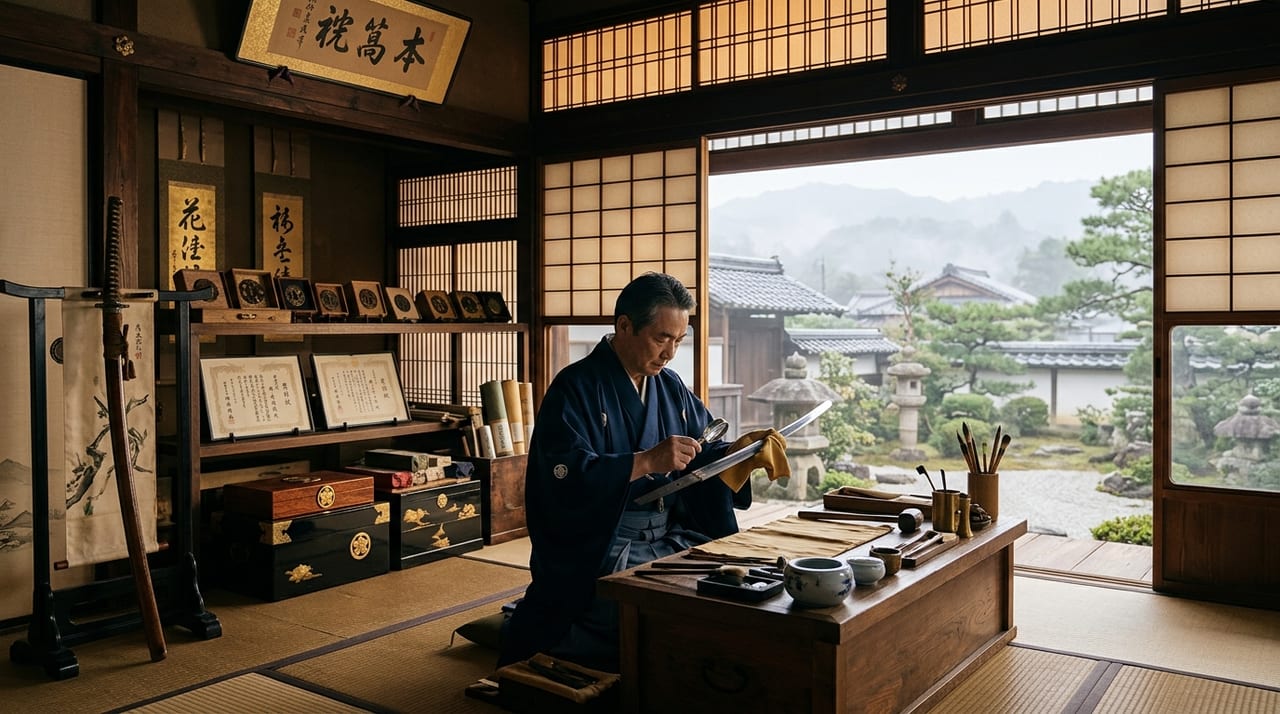
 * Image is for illustrative purposes only.
The Hon'ami Family and the Sword Appraisal Tradition
本阿弥家と刀剣鑑定の伝統
The Hon'ami family served as the official sword polishers and appraisers to successive rulers from the Muromachi period onward, establishing the ori-gami certification system that defined the standards of sword valuation throughout the Edo period and beyond.
Description
Formation and Role of the Hon'ami Family
The Hon'ami family took shape in the early Muromachi period (14th century) as a household whose hereditary occupation was the polishing, nugui, and appraisal of swords. The family is said to have begun serving the Ashikaga shogunal house from the time of its first head, Hon'ami Myōhon. The family's hereditary duties joined the polishing and cleaning of blades with the appraisal of authenticity, maker, and quality.
Establishment of the Origami System
The most important institution the Hon'ami family established was the origami. An origami was an appraisal document for swords issued by the Hon'ami family, recording the smith's name, the estimated period of manufacture, and the assessed value. In the Edo period, Hon'ami origami carried great authority in the sword market as a seal of approval, and swords accompanied by an origami sold for considerably higher prices than comparable swords without one.
The Kyōhō Meibutsuchō, compiled in the mid-Edo period during the Kyōhō era by the Hon'ami family (Hon'ami Kōchū) at the command of eighth shogun Tokugawa Yoshimune, records a list of famous swords based on Hon'ami appraisals. It remains one of the standards for evaluating old swords to this day.
Hon'ami Kōetsu and Cultural Activities
The most famous member of the Hon'ami family is Hon'ami Kōetsu (1558–1637). While continuing the family's hereditary work in sword appraisal and polishing, Kōetsu showed outstanding talent in calligraphy, ceramics, maki-e lacquer, and other fields, and is counted among the greatest multi-disciplinary artists of the early Edo period. He is known for receiving the land of Takagamine in Rakuhoku, northern Kyoto, from Tokugawa Ieyasu, and for forming there an artists' community called Kōetsu-mura (Kōetsu Village).
Although Kōetsu was born into a family whose business was sword appraisal and polishing, almost none of his surviving letters mention swords.
The Hon'ami Family and the Shogunate in the Edo Period
The Edo shogunate recognized the Hon'ami family as official sword appraisers and commissioned it to carry out regular appraisals for the government. In particular, the management and appraisal of the shogun's okoshimono, the swords the shogun wore or held in his collection, was an important duty of the Hon'ami family. The family was also often asked to appraise famous swords held by daimyo houses, and so it played a central role in the distribution and evaluation of swords across the country.
Sword Appraisal in the Modern Era
After the Meiji Restoration, the Haitōrei (Edict Banning Swords, 1876) removed the practical significance of swords, but their evaluation as art objects and cultural properties continued. Today, sword appraisal is carried out by the Nihon Bijutsu Tōken Hozon Kyōkai (NBTHK), a public interest incorporated foundation. Its examination system, with the categories Tokubetsu Jūyō Tōken, Jūyō Tōken, Tokubetsu Hozon Tōken, and Hozon Tōken, can be regarded as the modern successor to the Hon'ami origami system.
Characteristics of This Era
- Ori-gami certificates standardizing smith attribution, period, and monetary valuation
- Integrated hereditary role of polishing, nugui (wiping/cleaning), and appraisal
- Contribution to the Kyōhō Meibutsu-chō as the defining catalog of famous ancient swords
- Shogunate-sanctioned authority as official appraisers to the Tokugawa
- Hon'ami Kōetsu's synthesis of sword culture with broader artistic achievement