New Arrivals — Browse our catalog for the latest authentic Japanese sword arrivals. Browse →
4th month, Genki 1 (1570)
Kanegasaki Castle and Tsuruga Harbor, Tsuruga District, Echizen Province (present-day Kanegasaki Town, Tsuruga City, Fukui Prefecture)
Forces
Asakura-Azai Coalition (pursuers)
Oda Forces (withdrawing)
About 13 min read
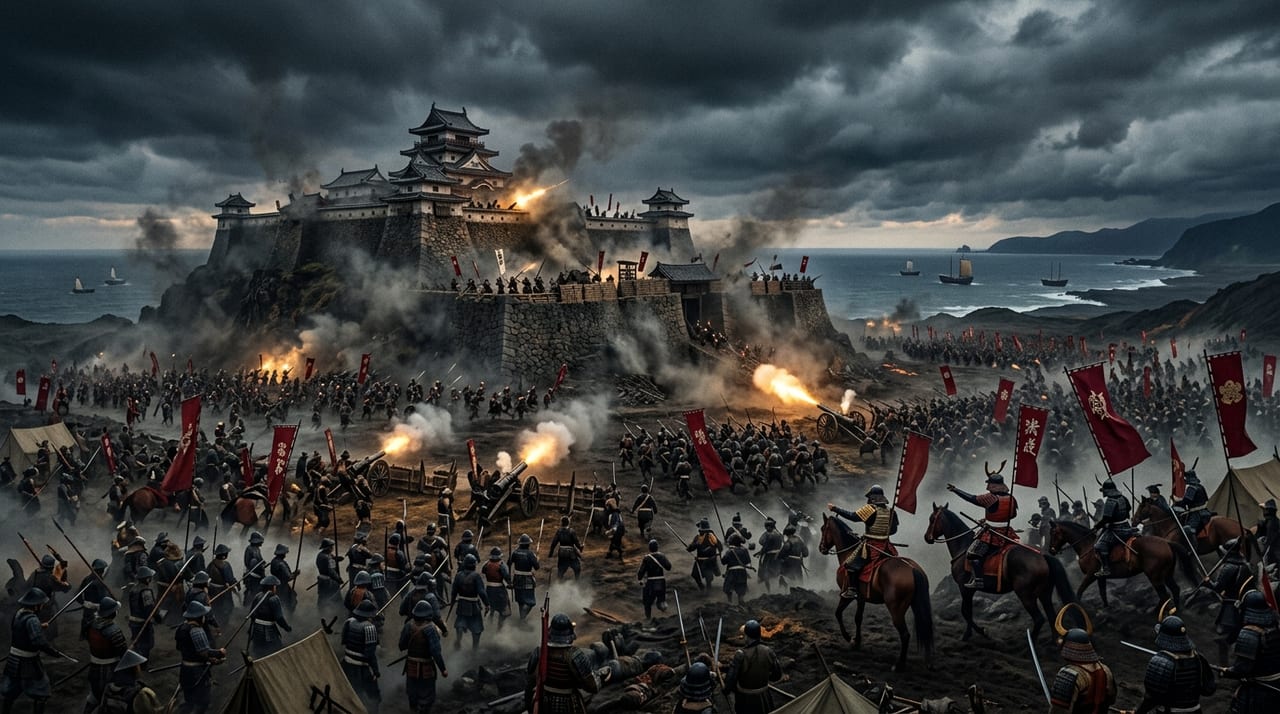
In the 4th month of Genki 1 (1570), Oda Nobunaga invaded Echizen Province (now Fukui Prefecture) and was suddenly faced with an unexpected crisis: the betrayal of his ally Azai Nagamasa. With the large army of Asakura Yoshikage ahead and Azai's forces behind, Nobunaga escaped with remarkable speed. This 'Kanegasaki no Nokikuchi (the Kanegasaki withdrawal)' is remembered as a famous episode in which Kinoshita Hideyoshi (later Toyotomi Hideyoshi), serving as rear guard, showed his true worth and took the first step toward becoming ruler of the realm.
In the 4th month of Genki 1 (1570), Oda Nobunaga led an army of about 30,000 through Ōmi into Echizen to attack the Echizen daimyo Asakura Yoshikage. Asakura had long refused to submit to the shogun Ashikaga Yoshiaki despite repeated demands, and Nobunaga intended to defeat him decisively on this occasion.
The Oda army broke through the Echizen border and advanced smoothly, taking Kanegasaki Castle (now Tsuruga City). Immediately afterward, however, Nobunaga received information that was fatal to him. Azai Nagamasa, a daimyo of Ōmi who had married Nobunaga's younger sister Oichi and was supposed to be his brother-in-law, was giving priority to his old alliance with the Asakura family and was attempting to cut off the Oda army from behind.
Asakura's great army ahead and Azai's forces behind: Nobunaga's expeditionary force in Echizen was suddenly in danger of being trapped like a rat in a bag. Nobunaga at first dismissed the reports, saying 'it must be a false rumor,' but as news kept arriving he was reportedly forced to accept that it was true. It is unclear who first brought the news. The anecdote that Oichi sent a bag of red adzuki beans tied at both ends to warn of the danger is considered a later invention.
Nobunaga immediately decided to withdraw. He could not leave a large army in Echizen, so the only option was to gather his forces and head straight for Kyoto by way of Ōmi.
The most dangerous role in this withdrawal was that of commander of the rear guard (shingari), the unit that retreats at the very back and holds off the pursuing enemy. The rear guard commander kept fighting while being chased and continued to take enemy attacks until the main body of the army reached safety. It was an honor carrying mortal danger.
The man who took on this rear guard was Kinoshita Hideyoshi (later Hashiba Hideyoshi, and then Toyotomi Hideyoshi). Ikeda Katsumasa, shugo of Settsu, and Akechi Mitsuhide also joined the rear guard. (Although some Edo-period records state that Tokugawa Ieyasu also joined, his name does not appear in primary sources.) The rear guard held off the pursuing Asakura and Azai forces and bought time for Nobunaga's main force to escape from Tsuruga to Kyoto by way of the Wakasa road and the Ōmi road.
Nobunaga is said to have fled back to Kyoto at remarkable speed, accompanied by only a minimal escort. This escape came to be known as the Kanegasaki no Nokikuchi, and it is remembered as a celebration of Nobunaga's quick decisiveness and Hideyoshi's achievement.
In the Kanegasaki no Nokikuchi, the swords carried by the commanders who served in the rear guard were the last support in a 'life-or-death close-quarters fight.' There is no doubt that in the melee, where the pursuing Asakura and Azai mounted warriors clashed with the Oda foot soldiers and horsemen defending the rear, swords and spears flew in close combat.
No clear record survives of the sword Kinoshita Hideyoshi used in the rear guard, but in later years Hideyoshi showed strong interest in collecting swords alongside the tea ceremony. Sōza Samonji is a famous sword of the realm that was transmitted from Imagawa Yoshimoto to Oda Nobunaga and then to Toyotomi Hideyoshi. At the time of the Kanegasaki no Nokikuchi this sword was still in Nobunaga's possession, but its later connection to Hideyoshi is deep.
The fact that Akechi Mitsuhide joined the rear guard is also noteworthy. Mitsuhide would later kill Nobunaga in the Honnō-ji Incident (1582), but at Kanegasaki he served in the rear guard at the risk of his life to protect Nobunaga's life. This twelve-year span is one of the most dramatic reversals in the history of the Japanese sword, in which a blade changed from a 'symbol of loyalty' into a 'blade of rebellion.'
Azai Nagamasa's betrayal is recorded in history as a typical example of the fragility of 'alliances' in the Sengoku period. Although Nagamasa was bound to Nobunaga as a brother-in-law through his marriage to Oichi, he gave priority to his old ties with the Asakura family. This decision eventually led to the downfall of the Azai family (1573), with the fall of Odani Castle.
Yoshimoto Samonji, another name for the Sōza Samonji mentioned above, was owned by Imagawa Yoshimoto and was a famous sword that Oda Nobunaga obtained as a spoil of war at the Battle of Okehazama (1560). This sword was later transmitted from Nobunaga to Hideyoshi, and then to later generations. At the time of the Battle of Kanegasaki it is said to have been in Nobunaga's hands, and as a sword that embodies the human drama of alliance and betrayal in the Sengoku period, it is a symbolic presence.
After the Kanegasaki no Nokikuchi, Nobunaga rebuilt his strength and in the 6th month of the same year fought head-on with the combined Azai and Asakura forces at the Battle of Anegawa, defeating them. However, the resistance of Azai and Asakura continued, and the Nobunaga encirclement alliance, which also included Ishiyama Hongan-ji, Takeda Shingen, and Matsunaga Hisahide, troubled Nobunaga throughout the Genki era.
Nobunaga overcame this difficult period through decisiveness as sharp as a blade and a genius for military and political strategy. Kanegasaki was both a failure for Nobunaga and the place where Hideyoshi's ability as a warrior was first proven to the realm. Through his achievement in the rear guard, Hideyoshi further deepened Nobunaga's trust in him and began steadily walking the road toward becoming ruler of the realm.
In Kanegasaki-chō, Tsuruga City, Fukui Prefecture today, the Kanegasaki Castle ruins and the Kanegasaki-gū shrine remain. The Kanegasaki-gū is a shrine enshrining Prince Takanaga and Prince Tsunenaga, who met tragic deaths in the Nanboku-chō period, and it is known for its blessings of breaking through difficult challenges and bringing good relationships.
From the Kanegasaki Castle ruins one can overlook all of Tsuruga Bay and still see the harbor from which Nobunaga escaped by the skin of his teeth more than 450 years ago. When one imagines the scene of Hideyoshi's rear guard, with swords at their waists, holding off the pursuing Asakura and Azai forces as they left this place, the harshness of the withdrawal battles of the age of the Japanese sword and the figures of the commanders who staked their lives there stand out vividly. Kanegasaki is also the starting point of the history in which Azai Nagamasa, a warrior who put righteousness above alliance, met his end. As a place where the human drama of the Sengoku period is condensed, it continues to attract many history enthusiasts today.
Oda Nobunaga
Oda Nobunaga — the Oda commander who executed the desperate withdrawal from Kanegasaki
Toyotomi Hideyoshi
Kinoshita Hideyoshi (later Toyotomi Hideyoshi) — the rear-guard commander whose performance at Kanegasaki marked his rise
Akechi Mitsuhide
Akechi Mitsuhide — who fought in the Kanegasaki rear guard protecting Nobunaga twelve years before killing him at Honnōji
Tokugawa Ieyasu
Tokugawa Ieyasu — Nobunaga's ally who participated in the covering withdrawal from Kanegasaki
Asai Nagamasa
Azai Nagamasa — Nobunaga's brother-in-law whose sudden betrayal triggered the Kanegasaki crisis
Asakura Yoshikage
Asakura Yoshikage — Nobunaga's target in Echizen who coordinated with the Azai against the Oda withdrawal
Tsuruga Castle
Tsuruga Castle — the Tsuruga area stronghold adjacent to Kanegasaki from which Nobunaga escaped
Ichijōdani Castle (Asakura Clan Castle Ruins)
Ichijōdani Castle — Asakura Yoshikage's headquarters, the base of the Asakura forces at Kanegasaki
Odani Castle
Odani Castle — Azai Nagamasa's stronghold where the decision to betray Nobunaga was made, later destroyed by Nobunaga