The Siege of Shiga: Nobunaga's Greatest Crisis and the Tension at Mt. Hiei
9th–12th month, Genki 1 (1570)
Shiga District, Ōmi Province (present-day northern Ōtsu, Shiga Prefecture)
- Date
- 9th–12th month, Genki 1 (1570)
- Location
- Shiga District, Ōmi Province (present-day northern Ōtsu, Shiga Prefecture)
- Result
- Establishment of a truce through the mediation of the imperial court and Yoshiaki. Though Nobunaga was forced into compromise, he steeled his resolve for the burning of Mt. Hiei the following year.
Forces
Oda Forces
Asai–Asakura Alliance and Enryaku-ji
About 8 min read
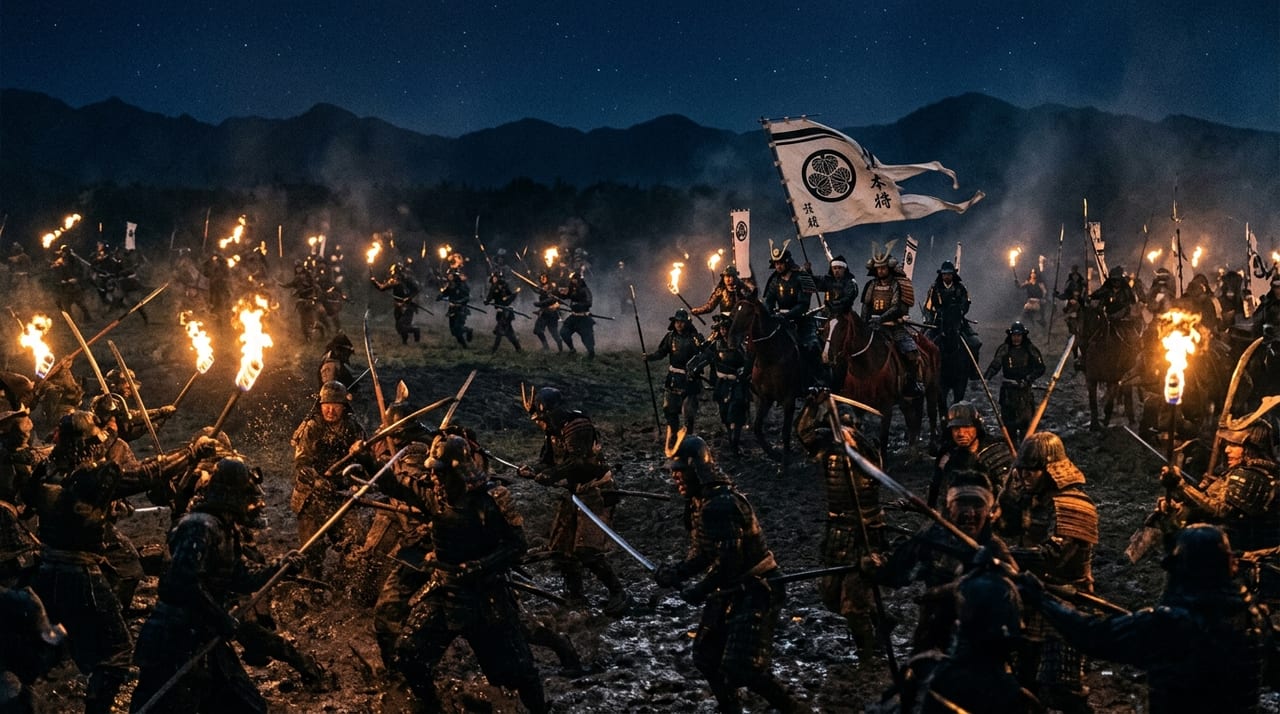
The Siege of Shiga (Shiga no Jin) was a prolonged standoff fought from the 9th to the 12th month of Genki 1 (1570) in Shiga District of Ōmi Province (present-day northern Ōtsu, Shiga Prefecture). In this battle, the combined forces of Asai Nagamasa and Asakura Yoshikage joined with the sōhei of Enryaku-ji to fight against Nobunaga, and it is known as one of the most difficult struggles of Nobunaga's career. In the end, Nobunaga was compelled to accept a peace brokered by the imperial court and the Ashikaga shogunal house, but this humiliation became the direct trigger for the attack on Mt. Hiei the following year, Genki 2 (1571).
Background: Collapse of the Alliance and Reverse Encirclement
In the 4th month of Genki 1 (1570), Nobunaga never dreamed that Asai Nagamasa, with whom he had friendly relations, would defect by citing their old alliance, so he invaded Echizen to subdue Asakura Yoshikage (the Battle of Kanegasaki). News of Asai Nagamasa's sudden betrayal of Nobunaga spread through the camp like lightning, and Nobunaga barely escaped in retreat (the so-called withdrawal from Kanegasaki). In the subsequent Battle of Anegawa in the 6th month, the combined forces of Nobunaga and Tokugawa Ieyasu defeated the Asai-Asakura alliance, but they failed to take control of the Asai and Asakura home territories.
In the 9th month, the Asai-Asakura forces moved south along the western shore of Lake Biwa and advanced into Shiga District (present-day northern Ōtsu). Nobunaga suffered serious losses, including the death of Mori Yoshinari, who was defending Usayama Castle on the Oda side, in fighting on the 20th day of the 9th month. Furthermore, because Enryaku-ji on Mt. Hiei sided with the Asai and Asakura and admitted the combined forces onto the mountain, Nobunaga was forced into a disadvantageous position: he had to keep Mt. Hiei under siege and could not pursue a quick decisive battle.
Nobunaga's Predicament and the Intervention of the Imperial Court and Ashikaga Yoshiaki
During the Siege of Shiga, Nobunaga was caught from front and rear, and the uprising of Hongan-ji (the Genki-era Ikkō uprisings) added to these pressures, forcing him to respond on many fronts. As the standoff dragged on into the 11th month, Nobunaga took the unusual step of asking the imperial court and the shogun, Ashikaga Yoshiaki, to mediate a peace, a compromise that was out of character for him.
On the 13th day of the 12th month, peace was established through the mediation of the imperial court and Ashikaga Yoshiaki. Nobunaga accepted certain conditions for Asai and Asakura, and both sides withdrew their forces. Explanations for why Nobunaga agreed to the peace vary: some say he wanted to avoid prolonged attrition in the mountainous terrain during winter, while others say he wanted to give priority to dealing with Hongan-ji. Either way, this was one of the few cases in his career in which he himself sought a compromise.
Resolution to Burn Mt. Hiei
Nobunaga's indignation was deep. During the Siege of Shiga, the monks and shuto (temple clergy) of Enryaku-ji had sheltered the Asai and Asakura forces and used their religious authority for political purposes. After the peace was established, Nobunaga bided his time. On the 12th day of the 9th month of Genki 2 (1571), he suddenly sent a large army against Enryaku-ji on Mt. Hiei, burned its halls, pagodas and monastic complexes, including the Konponchūdō, and killed large numbers of monks, clergy and lay followers alike (the burning of Mt. Hiei).
Many historians point out that the direct cause of this burning lay in Enryaku-ji's political position during the Siege of Shiga.
Impact on Sword Culture
The sōhei (warrior monks) of Enryaku-ji, known as dōshū, used the naginata as their primary weapon, carried swords and spears, and wore armor. Throughout the Muromachi period, they were 'armed religious practitioners' with great influence over politics. The Siege of Shiga, in which the military strength of Enryaku-ji last tormented Nobunaga, symbolizes the final phase of the history of sōhei armament.
After Nobunaga gained control of Mt. Hiei, the conventional 'armed temple and shrine forces' were greatly weakened, and the holding of swords became more clearly concentrated among the warrior houses (buke). The series of events comprising the Siege of Shiga and the burning of Mt. Hiei can be positioned as historical incidents that redefined who the 'bearers' of swords were at the close of the Sengoku period.