New Arrivals — Browse our catalog for the latest authentic Japanese sword arrivals. Browse →
July 30, 1570 (Genki 1, 6th month, 28th day)
Banks of the Anegawa River, Azai District, Ōmi Province (present-day Nomura-chō and Mita-chō, Nagahama City, Shiga Prefecture)
Forces
Oda-Tokugawa Coalition
Azai-Asakura Coalition
About 12 min read
The Battle of Anegawa, fought on the 28th day of the 6th month of Genki 1 (1570) on the banks of the Anegawa River in Azai District, Ōmi Province, was one of the outstanding field battles of the Sengoku period, pitting the combined forces of Oda Nobunaga and Tokugawa Ieyasu against the combined forces of Azai Nagamasa and Asakura Yoshikage. The battle marked the peak of resistance by northern Ōmi and Echizen to Nobunaga's campaign for national unification, and it became the turning point that signaled the effective end of the Azai-Asakura alliance.
The immediate cause of the Battle of Anegawa lay in the Retreat from Kanegasaki earlier that same year, in the 4th month. Nobunaga had advanced into Echizen to attack Asakura Yoshikage, but Azai Nagamasa, the husband of Nobunaga's sister, Lady Oichi, suddenly turned against Nobunaga, allied himself with the Asakura, and threatened Nobunaga's army from behind. Nobunaga was forced to withdraw with great difficulty, and those who rescued him from this predicament were Kinoshita Hideyoshi (later Toyotomi Hideyoshi) and Akechi Mitsuhide, who served as the rear guard.
After the withdrawal, Nobunaga rebuilt his forces in order to bring down Azai Nagamasa and requested reinforcements from Tokugawa Ieyasu. Ieyasu readily agreed and joined his troops with the Oda army. On the 24th day of the 6th month, Nobunaga laid siege to Yokoyama Castle, the Azai stronghold to the south of Odani Castle across the Anegawa, and encamped at Tatsugahana. Ieyasu, who had joined him, also set up his camp at Tatsugahana.
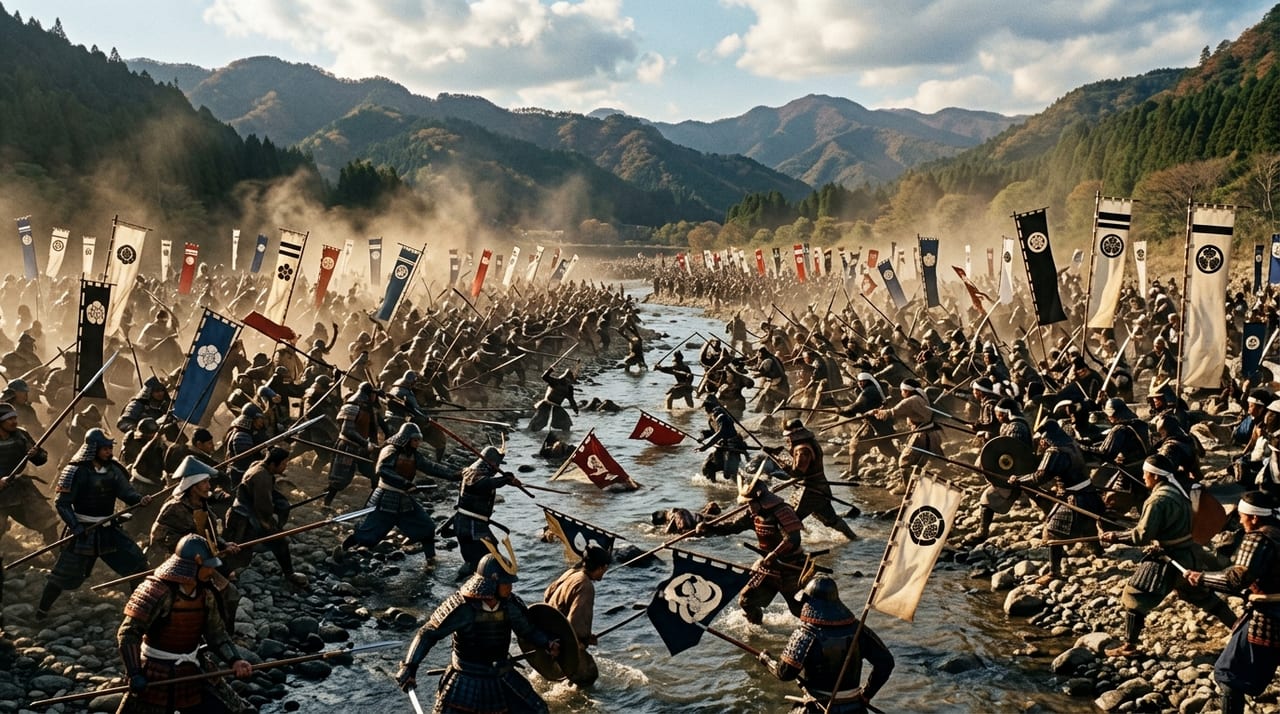
Early on the morning of the 28th day of the 6th month, the two armies faced each other across the Anegawa. Nobunaga adopted a formation in which he personally led the Oda army against the Azai forces, while Ieyasu led the Tokugawa army against the Asakura forces.
At first, the Asakura army held the numerical advantage and pressed hard against the left flank of the Tokugawa army. The situation was turned around by the valiant efforts of Sakakibara Yasumasa and others, senior retainers of the Tokugawa house. Yasumasa struck the flank of the Asakura army and at once reversed the course of a battle that had been going against his side. For this achievement, Sakakibara Yasumasa established his reputation as one of the Four Heavenly Kings of the Tokugawa.
Meanwhile, the head-on clash between the Oda and Azai forces was also extremely fierce. Azai Nagamasa was known as a bold and decisive commander, and the warriors under his banner were formidable. However, once the Asakura army collapsed, the Azai army was also struck on its flank, and in the end the combined Azai and Asakura forces suffered heavy losses and were compelled to withdraw.
According to records made after the battle, the Azai and Asakura forces killed by the Oda and Tokugawa side reportedly numbered more than 1,100.
Because the Battle of Anegawa was an open-field battle fought on a riverbank, it is known for the especially fierce close-quarters combat with swords and spears. Although firearms were beginning to spread across the battlefield at this time, in an open-field battle in which armies faced each other across a river, close-quarters combat still carried great weight, and the practical role of the sword remained strong.
Of particular interest is the "brother-in-law" relationship between Oda Nobunaga and Azai Nagamasa, and the possibility that it was expressed through the exchange of swords as gifts. Among the warlords of the Sengoku period, it was customary to exchange famous swords when concluding an alliance, and it is presumed that such a sword exchange also accompanied the marriage tie between Nobunaga and Nagamasa. In this battle, however, former allies drew their swords against each other.
The famed sword Yoshimoto Samonji, which Nobunaga is said to have possessed, is known as the blade he took as a trophy after killing Imagawa Yoshimoto at Okehazama. The movement of famous swords across battlefields was not rare in the Sengoku period. Even on the fierce battlefield of the Anegawa, the swords worn by the commanders were used as tools of violent close-quarters combat.
After the defeat at the Anegawa, Azai Nagamasa retreated into Odani Castle, his main stronghold in northern Ōmi. Odani Castle was a steep mountain castle, and its defensive strength was among the highest of its time. However, the defeat at the Anegawa greatly reduced Nagamasa's power, and his relationship with Asakura Yoshikage also changed.
Nagamasa's wife was Lady Oichi, Nobunaga's sister, and the couple had three daughters: Chacha, Hatsu and Gō. These three sisters later left their names in Sengoku history as the three Azai sisters. Chacha became the concubine Yodo-dono of Toyotomi Hideyoshi and the mother of Toyotomi Hideyori, and she stood at the center of the great historical current that led to the Siege of Osaka.
Sakakibara Yasumasa, who achieved the greatest distinction at the Battle of Anegawa, is counted among the Four Heavenly Kings of the Tokugawa alongside Sakai Tadatsugu, Honda Tadakatsu and Ii Naomasa. Yasumasa's military achievements extended beyond the Anegawa to the Battle of Komaki and Nagakute.
The Tokugawa warriors were also known for their high discernment in matters of swords. Ieyasu carefully selected the swords in his own collection, and after the establishment of the Edo shogunate, a magnificent array of masterpieces, including Masamune, Yukimitsu and Yoshimoto Samonji, were kept as "famous swords of the shogun's house."
The victory of the Oda and Tokugawa at the Battle of Anegawa brought about the effective collapse of the Azai-Asakura alliance. After this battle, Nobunaga faced a united resistance from Takeda Shingen, the Hongan-ji, the Azai and the Asakura, known as the "encirclement network," but he adopted a policy of defeating each enemy individually.
In the 9th month of Tenshō 1 (1573), Azai Nagamasa took his own life after Nobunaga's forces launched a full-scale assault on Odani Castle, and the Azai house was destroyed. The Asakura house was also destroyed in the same year. This took place three years after the Battle of Anegawa.
This battle belongs to the final period of the age in which the Japanese sword was used most fiercely as a weapon in actual combat. Afterward, the weight of close-quarters combat on the battlefield gradually declined, as represented by Nobunaga's extensive use of firearms at the Battle of Nagashino (1575). Nevertheless, the battle of swords and spears fought on the banks of the Anegawa is recorded in the history of the sword as a symbolic scene from the era in which the Japanese sword was the "main actor of the battlefield."
Asai Nagamasa
Commanded the Azai-Asakura coalition against Nobunaga
Oda Nobunaga
Oda supreme commander who directly engaged the Azai forces
Tokugawa Ieyasu
Led the Tokugawa forces to defeat the Asakura and turn the tide of battle
Honda Tadakatsu
Fought as a key Tokugawa commander at the Anegawa
Asakura Yoshikage
Daimyo of Echizen who allied with Azai against Oda
Niwa Nagahide
Senior Oda retainer who participated in the battle