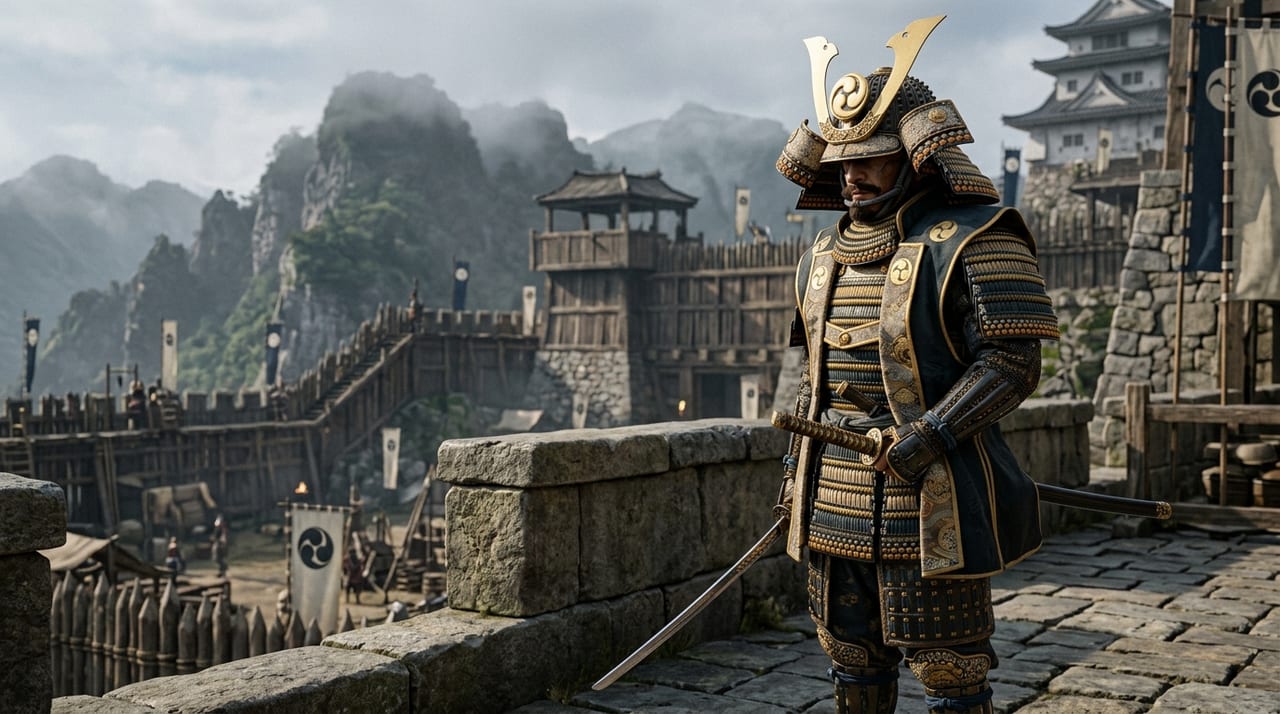
 * Image is for illustrative purposes only.
Niwa Nagahide
丹羽長秀
One of Oda's Four Generals, Governor of Echizen and Wakasa
Description
Life and Origins
Niwa Nagahide (1535–1585) was a military commander from Owari Province who served Oda Nobunaga from a young age and was one of his most senior and longest-serving retainers. He was known by the nickname “Kome Gorōza,” meaning “Gorōza, as indispensable as rice” (Gorōza being Nagahide’s common name), a title that reflected Nobunaga’s deep trust. He received special treatment on a par with Nobunaga’s own kinsmen and held great weight within the household.
Senior Retainer Who Supported the Oda Regime
Nagahide was a versatile commander who excelled not only in martial prowess but also in domestic administration, diplomacy, and construction (civil engineering and architecture). From Tenshō 4 (1576), when work began on Azuchi Castle, he served as overall supervisor and gave concrete form to Nobunaga’s grand vision as a castle. He also accompanied campaigns across various regions and earned merit, including in the suppression of the Echizen Ikkō-ikki. After the Honnō-ji Incident of Tenshō 10 (1582), at the Kiyosu Conference he allied with Hashiba Hideyoshi against Shibata Katsuie, supporting Hideyoshi in the struggle for leadership over the succession to the Oda regime. After the Battle of Shizugatake he was granted the whole of Echizen Province and two districts of Kaga, becoming a great daimyō as lord of Kitanoshō Castle. He died of illness in Tenshō 13 (1585) (reportedly suffering from shakuju, an abdominal mass). Some records, including the Hideyoshi-fu, also state that, unable to bear the pain of his illness, he cut open his own belly.
Swords and Armor
Among the swords associated with Niwa Nagahide (his beloved blades), three are best known: the large wakizashi “Nikkari Aoe,” the kodachi “Kannagiri Nagamitsu,” and the wakizashi “Azamaru.” First, “Nikkari Aoe” is a large wakizashi by Aoe Sadatsugu of the Aoe school of Bitchū in the Nanboku-chō period (blade length approx. 60.3 cm; Important Art Object). After it was held by Shibata Katsuie, it passed through Katsuie’s son Katsutoshi into Nagahide’s hands, was then presented to Toyotomi Hideyoshi, and finally came down to the Kyōgoku family of Marugame in Sanuki. The gold-inlaid inscription “Hashiba Gorōzaemon-no-jō Naga” remaining on the tang (nakago) is thought to refer to Nagahide or his son Nagashige, but the circumstances under which it was inscribed are not known.
Second, “Kannagiri Nagamitsu” is a kodachi by Nagamitsu of the Bizen Osafune school from the Kamakura period (Important Art Object; now held by the Tokugawa Museum, which is associated with the Mito Tokugawa family). It is said to have been bestowed on Nagahide by way of Rokkaku Yoshikata and Oda Nobunaga. Third, “Azamaru,” said to have been the sword worn by Fujiwara no Kagekiyo, a brave general of the Taira, is recorded with an anecdote: after Nagahide possessed it, he contracted an eye ailment, and so he dedicated it to Atsuta Shrine.
Later Assessment
After Nagahide’s death, the greatness of his presence was made clear again by the rapid upheaval of the Oda-affiliated regime. How much this versatile senior retainer, once described as “indispensable,” had supported the organization is shown by the political situation that followed his death. Not one-sidedly a man of martial valor, but a commander of comprehensive ability skilled in castle-building, administration, and mediation, Nagahide established a distinctive reputation even among the Oda vassals.
What Swords and Tachi Did Niwa Nagahide Favor?
Famous swords traditionally associated with Niwa Nagahide are three: the large wakizashi “Nikkari Aoe,” the kodachi “Kannagiri Nagamitsu,” and “Azamaru.” “Nikkari Aoe” is the work of Aoe Sadatsugu of the Aoe school of Bitchū in the Nanboku-chō period; it passed from Shibata Katsuie through Nagahide, was presented to Toyotomi Hideyoshi, and came down to the Kyōgoku family of Marugame in Sanuki (it is now held by the Marugame City Museum; Important Art Object). “Kannagiri Nagamitsu” is a kodachi by Nagamitsu of Bizen Osafune from the Kamakura period, said to have been bestowed on Nagahide through Rokkaku Yoshikata and Oda Nobunaga; it is now held by the Tokugawa Museum, associated with the Mito Tokugawa family. “Azamaru” is an old sword said to have been worn by Fujiwara no Kagekiyo, a brave general of the Taira; legend holds that whoever wears it suffers from eye disease. Nagahide, having developed an eye ailment, is said to have dedicated it to Atsuta Shrine (it is still held by Atsuta Shrine; the sword type is wakizashi). Nagahide’s famous pieces centered on wakizashi and kodachi rather than tachi themselves, but all of them convey the wanderings of famous swords that graced the Oda and Toyotomi regimes, and speak to the high rank of Niwa Nagahide as a senior retainer.
Notable Swords
- Nikkari Aoe (an ō-wakizashi by Aoe Sadatsugu from the Nanboku-chō period, Important Art Object; passed from Shibata Katsuie to Nagahide and later presented to Toyotomi Hideyoshi)
- Kannagiri Nagamitsu (a kodachi by Bizen Osafune Nagamitsu from the Kamakura period, Important Art Object; said to have been bestowed upon Nagahide through Rokkaku Yoshikata and Oda Nobunaga)
- Azamaru (a wakizashi said to have been the sword of the legendary Heike warrior Fujiwara no Kagekiyo; donated to Atsuta Shrine by Nagahide after he suffered an eye ailment)