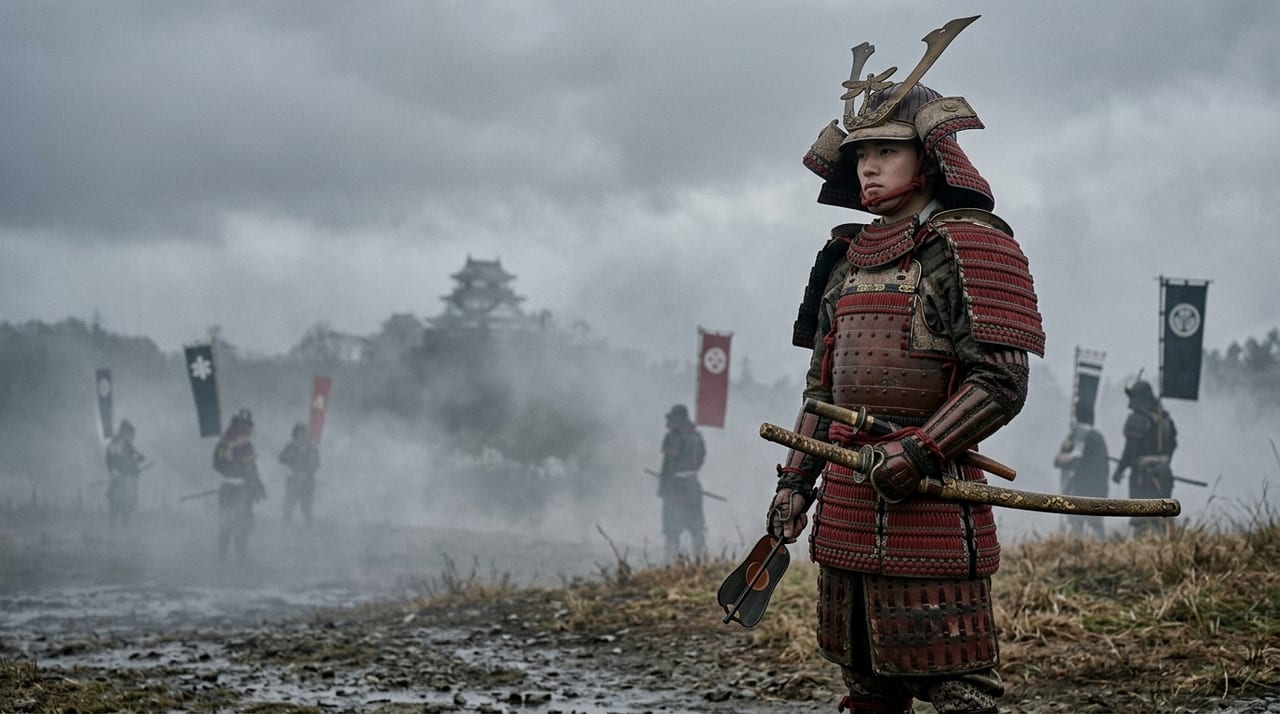
 * Image is for illustrative purposes only.
Konishi Yukinaga
小西行長
Christian Daimyo and Commander of the Korean Invasion
Description
The Birth of a Christian Daimyō
Born in Kyoto in Eiroku 1 (1558) as the second son of Konishi Ryūsa, a merchant of Sakai, Konishi Yukinaga rose under Toyotomi Hideyoshi to become lord of Uto Castle in Higo Province, and at the same time he was a Christian daimyō with the baptismal name Augustinus (Agostinho), a devout Christian. Yukinaga's father, Konishi Ryūsa, amassed wealth as a merchant of Sakai. This merchant background shaped Yukinaga's diplomatic sense and his inclination toward peace, forming him into a warrior with a diplomat's temperament who stood apart from the militarist generals.
The Vanguard of the Invasion of Chōsen
In Bunroku 1 (1592), during the invasion of Chōsen, Yukinaga served as the vanguard as supreme commander of the First Division, and achieved a lightning-fast advance, reaching Hanseong (Seoul) from Busan in less than twenty days. This astonishing march speed demonstrated Yukinaga's outstanding command ability and the high training level of his troops. However, Yukinaga was not a pure militarist; he tended to prefer resolving matters through negotiation rather than battle. After the occupation of Hanseong, Yukinaga had already begun moving toward peace negotiations with Ming, and started secret negotiations with Shen Weijing, an envoy of Ming.
Obsession with Peace and Deception
Yukinaga's reasons for seeking peace between Ming and Chōsen were, together with the influence of Christian pacifism, a calm recognition of the practical attrition produced by the continuation of war. However, the peace terms Hideyoshi presented were unrealistic and far exceeded the range to which the Ming side could compromise. To resolve this contradiction, Yukinaga is said to have attempted a dangerous double deception: telling Hideyoshi that Ming would surrender, and telling Ming that Hideyoshi would surrender. This deception was exposed at the audience of Ming envoys at Osaka Castle in the 9th month of Bunroku 5 (1596), provoking Hideyoshi's fury and worsening the situation into the Keichō campaign (the second invasion of Chōsen).
Swords and Diplomacy
Yukinaga's view of swords was deeply tied to his diplomatic character. Swords were not mere weapons; they functioned as diplomatic gifts, instruments of intimidation, and symbols of status. Moreover, the two symbols Yukinaga carried, the cross he held as a Christian and the sword he wore as a samurai, expressed the complex spiritual world of Yukinaga. Faith and arms, the longing for peace and the reality of war: Yukinaga's sword, which had lived through these contradictions, bore the history of that inner conflict.
The Choice at Sekigahara
In the Battle of Sekigahara in Keichō 5 (1600), Yukinaga, like Ishida Mitsunari, sided with the Western Army, hoping for the survival of the Toyotomi regime. This choice was based on Yukinaga's loyalty to the Toyotomi house and his wariness of Tokugawa Ieyasu. However, the Battle of Sekigahara ended in a complete defeat for the Western Army. After fleeing into the mountains, Yukinaga was sheltered by Hayashi Zōsu, a village headman of Sekigahara, and was eventually handed over to the Eastern Army. As a Christian, Yukinaga was forbidden to take his own life, and even after being captured he did not try to end his life himself. On 6 November 1600 (Keichō 5/10/1), Yukinaga was beheaded at the Rokujō riverbank (Rokujō-gawara).
The Coexistence of Faith and Bushidō
The reason Konishi Yukinaga is an unusual figure in Japanese history lies in his complex spirit, which simultaneously pursued Christian faith and a samurai way of life. Yukinaga's figure, seeking peace while bearing a sword and continuing to seek reconciliation while standing on the battlefield, embodied in himself the contradictions of the Sengoku period. Yukinaga's sword was not a mere weapon but a symbolic presence of a person who held two spiritual pillars, faith and bushidō. Yukinaga's life illuminates a core theme of nihontō culture: that the nihontō is not merely a tool for fighting, but embodies human spirituality and the ideals of its age.