New Arrivals — Browse our catalog for the latest authentic Japanese sword arrivals. Browse →
December 11, 1637 – April 12, 1638 (Kan'ei 14, 10th month, 25th day – Kan'ei 15, 2nd month, 28th day)
Shimabara, Hizen Province, and Amakusa, Higo Province (present-day Minamishimabara, Nagasaki and Amakusa, Kumamoto)
Forces
Shogunate Coalition Forces
Shimabara-Amakusa Rebel Forces
About 11 min read
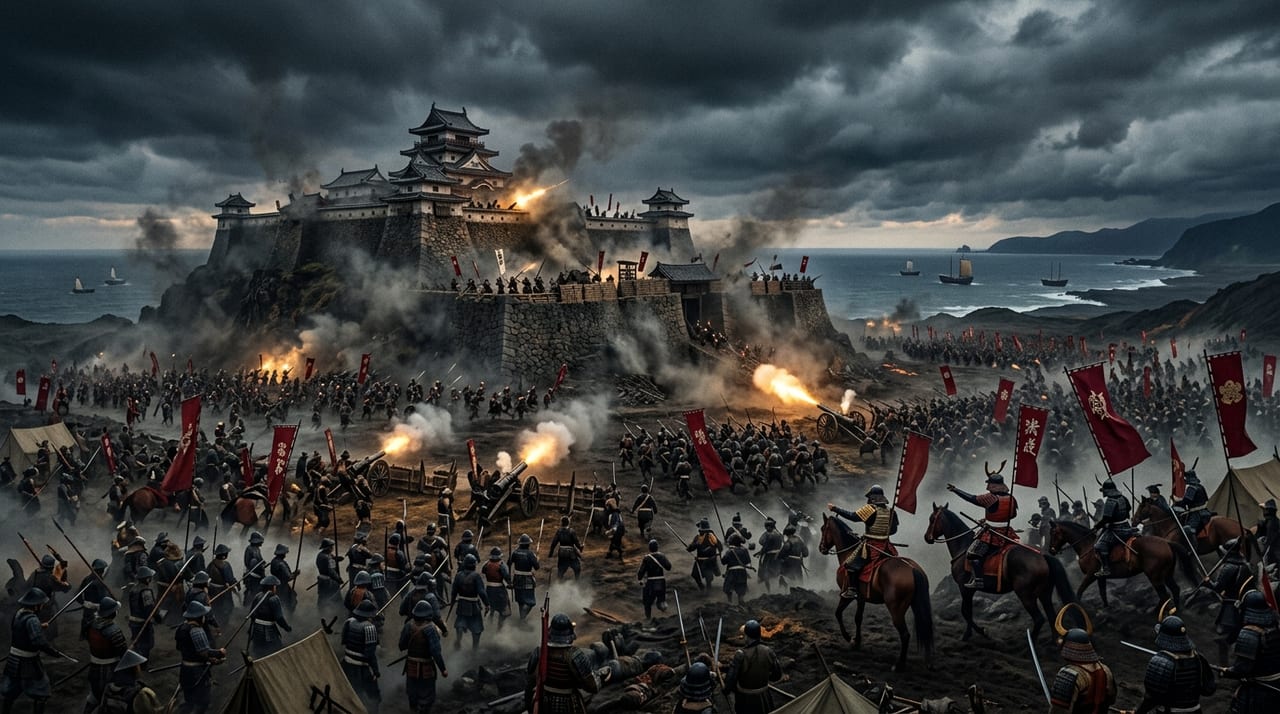
In the 10th month of Kan'ei 14 (1637), peasants of Shimabara in Hizen Province (Nagasaki Prefecture) and Amakusa (Kumamoto Prefecture) rose up together against harsh land taxes and severe persecution of Christians. This is the Shimabara Rebellion. The rebel army, numbering a total of 37,000 people, took shelter in Hara Castle. They followed Amakusa Shirō Tokisada, a boy of around 16 years of age, who served as their figurehead. From the 12th month of Kan'ei 14 to the 2nd month of Kan'ei 15 (1638), they fought a siege of about three months against a shogunate force of more than 120,000.
The Shimabara Peninsula and the Amakusa region had once been the domains of Christian daimyō such as Arima Harunobu and Konishi Yukinaga, and many peasants had converted to Christianity. When the edict banning Christianity issued by the Edo shogunate (from 1612) was strengthened, the Shimabara Domain (Matsukura family) and the Karatsu Domain (Terazawa family), which held Amakusa as an exclave, repeatedly carried out harsh fumie tests and crackdowns. On top of this, famine compounded the hardship, and the peasants were driven to the depths of despair.
Amakusa Shirō (real name Masuda Tokisada) was born as the child of a retainer of the former Christian daimyō Konishi Yukinaga. He was worshipped by the peasants as a 'child of God' who performed miracles. His charisma became the rallying point of the rebellion, and the rebel forces faced the shogunate army under a battle banner depicting the Holy Sacrament (Eucharist).
The Shimabara Rebellion holds an interesting aspect when considering the sword culture of the early Edo period. Because the rebel army was made up mainly of peasants, its main weapons were not the swords of regular samurai but farm tools modified into weapons, bamboo spears, sickles, and firearms. However, among those who came from the retinues of the former Christian daimyō were samurai who had experience in actual combat, and a certain number carried swords or spears.
The overall commander, Matsudaira Nobutsuna (Izu-no-kami), was a capable official known as 'Chie Izu' (Wise Izu), and he directed the operations from the shogunate's political standpoint. The first commander, Itakura Shigemasa, pursued a strategy of direct assault and struggled against the rebels' resistance. He was killed in action in the general assault in the 1st month of the following year.
In the siege of Hara Castle, the shogunate forces made active use of artillery. At their request, the head of the Dutch trading post dispatched the Dutch ship de Ryp, which bombarded Hara Castle from the sea. However, there was no notable effect, and criticism grew over receiving help from foreigners, so the bombardment was halted. Yet the rebels' resistance remained fierce, and the final fall of the castle was delayed until the rebels were at the brink, their food exhausted.
In the 2nd month of Kan'ei 15 (1638), the shogunate forces launched a full-scale assault on Hara Castle. The rebel army, weakened by the siege to starve them out, made a final attempt at resistance. However, against the overwhelming disparity of 120,000 to 37,000, Hara Castle fell on the 28th day of the 2nd month.
Amakusa Shirō was killed within the castle, and his head was displayed in front of the Ōtemon gate of Hara Castle and in front of the main entrance of Dejima in Nagasaki. It is said that most of the 37,000 people who had taken shelter in the castle were killed in battle or executed, and that almost no survivors remained. The stone walls of the Hara Castle ruins still remain today, and the site is registered as part of the World Heritage property 'Hidden Christian Sites in the Nagasaki Region.'
The shogunate that suppressed the Shimabara Rebellion moved on to further persecution of Christians and to strengthening the policy of national seclusion. In Kan'ei 16 (1639), the arrival of Portuguese ships was prohibited. In Kan'ei 18 (1641), the Dutch trading post was moved from Hirado to Dejima in Nagasaki, and the so-called sakoku (closed country) system was consolidated.
In terms of sword culture, the arrival of a peaceful Edo period prompted a shift from 'the sword as a weapon' to 'the sword as a work of art and a symbol of the warrior class.' After the Shimabara Rebellion, the demand for swords used in actual combat dropped sharply. Instead, swords came to be valued for their formal beauty, appreciative worth, and ceremonial meaning.
This shift coincides with the background against which the smiths of the shintō ('new swords') period came to pursue the beauty of the hamon (blade pattern) and the refinement of the jigane (steel base) rather than battlefield practicality. The Shimabara Rebellion was the last major armed clash that symbolized the transition from the warring states period to the Edo period, and from rule by military force to civil rule.
The Shimabara Rebellion occurred in the midst of the shintō era. More than twenty years had passed since the Siege of Osaka (1615), and the smiths of the early Edo period were producing swords of a new age known as shintō. Shintō, characterized by beautiful midare-ba (irregular blade patterns) and notare-ba (undulating blade patterns), had begun to be valued more as tools for appreciation, gift-giving, and status than for actual combat.
After the Shimabara Rebellion, the peace of the Edo shogunate lasted for about 230 years. In this 'age of peace' (taihei no yo), the sword came to play a role less as a weapon and more as the 'soul of the samurai' and a 'cultural symbol.' The suppression of the Shimabara Rebellion was also an event that marked the firm beginning of that long age of peace.