New Arrivals — Browse our catalog for the latest authentic Japanese sword arrivals. Browse →
April 21, 1701 (Genroku 14) / Raid: January 30, 1703 (Genroku 15, 12th month, 14th day)
Edo (Edo Castle's Matsu no Ōrōka corridor; Kira mansion) / Akō, Harima Province
Forces
Akō rōnin (Forty-Seven Samurai)
Kira household
About 10 min read
In the late night of the 14th day of the 12th month of Genroku 15 (30 January 1703), as snow fell, 47 samurai silently gathered in Honjo Matsuzaka-chō, Edo. This was the raid of the Akō rōnin, the Forty-Seven Rōnin. The incident was passed down to later generations as “Chūshingura” and became a historical event that embodied the Japanese reverence for loyalty, bushidō, and swords.
On 21 April 1701 (Genroku 14/3/14), Asano Takumi-no-kami Naganori, lord of the Akō domain in Harima Province with 53,000 koku, was at Edo Castle, charged with entertaining an imperial envoy. In the Matsu no Rōka (Pine Corridor), he suddenly drew his sword against Kira Kōzuke-no-suke Yoshinaka, the head of the kōke (masters of court ceremony), and slashed at him. Kira suffered wounds to his forehead and back but survived. Asano, who had violated the prohibition against drawing a blade inside the castle, was ordered to commit seppuku that same day, and the Akō domain was subjected to kaieki (confiscation of the domain, abolition of the house).
The blade Asano drew in this assault was a chiisagatana (short sword worn inside the castle). Why Asano attacked Kira is described either as a “personal grudge” or as “anger at Kira's inadequate guidance,” and the debate continues more than three hundred years later.
After the death of their lord Asano, the chief retainer (karō) Ōishi Kuranosuke Yoshio kept his plan for revenge hidden in his heart. Outwardly he feigned a life of dissipation and deceived the shogunate, which was watching him. About one year and nine months later, in the winter of Genroku 15 (early 1703), the 47 carried out the raid on Kira's residence.
Of Ōishi Kuranosuke's personal swords, the tachi and wakizashi have been scattered, but a haitō (sword worn at the side) whose inscription and provenance are unknown has been handed down at Akō Ōishi Shrine. Yoshida Chūzaemon was a seasoned samurai trained in Kōshū-ryū military science, and during the raid he served as mentor to Ōishi Chikara, commander of the rear-gate unit.
On the night of the raid, the swords the men carried were not standardized; each used his own sword. For rōnin (masterless samurai who had lost their posts), upkeep and maintenance of a sword was a serious economic burden. It could be said that the rōnin who kept good-quality swords displayed their resolve through their blades.
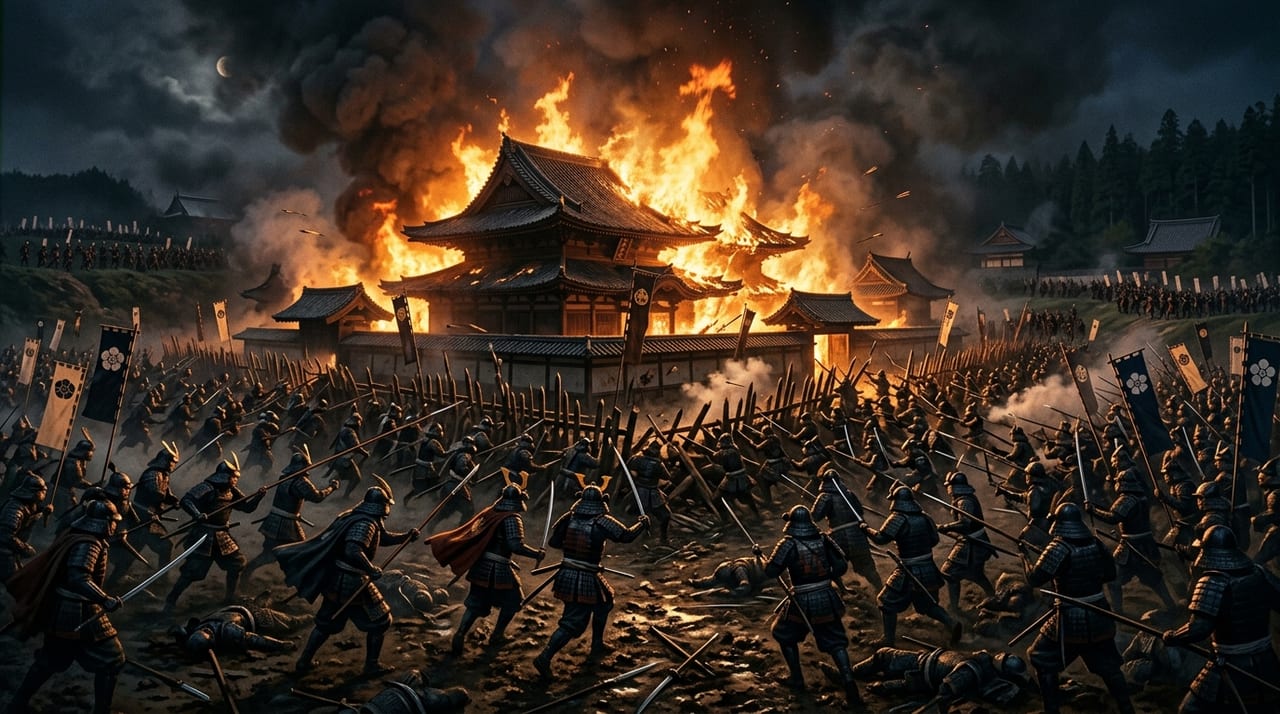
In the late night as snow fell, the Forty-Seven Rōnin divided into two groups and simultaneously stormed Kira's residence through the front and rear gates. Kira's residence is said to have housed about 100 retainers, but owing to prior scheming and the effect of the surprise attack, the Forty-Seven Rōnin fought from an overwhelmingly advantageous position.
Kira Kōzuke-no-suke was finally discovered hiding in a charcoal shed. He was cut down by Hazama Jūjirō, Takebayashi Tadashichi, and others. The rōnin confirmed that it was Kira by the wound inflicted by Takumi-no-kami, and thereby fulfilled their long-held purpose.
The raid is said to have lasted about two hours, and none of the Forty-Seven Rōnin died (two were wounded). The number of deaths on the Kira side is recorded as 15 to 18, depending on the historical sources.
After the raid, the Forty-Seven Rōnin carried Kira's head to the grave of their lord Asano at Sengaku-ji in Takanawa, Tokyo. Afterward, while being interrogated by the shogunate, the rōnin were placed in the custody of various daimyō.
The shogunate's deliberations were difficult. On one side, there were voices praising the act as a gikyo (righteous deed). On the other, there were opinions that emphasized the violation of the law, namely the ban on private retribution. In the end, the shogunate ordered seppuku, and on 20 March 1703 (Genroku 16/2/4), 46 men, excluding Terasaka Kichiemon, committed seppuku and died. The youngest of the Forty-Seven was Ōishi Chikara, son of Ōishi Kuranosuke (16 years old by traditional counting), and the oldest was Horibe Yahei (77 years old by traditional counting). Terasaka Kichiemon had left the group after the raid.
The graves of all of them remain at Sengaku-ji today, and every 14 December the Gishi-sai festival is held.
Throughout the Edo period, the Akō Incident was repeatedly depicted in various forms as “Chūshingura,” including kabuki, jōruri, yomihon, and paintings. The influence this story has had on Japanese culture is immeasurable.
In terms of its influence on sword culture, the swords of each of the Forty-Seven were idealized and passed down as “swords of righteousness.” As a result, swords came to be strongly perceived not merely as weapons but as embodiments of the “samurai spirit.” In the warrior society of the mid-Edo period, the notion that the sword was the “soul” and a proof of “loyalty” permeated down to commoners through the story of Chūshingura.
Even today, Sengaku-ji attracts many visitors, and there are facilities that display relics of the Forty-Seven Rōnin. The Akō Incident, as the event that shaped the archetype of the feelings Japanese people hold toward “the sword and righteousness,” will continue to be passed down in the future.