New Arrivals — Browse our catalog for the latest authentic Japanese sword arrivals. Browse →
December 1868 – June 1869 (Meiji 1, 10th month – Meiji 2, 5th month)
Ezo (present-day Hakodate, Hokkaido)
Forces
Former Shogunate Forces (Republic of Ezo)
Meiji Imperial Forces
About 12 min read
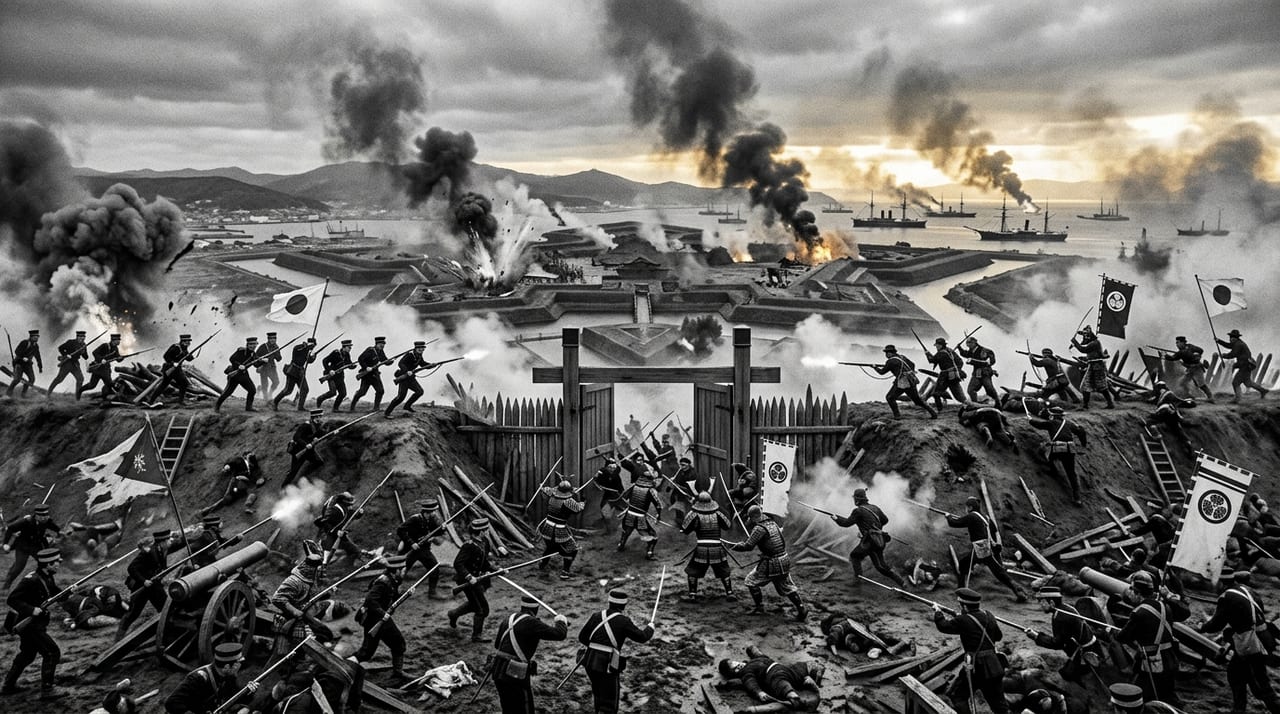
In the 5th month of Meiji 2 (June 1869), the final resistance of the old shogunate forces entrenched in the Goryōkaku fortress in Hakodate, Hokkaido, was suppressed by the new government army. This battle, called the "Battle of Hakodate" or the "Battle of the Goryōkaku," came approximately one and a half years after the start of the Boshin War in 1868, at the moment when the last "stronghold" of the old shogunate forces fell, and it became the battle that announced the virtual end of the age of the samurai in Japan.
The Boshin War, which began with the Battle of Toba-Fushimi (January 1868), continued with the bloodless opening of Edo Castle (May 1868) and the Northeastern War (summer-autumn 1868), and the main military forces of the old shogunate were destroyed one after another. However, Enomoto Takeaki, who commanded the old shogunate's fleet that had preserved its naval strength, led eight warships away from Shinagawa in October 1868, embarked remnants of the northeastern domains, and headed for Hokkaido (then called Ezo).
In December 1868, Enomoto's forces occupied Hakodate and, on January 27, 1869 (Meiji 1, 12th month, 15th day), with the Goryōkaku as their base, declared an independent government, the "Republic of Ezo." Enomoto was elected president (sōsai) by ballot, and Hijikata Toshizō was appointed deputy army magistrate (rikugun bugyō-nami) to organize the military forces.
This "Republic of Ezo" is noted as an experiment in republican governance—the first in Japanese history where leaders were chosen by election—but from the outset it was an inescapable fate to confront the new government army.
A figure indispensable to any account of the Battle of Hakodate is Hijikata Toshizō, vice-commander of the Shinsengumi. Born in 1835, Hijikata survived the tumultuous years of the late Bakumatsu period as vice-commander of the Shinsengumi and, even after the defeat at Toba-Fushimi, consistently remained loyal to the Tokugawa shogunate.
The sword that Hijikata is said to have favored and carried in his battles with the Shinsengumi was the Izuminokami Kanesada. This katana, forged by the Aizu swordsmith Kanesada, was highly prized among late-Bakumatsu swordsmen as a blade of high practical value in actual combat. Hijikata is said to have brought this sword, his "beloved blade," all the way to Hakodate.
In the Battle of Hakodate, Hijikata fought fiercely at places such as Miyako Bay and Futamata-guchi, but the ultimate battlefield became the streets of Hakodate itself. On June 20, 1869 (Meiji 2, 5th month, 11th day), as the new government army landed in Hakodate and street fighting unfolded, Hijikata was struck by a bullet while commanding from horseback, and died in battle at the age of thirty-four (thirty-five by traditional East Asian reckoning).
The fact that Hijikata "fell to a rifle bullet while still carrying his sword" is symbolic. The transition from the age of swordsmanship to the age of firearms—Hijikata's death embodied this very turning point. His burial place has never been determined, and there are various theories about it.
The Goryōkaku was a Western-style star-shaped fortress that the shogunate began constructing in the fourth year of Ansei (1857) for the purpose of defending Ezo. The pentagonal design was a rational structure that allowed each corner to provide supporting fire to adjacent corners, and it represented the latest in military architecture of the late-Bakumatsu period.
However, the old shogunate forces entrenched in this modern fortress, despite possessing modern firearms (rifles and cannons), were inferior to the new government army in organization, training, and supply. The new government army had Western-style forces from Satsuma, Chōshū and other domains, while the old shogunate side was joined by members of the French military mission, including Jules Brunet.
In the new government army's general offensive in the 5th month of Meiji 2 (June 1869), modern military tactics combining naval gunfire from the sea and artillery and infantry assault from the land were deployed. The old shogunate forces, cut off from ammunition and food supplies, resulted in Enomoto Takeaki offering his surrender on June 27 (Meiji 2, 5th month, 18th day).
The Battle of Hakodate was one of the last large-scale conflicts in which the Japanese sword and modern firearms existed side by side. Many of the old shogunate forces were equipped with Western firearms, but they also carried Japanese swords simultaneously. In this transitional period, a mixture of weapons was evident: the sword was used in close combat, while the rifle was used in gunfire exchange.
The swords carried by the swordsmen of the Shinsengumi and old shogunate forces were often excellent blades forged by renowned smiths of the late Bakumatsu period. Hijikata's "Izuminokami Kanesada" is known as the beloved blade of a late-Bakumatsu swordsman.
However, in the street fighting of Hakodate, where gunfire exchanges became the main form of combat, the sword was no longer a primary weapon. The fact that Hijikata was struck down by a rifle bullet symbolized the "end of the age of the sword" in this era. Seven years later, the Edict of Prohibited Swords (1876) was the logical conclusion to this.
Enomoto Takeaki, who resisted to the end in the Battle of Hakodate, surrendered on June 27, 1869 (Meiji 2, 5th month, 18th day). The new government imprisoned Enomoto for a time but, recognizing his abilities and insight, pardoned him in 1872. Enomoto later contributed to the development of Hokkaido and served in important positions in the Meiji government, including ambassador to Russia, minister of communications, and minister of agriculture and commerce.
The transformation of Enomoto—"from defeated rebel to benefactor of Meiji"—is a prime example of how the Meiji government actively recruited talented individuals from the old shogunate side. The fact that both the "victors" and "vanquished" of the Boshin War participated in the construction of the same Meiji nation-state demonstrates the capacity for inclusion of modern Japan.
The conclusion of the Battle of Hakodate marked the virtual end of the "age of the samurai" in Japan. When the last organized resistance in Hakodate disappeared, the social order of the samurai—a nation-state ruled by sword-bearing samurai—that had been created over 260 years of the Edo period came to a complete end. The Meiji Edict of Prohibited Swords was merely the official "monument" to that ending.
Hijikata Toshizō
Shinsengumi vice-commander; died at Hakodate in final loyalty to the shogunate
Okita Sōji
Shinsengumi 1st unit captain; died of illness before Hakodate, one of the era's greatest swordsmen
Kondō Isami
Shinsengumi commander; executed before the Hakodate battle, symbolic figure of the shogunate's cause
Saigō Takamori
Central figure of Satsuma's movement; led the Boshin War that culminated at Hakodate