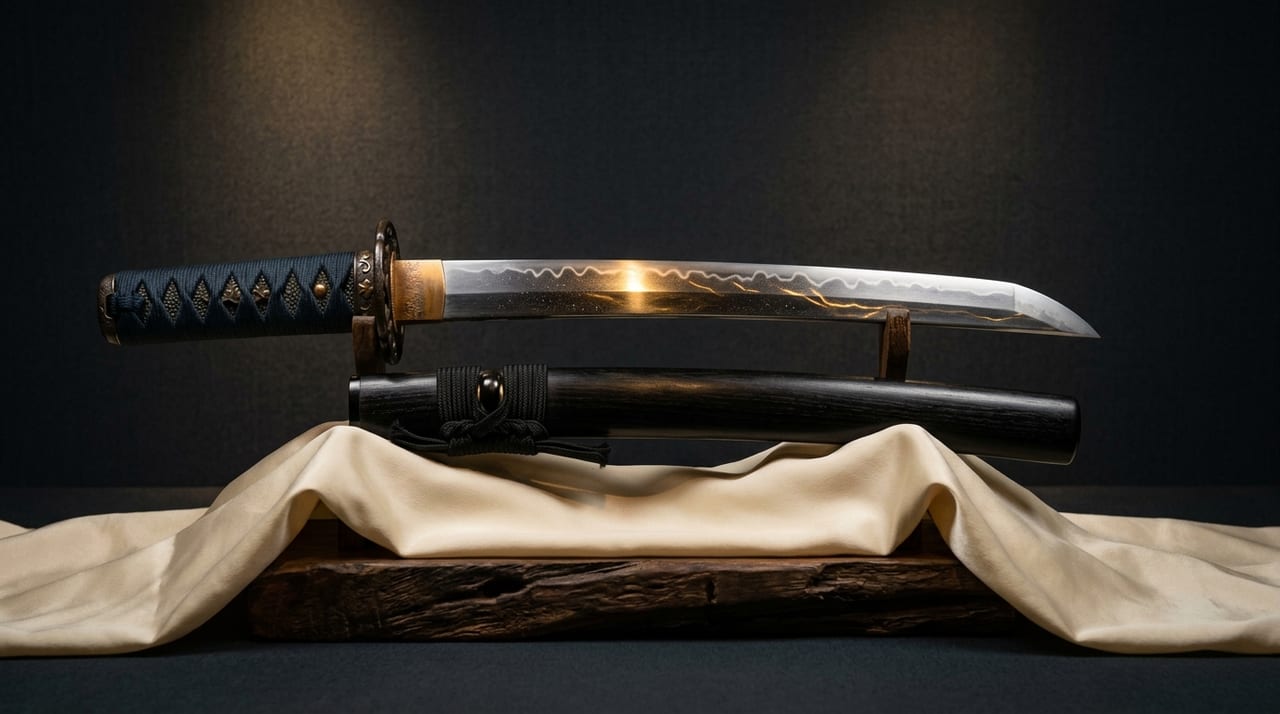
 * Image is for illustrative purposes only.
Hyūga Masamune
日向正宗
Also known as: Ōgaki Masamune; Katata Masamune
Description
Overview of the Sword
Hyūga Masamune is a masterpiece tantō forged by Masamune (Sōshū Masamune), the greatest swordsmith in the history of nihontō. It is known as a famous sword (meibutsu) that Ishida Mitsunari gave to his younger sister's husband, Fukuhara Nagataka, and that Mizuno Katsunari (Hyūga-no-kami) of the Eastern Army acquired during the Battle of Sekigahara. It is a hira-zukuri tantō with a blade length of 8 sun 2 bu (approximately 24.8 cm), and its high level of finish leads appraisers to rate it highly as one of the finest Masamune tantō. The jigane is a tight ko-itame with dense hada, heavy jibuke, chikei, and yubashiri, and the intense nie character typical of Masamune is condensed into a small blade. The hamon is a large-pattern gunome mixed with notare, in which coarse nie shines and kinsuji and inazuma run vertically and horizontally, showing the true essence of Masamune. The name “Hyūga” derives from Hyūga-no-kami, the court title of Mizuno Katsunari, who acquired this sword. In the Kyōhō Meibutsuchō, it is recorded as a meibutsu under the name “Hyūga Masamune.” Hyūga Masamune is a single blade that condenses the intense beauty of the Sōshū tradition into a small world.
Provenance: From Ishida Mitsunari to Mizuno Katsunari
Hyūga Masamune was originally owned by Katata Hirozumi of Katata in Ōmi, when it was called “Katata Masamune.” It is said to have later been owned by Ishida Mitsunari, who gave it to his younger sister's husband, Fukuhara Nagataka. In 1600 (Keichō 5), during the Battle of Sekigahara, Ōgaki Castle, which Fukuhara was defending, surrendered, and the sword came into the hands of Mizuno Katsunari of the Eastern Army, who had been attacking the castle. It was first called “Ōgaki Masamune.” It later passed to the Kishū Tokugawa house, and was given the name “Hyūga Masamune” after Katsunari's court title, Hyūga-no-kami. The history of this masterpiece by Masamune passing into the hands of Mizuno Katsunari, a fierce commander known for his militant, hard-line character, gives the sword a distinctive narrative against the backdrop of the turbulent period from the late Sengoku era to the early modern era.
The Tantō of Masamune: A Small Universe Within a Great Body of Work
Masamune's fame was established mainly by the innovative hamon of his long swords (tachi and ōdachi), but his tantō also show technical achievement equal to his tachi. Condensing the large-grained nie, tobiyaki, kinsuji, and inazuma characteristic of Masamune into a blade of around 8 sun presents a technical difficulty different from that of expression in long swords. In Hyūga Masamune, this condensed small universe is perfectly realized, and the aesthetics of the Sōshū tradition are completely sealed within a small blade. Among sword researchers, it is said that Masamune's tantō display the swordsmith's skill with greater concentration than his tachi, and Hyūga Masamune most directly embodies that assessment. Whether Masamune deliberately forged tantō or whether the small universe is the chance result of applying the same methods used on tachi to a shorter blade is not known. In either case, the fact that the entirety of Masamune's skill is contained within the blade of Hyūga Masamune guarantees a richness of discovery that viewers never tire of, no matter how often they look.
The Kyōhō Meibutsuchō and the Prestige of a Meibutsu
Hyūga Masamune is listed among the formal meibutsu registry as one of the named Masamune meibutsu recorded in the Kyōhō Meibutsuchō. The Kyōhō Meibutsuchō is a catalog of famous swords compiled during the Kyōhō era (1716–1736) under the orders of Tokugawa Yoshimune, the eighth shōgun of the Edo shogunate, which surveyed and recorded swords held by daimyō houses and major temples and shrines across the country. Being listed in this registry meant that a sword's provenance and value were officially certified, and it carried decisive authority in later sword rankings. The fact that Hyūga Masamune is recorded in the Masamune section of the Kyōhō Meibutsuchō means that the sword was guaranteed as an authentic work of Masamune by the highest authority in Edo-period sword appraisal, and that reliability has been carried forward into modern scholarly evaluation. Other Masamune swords recorded in the Kyōhō Meibutsuchō include Ishida Masamune, Fudō Masamune, Kanze Masamune, and Kuki Masamune, and Hyūga Masamune is referenced by researchers, alongside these, as the highest evidence of Masamune's works.
The Origin of the Name “Hyūga”
The name “Hyūga Masamune” was given after Hyūga-no-kami, the court title of Mizuno Katsunari, who acquired this sword during the Battle of Sekigahara. “Hyūga” is the old provincial name corresponding to present-day Miyazaki Prefecture. It is also a sacred land in Japanese mythology, where the descent of the heavenly grandchild took place (Ninigi-no-Mikoto descended to the peak of Takachiho). However, the name of this sword derives strictly from the court title of its holder. Even so, the image of sunlight carried by the word “Hyūga” (hinata, a sunny spot) resonates poetically with the brilliance of Masamune's hamon, and the beauty of sound and rich imagery of the combination “Hyūga Masamune” give the sword's name a particular charm.
Modern Ownership and Preservation
In 1927 (Shōwa 2), Hyūga Masamune was won at an auction of the Kishū Tokugawa house by the Mitsui baronial family. It was designated a former National Treasure in 1941 (Shōwa 16) and a National Treasure in 1952 (Shōwa 27). It is now owned by the public interest foundation Mitsui Bunko and housed at the Mitsui Memorial Museum in Tokyo. The Mitsui Memorial Museum preserves and exhibits art and craft objects handed down in the Mitsui family and boasts an excellent collection. Within the museum's sword collection, Hyūga Masamune holds a particularly important position as a representative work of Masamune, and sword enthusiasts from across the country visit during its regular exhibitions. As a point where the history of the warrior Mizuno Katsunari and the skill of the swordsmith Masamune intersect, Hyūga Masamune is one of the works that most clearly shows that the Japanese sword is a fusion of history and art.
Legends & Stories
Provenance of the Meibutsu Hyūga Masamune
Hyūga Masamune was originally owned by Katata Hirozumi of Ōmi, when it was called “Katata Masamune.” It passed through Ishida Mitsunari and was given to his brother-in-law, Fukuhara Nagataka. When Ōgaki Castle, where Fukuhara was holding out, surrendered during the Battle of Sekigahara, the sword came into the hands of Mizuno Katsunari of the Eastern Army. It was first called “Ōgaki Masamune,” and came to be called “Hyūga Masamune” after Katsunari's court title, Hyūga-no-kami. It later passed to the Kishū Tokugawa house. During the Jōō era, Tokugawa Yorinobu presented it to his eldest son, Tokugawa Mitsusada, and it was handed down through generations. The history of a single sword, protected and passed on through many hands, shows that swords were treated as spiritual vessels that went beyond mere weapons.
The Mystery of Masamune: A Genius Without Records
Astonishingly few historical records of Masamune survive, and his dates of birth and death, his family, and his origins are all unknown. Beyond the statement that he was a “swordsmith of Kamakura in Sōshū (Kanagawa Prefecture),” no certain biographical facts exist. The estimate that he was active in the first half of the fourteenth century rests only on dated works by Shintōgo Kunimitsu, his presumed teacher, and on tantō bearing Shōwa era (1312–1317) and Karyaku era dates recorded in the section on works lost in fire in the Kyōhō Meibutsuchō. It is a mystery that a genius of this stature left so few records. Conversely, regarding the swordsmith Masamune, the blade itself is the only witness. The fact that Masamune's own living evidence exists in the blade of Hyūga Masamune embodies the core of the Japanese view of swords: a blade is not merely a craft object but a recording medium that encapsulates the entire personality of the person who made it.
The Formation of the Myth of “Masamune”
The fame of Masamune reached mythic heights throughout the Edo period. The Kyōhō Meibutsuchō records 59 works by Masamune, and in the early modern era “Masamune” became synonymous with famous swords. As the supreme embodiment of the concept of “genius,” Masamune holds a place in Japanese culture such that, when one faces the single blade of Hyūga Masamune, one feels that something more than mere iron dwells within it. As evidence left by a genius of seven hundred years ago whose identity remains a mystery, Hyūga Masamune continues to speak to us today.