New Arrivals — Browse our catalog for the latest authentic Japanese sword arrivals. Browse →
1st–2nd month, Genki 4 (1573)
Noda, Shidara-gun, Mikawa Province (present-day Noda, Shinshiro City, Aichi Prefecture)
Forces
Takeda Forces
Noda Castle Garrison (Tokugawa)
About 12 min read
The Western Campaign (Saijō sakusen) that Takeda Shingen carried out from autumn of Genki 3 (1572) through the following Genki 4 (1573) swept through Kai, Shinano, Tōtōmi, and Mikawa. It was a historic great expedition that crushed Tokugawa Ieyasu at the Battle of Mikatagahara. The final phase of that Western Campaign was the siege of Noda Castle, located in Shitara District, Mikawa Province (present-day Shinshiro, Aichi Prefecture). The Battle of Noda Castle is recorded in history as the last battle in which "the Tiger of Kai," Takeda Shingen, directed the fighting on the field.
In the 10th month of Genki 3 (1572), Takeda Shingen departed Tsutsujigasaki Residence (present-day Kōfu, Yamanashi Prefecture) and set out for the west at the head of a total force of about 30,000 men. This Western Campaign was not merely an invasion of Tokugawa territory. It was a grand strategy that also took into view the opposition to Oda Nobunaga at his back. Shingen sought to split the Oda–Tokugawa alliance. By coordinating with the anti-Nobunaga forces in the Kinai, namely Ashikaga Yoshiaki, the remnants of the Miyoshi, and Hongan-ji, he aimed to play a decisive part in the encirclement of Nobunaga.
Shingen's army entered Tōtōmi Province (present-day western Shizuoka Prefecture), captured Futamata Castle (present-day Tenryū Ward, Hamamatsu), and then threatened Hamamatsu Castle, the seat of Tokugawa Ieyasu. On January 25, 1573 (Genki 3/12/22), the Battle of Mikatagahara broke out at Mikatagahara (present-day Chūō Ward, Hamamatsu). Ieyasu's army sallied out from Hamamatsu Castle, joined by Oda reinforcements, and clashed with the Takeda army of about 30,000 men. This battle was an overwhelming victory for the Takeda army, and the Tokugawa forces were left in a state of rout. Ieyasu is said to have fled barely with his life back into Hamamatsu Castle. A legend remains that, so as never to forget this humiliation, he had a grimacing self-portrait painted, the "shikami-zō" (a grimacing portrait).
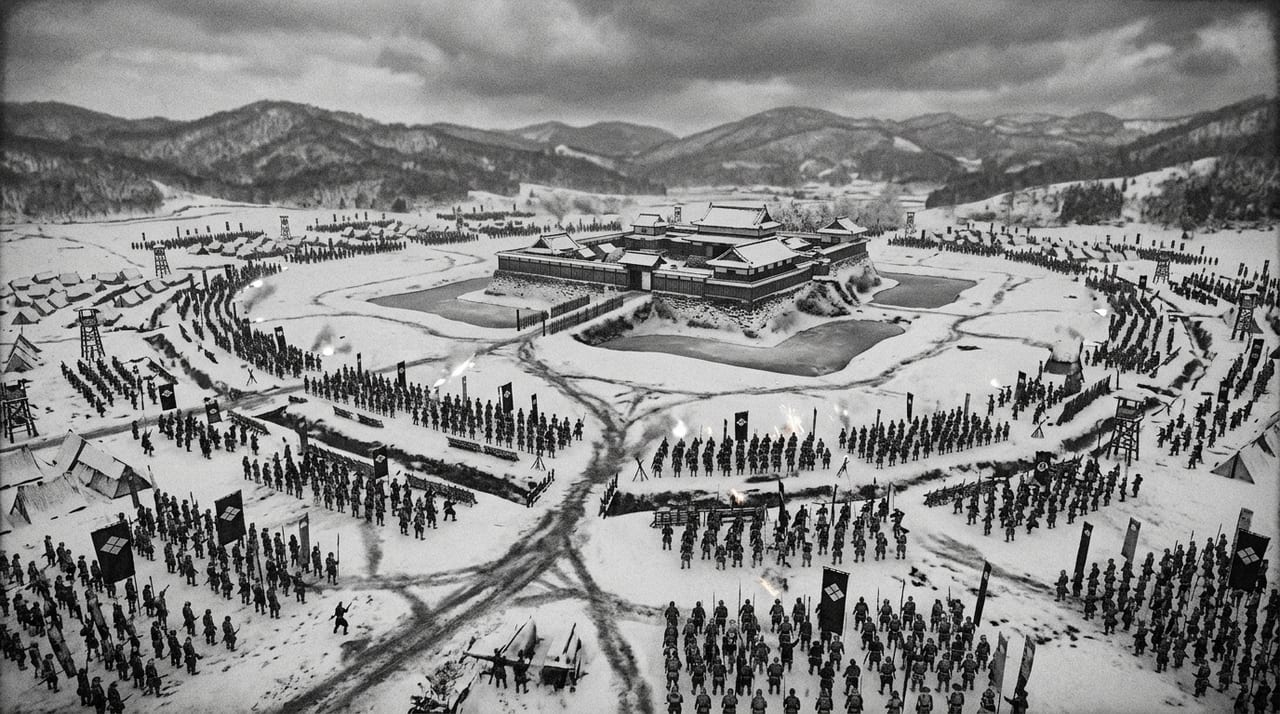
Following the great victory at Mikatagahara, Takeda Shingen continued his advance into Mikawa Province. From the 1st month of Genki 4 (1573), he began the siege of Noda Castle. Noda Castle was a small subsidiary castle held by Suganuma Sadamitsu, a commander on the Tokugawa side, and it was known for firm defenses that made use of the terrain.
The garrison was said to number only about 500 men against the total strength of the Takeda army. Even so, Suganuma Sadamitsu shut himself inside Noda Castle and resisted stubbornly. During the prolonged siege, the episode most often passed down about the attack on Noda Castle is the story of "Shingen's bullet." Since the Edo period, it has been transmitted that the sound of a flute from within the castle drifted to Shingen's encampment every night. Shingen was moved by it and went outside his camp to listen closely, whereupon he was shot at from within the castle and struck by a bullet. There are various theories about the historical truth of this tradition, and the causes of Shingen's death include various theories, such as "a wound from a bullet" and "the worsening of a chronic illness (also said to have been pulmonary tuberculosis)."
In the 2nd month of Genki 4 (1573), Noda Castle finally surrendered. Suganuma Sadamitsu handed over the castle and was taken captive by the Takeda army. However, immediately after this, Shingen's health rapidly deteriorated.
After taking Noda Castle, Shingen set out on the return journey to Kai. However, his condition worsened by the day. On May 13, 1573 (Genki 4/4/12; Tenshō 1), Takeda Shingen died at Komaba in Shinano Province (present-day Achi Village, Shimoina District, Nagano Prefecture). He was 53 years old.
Facing death, Shingen is said to have left a will to his eldest son, Takeda Katsuyori, directing him to "keep my death secret for three years." However, this secret could not be kept for long, and news of Shingen's death soon became known to the surrounding commanders. The formation of the anti-Nobunaga encirclement, which had been the goal of the Western Campaign, collapsed with Shingen's death.
In the 7th month of Genki 4 (1573), three months after Shingen's death, Ashikaga Yoshiaki was expelled from Kyoto by Nobunaga, and the Muromachi shogunate effectively came to an end. The anti-Nobunaga coalition that Shingen had expected never materialized. The Takeda house then declined rapidly under Katsuyori's leadership, and led to the fall of the Takeda clan in Tenshō 10 (1582) (Takeda Katsuyori; the Kōshū Conquest).
Takeda Shingen's relationship with swords was deep, and many traditions about it remain. Among the Sengoku warlords, Shingen had a particularly strong interest in swords. He actively used the collection and bestowal of famous blades as a political tool.
At the Battle of Noda Castle, it is thought that along with the surrender of Suganuma Sadamitsu, the swords and armor kept in the castle were also seized by the Takeda army. In sieges of the Sengoku period, the armory of a fallen castle was a treasure trove of spoils. There was a practice of redistributing famous swords and spears as proof of loyalty to a new lord. The spoils Shingen obtained at Noda Castle, the final battlefield of his life, probably included works by swordsmiths rooted in the land of Mikawa.
In terms of scale and ferocity, the Battle of Noda Castle does not match the Battle of Mikatagahara or the Battles of Kawanakajima. However, because the siege of this small castle became the final stage closing Takeda Shingen's life, it has been remembered as a battle of special significance in Japanese history.
How would history have changed had Shingen not died and continued the Western Campaign? This "what if of history" has been discussed repeatedly by later historians, novelists, and game creators. It is a fact that Nobunaga was in a dire situation. It cannot be ruled out that, if Shingen had remained alive for at least several more years, the leading figure in unifying the realm would have been Shingen rather than Nobunaga.
Remains of Noda Castle still exist in present-day Shinshiro, Aichi Prefecture, and are preserved as a historic site. It has become a sacred place that history fans visit without end as "Shingen's last castle." Near the spot where Shingen is said to have been shot after being drawn out by the sound of the flute, a monument inscribed with that legend has also been erected. The Battle of Noda Castle continues, even now, to be a storyteller of the Sengoku period, as one of the small battlefields that decisively changed the course of history.