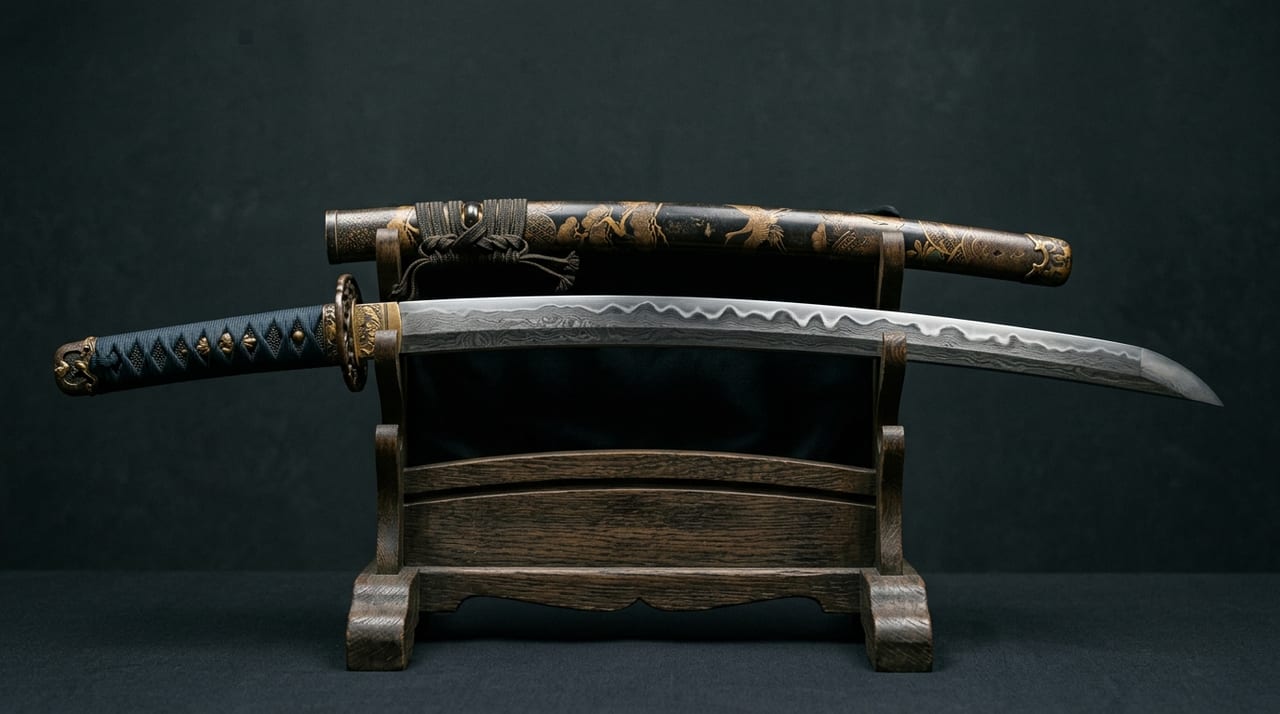
 * Image is for illustrative purposes only.
Naminohira Yukiyasu
波平行安
Also known as: A master of the Satsuma tradition and leading smith of the Naminohira school: the sword of the Shimazu
Description
Overview of Naminohira Yukiyasu and the Naminohira School
Naminohira Yukiyasu is the name of a smith lineage that arose in Satsuma Province (present-day Kagoshima Prefecture) from the late Heian period into the Kamakura period. As the name of a leading master of the Naminohira school (Naminohira-ha), whose name was passed down generation after generation by the main line until the Meiji period, it holds an important place in the sword history of Kyūshū. The Naminohira school was an old group of smiths based in Satsuma Province, and its origins are said to date back to the late Heian period. The name 'Naminohira' derives from the place name Naminohira in Taniyama District, Satsuma Province (present-day southern Kagoshima City), where the school was located. Because several smiths used the signature Yukiyasu, dating individual works can be difficult. However, few works by Heian and Kamakura period Yukiyasu survive, and the tachi 'Sasanuki', regarded as the representative work of the first-generation Yukiyasu, has been designated an Important Cultural Property and is held by the Kyoto National Museum.
Technical Characteristics of the Satsuma Tradition (Naminohira School)
The style of the Naminohira school is said to be an archaic one, close to the Yamato tradition of the same period. Early Yukiyasu works feature a small kissaki, a tachi form with deep koshi-zori, a jigane with shirake-gokoro, and a hoso-suguha hamon. The Important Cultural Property 'Sasanuki' has shinogi-zukuri with iori-mune, and its kissaki is in the ikubi style. Its curvature is deep, and its jigane of itame mixed with masame bears a suguha hamon, bringing it close to the style of the Yamato tradition.
Relationship with the Shimazu Family and Satsuma's Sword Culture
Smiths of the Naminohira school also had close ties with the Shimazu family, a powerful daimyo house based in southern Kyūshū. The Important Cultural Property 'Sasanuki' is a tachi that was passed down in the Kabayama family, a branch line of the Shimazu family. Its attached black-lacquered tachi mounting from the early Muromachi period bears the Shimazu family crest, the cross-in-a-circle (maru ni jūji), on its fittings.
Transition to Uchigatana and the Naminohira School's Adaptation
From the Nanboku-chō period to the Muromachi period, the principal sidearm of Japanese warriors shifted from the tachi to the uchigatana (what is commonly called the 'katana'). This change brought fundamental changes in blade length, curvature pattern, and manner of wear, and smiths were required to make a new form of weapon to meet the new demand. Naminohira Yukiyasu works include both tachi and katana forms, showing a flexible response to this period of transition.
Continuity of the Naminohira School — From Ancient to Early Modern Times
A notable feature of the Naminohira school is the length of its historical continuity. Said to have its origins in the late Heian period, the school continued making swords in Satsuma through the Kamakura, Nanboku-chō, Muromachi, Azuchi-Momoyama, and Edo periods, and continued into the early Meiji period. Such continuity of one regional tradition for six to seven hundred years or more is rare even in the history of Japanese swordsmiths, and the school's continuity was closely linked to the 'persistence of samurai culture in Satsuma.' Naminohira Yukiyasu, as the representative of the most brilliant period within this long continuity, is positioned at the core of the historical evaluation of the Naminohira school as a whole.
Legends & Stories
Shimazu's Valor and Satsuma Swords
The Shimazu family is renowned among Japanese warrior houses for being 'matchless in valor' (gōyū musō). In particular, the Shimazu no Nokiguchi (Shimazu's retreat), an unprecedented retreat battle in which they broke through enemy lines during the Battle of Sekigahara (1600), is still told as a legend of Japanese samurai bravery. As weapons that supported this valor of the Shimazu, Naminohira school swords have held a special position. 'Satsuma swords' functioned not merely as weapons but as symbols of the Satsuma samurai spirit, and they were carefully preserved over generations as the core of the Shimazu family's samurai culture. The story of Shimazu valor and the Naminohira Yukiyasu tachi are two sides of a single worldview of 'Satsuma samurai culture,' and knowing one is a key to understanding the other more deeply.
Southern Geopolitics and Sword Culture
Satsuma Province (present-day Kagoshima Prefecture) lies at the southernmost tip of Kyūshū. Since ancient times it has held a distinctive cultural position as a crossroads for travel with the continent, the Korean Peninsula, and the Ryūkyū Islands. Particularly through trade with Ryūkyū (present-day Okinawa), southern culture, goods, and people continued to flow into Satsuma. This geographic position at the 'southern edge' gave Satsuma's culture both a distinctive strength and a distinctive openness.
Legendary Longevity — The Continuity of the Naminohira School
The Naminohira school is a rare group of smiths said to have continued making swords in a single region for nearly 700 years, from the late Heian period to the late Edo period, or even later. This long continuity is remarkable even in the history of Japanese swordsmiths. Behind the continuity of the 'Naminohira' name across the ages lay the strong samurai culture of the Satsuma region and the long-term patronage of a stable daimyo house, the Shimazu. In an age when many schools were cut off by war, abolition, or renaming, the fact that the Naminohira school kept making swords under the same name in the same place for centuries is among the most eloquent examples of the staying power of a culture rooted in one place. Naminohira Yukiyasu is positioned in Japanese sword history as the smith representing the highest peak of this long history, the most beautiful part of the great river that is the Naminohira school.
Cultural Connections with Okinawa and Ryukyu
The historical relationship between Satsuma and Ryūkyū (Satsuma Domain's control of Ryūkyū after 1609) offers an interesting context for the sword culture of the Naminohira school. Ryūkyū developed its own martial arts and weapons culture, including sai and nunchaku, but it is thought that the samurai culture of Satsuma, which became the ruler, and the swords of the Naminohira school as its symbol, also influenced the upper-class samurai of Ryūkyū. On the other hand, cultural exchange with China and Southeast Asia through Ryūkyū may also have had an indirect influence on Satsuma's ironmaking and smithing culture. Viewed from this perspective of contact with the south, the history of Japanese swords took a unique course within the special cultural context of an intersection of inside and outside at the southern edge of Kyūshū. The swords of Naminohira Yukiyasu, as products of this complex cultural context, may carry layered meanings that cannot simply be grouped under 'Japanese swords.'
Modern Kagoshima and the Memory of Naminohira
The name 'Sasanuki' survives as the name of a neighborhood association in the former Kamifukumoto village Sasanuki (around present-day 1-chome, Higashi-Taniyama, Kagoshima City), where the Naminohira smiths lived. A well said to have been used for sword making also remains there. The Important Cultural Property tachi 'Sasanuki' carries an origin story for its name: a sword that Yukiyasu had thrown away stood upside down in a bamboo grove, with countless bamboo leaves stuck in its tip. However, sword researcher Fukunaga Suiken suggests that this story may have been made up from the place name.