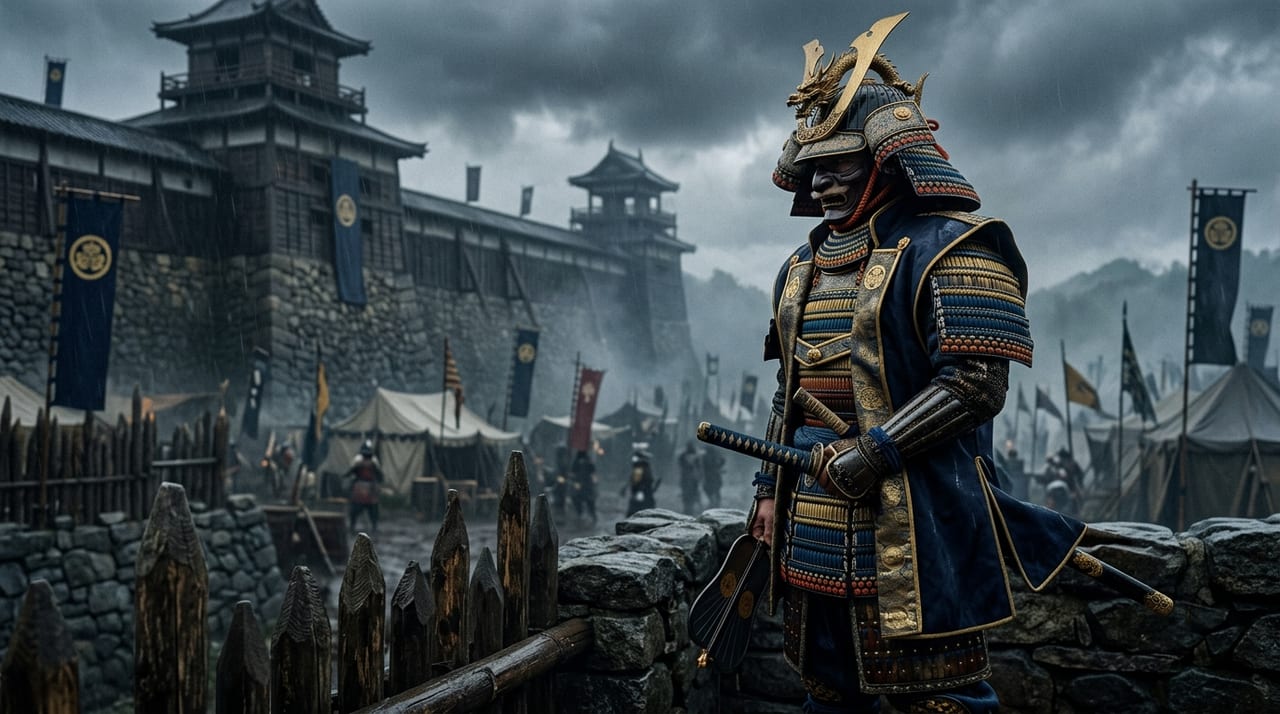
 * Image is for illustrative purposes only.
Sakuma Nobumori
佐久間信盛
Senior Elder of Oda Nobunaga, Supreme Commander of the Siege of the Hongan-ji
Description
Sakuma Nobumori (1528–1582) was a military commander who, as a senior vassal of the Oda house, supported Nobunaga for many years. In his later years, however, Nobunaga presented him with a harsh letter of rebuke, the letter of reprimand (sekkanjō), and he was expelled to Mount Kōya, meeting a turbulent end. The letter of reprimand, which thoroughly pointed out the meagerness of his military achievements, is still noted today as a historical document revealing the severe master–retainer relationship under Nobunaga.
Nobumori was a senior vassal of the Oda house, a native of Owari Province (present-day Aichi Prefecture), and had served Nobunaga since his youth. He took part in the Battle of Okehazama (1560) and remained active in campaigns across the country afterward. In particular, in the war against the Hongan-ji he served as commander-in-chief for a long period, keeping Ishiyama Hongan-ji (in the vicinity of present-day Osaka Castle) under blockade for many years. This was not a simple siege; it was a difficult war in which complex elements intertwined, from the management of naval forces and supply routes to diplomacy with the various daimyō. Nevertheless, Nobumori carried this burden for just over four years, from Tenshō 4 (1576).
In Tenshō 8 (1580), Nobunaga suddenly sent Nobumori and his eldest son, Sakuma Nobuhide, a letter of reprimand (sekkanjō) consisting of nineteen articles. Its contents listed in detail that, despite five years of campaigning, he had failed to take the Hongan-ji; that he showed no strategic initiative; that he had failed to recruit capable retainers; and so on. It thoroughly denounced his incompetence as a vassal. Nobumori and his son were immediately expelled and withdrew to Mount Kōya. Nobumori was never pardoned, and in the first month of Tenshō 10 (1582) he died in Kumano in Kii Province or on Mount Kōya. He was 55 years old.
In connection with Japanese swords, it is said that in the attack on Nagashima Ikkō-ikki in Tenshō 2 (1574), he forced his way across at the Matsunoki ferry crossing and cut down many ikki fighters from horseback. He was also skilled at commanding the rearguard in retreats, and was celebrated as “Sakuma of the retreat.”