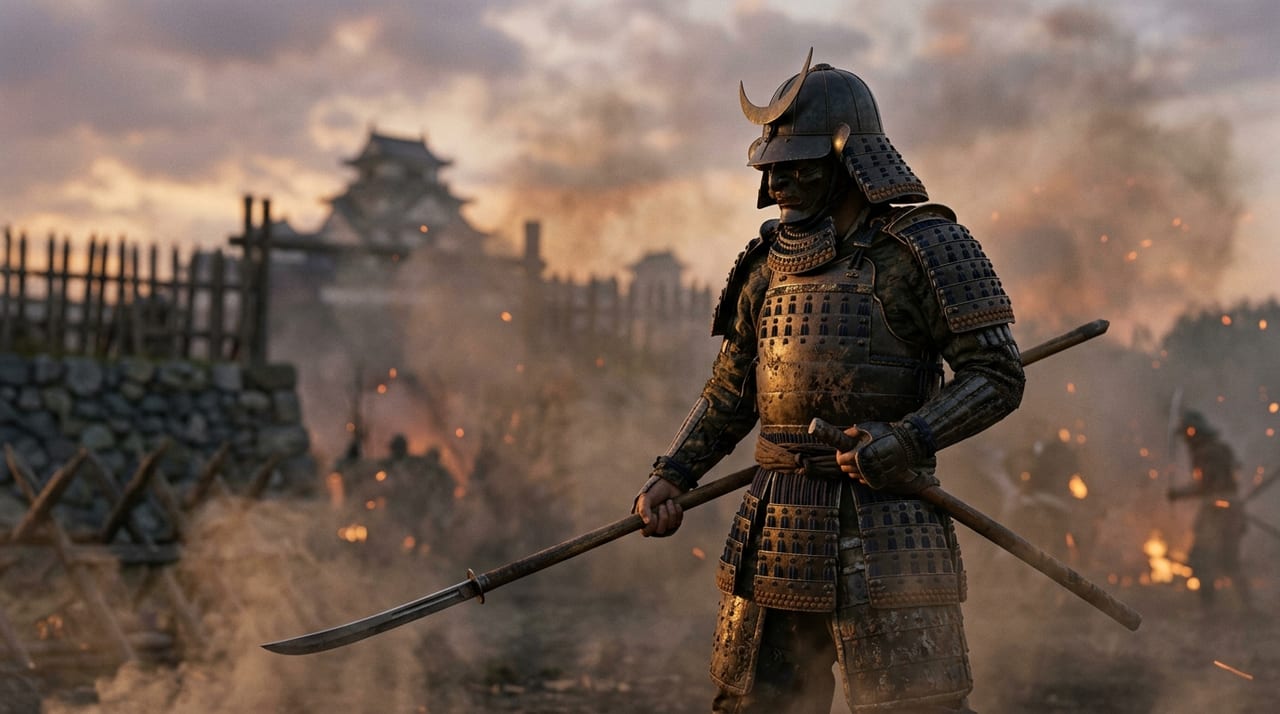
 * Image is for illustrative purposes only.
Shimazu Toyohisa
島津豊久
Sekigahara's Rear Guard—The Satsuma Warrior Who Sacrificed His Life to Save His Uncle Yoshihiro
Description
Shimazu Toyohisa, the Fierce General of the Shimazu
Born in Genki 1 (1570) as a son of Shimazu Iehisa, Shimazu Toyohisa received rigorous martial training from childhood as a member of the Shimazu house of Satsuma, the most powerful warrior family in Kyūshū. His father, Iehisa, was a renowned commander who excelled at the distinctly Shimazu tactic of Tsurinobuse (luring the enemy in with a decoy and annihilating them by encirclement), and Toyohisa was a general with strategic skill who had received that instruction. Having taken part in numerous battles at a young age, he also fought valiantly under his uncle Yoshihiro in the Japanese invasions of Korea (the Bunroku–Keichō campaigns), which raised his martial reputation.
Fighting in the Korean Campaigns
During the Bunroku–Keichō campaigns (1592–98), Toyohisa went to the Korean Peninsula with Shimazu Yoshihiro and experienced many fierce battles. In Keichō 2 (1597), at the naval Battle of Chilcheollyang, he fought valiantly by leaping onto enemy ships. In the following year, Keichō 3 (1598), during the attack on Eonyang Castle, he rode out alone as a vanguard and, though wounded, took an enemy's head. For this he was given letters of commendation by Asano Yoshinaga and Katō Kiyomasa. Experience on the Korean battlefields refined Toyohisa into an even fiercer warrior and laid the groundwork for his final actions at Sekigahara.
The Battle of Sekigahara: The Shimazu's Predicament
On the 15th day of the 9th month of Keichō 5 (1600), at the Battle of Sekigahara, which decided the fate of the Toyotomi regime, the Shimazu army under Shimazu Yoshihiro joined the fighting on the Western Army's side (led by Ishida Mitsunari). After defeat for the Western Army became certain, Yoshihiro carried out an unorthodox maneuver known as the 'Shimazu no Nokiguchi,' breaking through the Eastern Army forces deployed ahead of him and withdrawing. Charging toward the Tokugawa army in front while retreating was a strategy beyond convention. The Eastern Army commanders, caught off guard by this unexpected move, were unable to pursue them sufficiently.
Death at the Rear Guard: Saving His Uncle
In the 'Shimazu no Nokiguchi,' Toyohisa volunteered to serve as the rear guard (shingari) for his uncle Yoshihiro. To halt the pursuit by the Eastern Army, Toyohisa led his men in repeated counterattacks, each one buying time for Yoshihiro's escape. On the retreat route along the Ise Kaidō, Toyohisa came under fierce assault from the Eastern Army. As many of his retainers were cut down one after another, he himself kept fighting despite serious wounds. Eventually, Toyohisa, his body spent from his wounds, either took his own life or died in battle, and that valiant rear guard made Yoshihiro's return possible. He was 31 years old. There are various accounts of Toyohisa's words and actions at the end, but his last stand has been carved into the history of the Shimazu family as the embodiment of the ultimate spirit of the Satsuma warrior: giving one's life for one's lord.
Samurai Ethos and Sword Culture of the Shimazu
As the most powerful warrior family in Kyūshū, the Shimazu of Satsuma developed their own samurai ethos, the gojū kyōiku. Gojū kyōiku was an age-based group training system and became the foundation for building the resilient minds and bodies of Satsuma warriors. Satsuma also had its own sword-smithing culture in swords, and in the Edo period swords known as Satsuma shintō were produced. Toyohisa himself received a letter of commendation and one tachi sword from Shimazu Tadatsune for his merit in the Shōnai no ran (Shōnai Rebellion).
Legacy and Commemoration
Shimazu Toyohisa's name has been passed down as one of the symbolic acts of the Japanese samurai spirit, as the rear guard of the 'Shimazu no Nokiguchi' at the Battle of Sekigahara. In recent years, his name has become widely known among younger generations through his portrayal as the protagonist of the manga and anime work Drifters (by Hirano Kōta). The short but brilliant life of Shimazu Toyohisa, who at only thirty-one years old gave his life for his lord, as an embodiment of a warrior's pure loyalty, continues to move people's hearts even today.