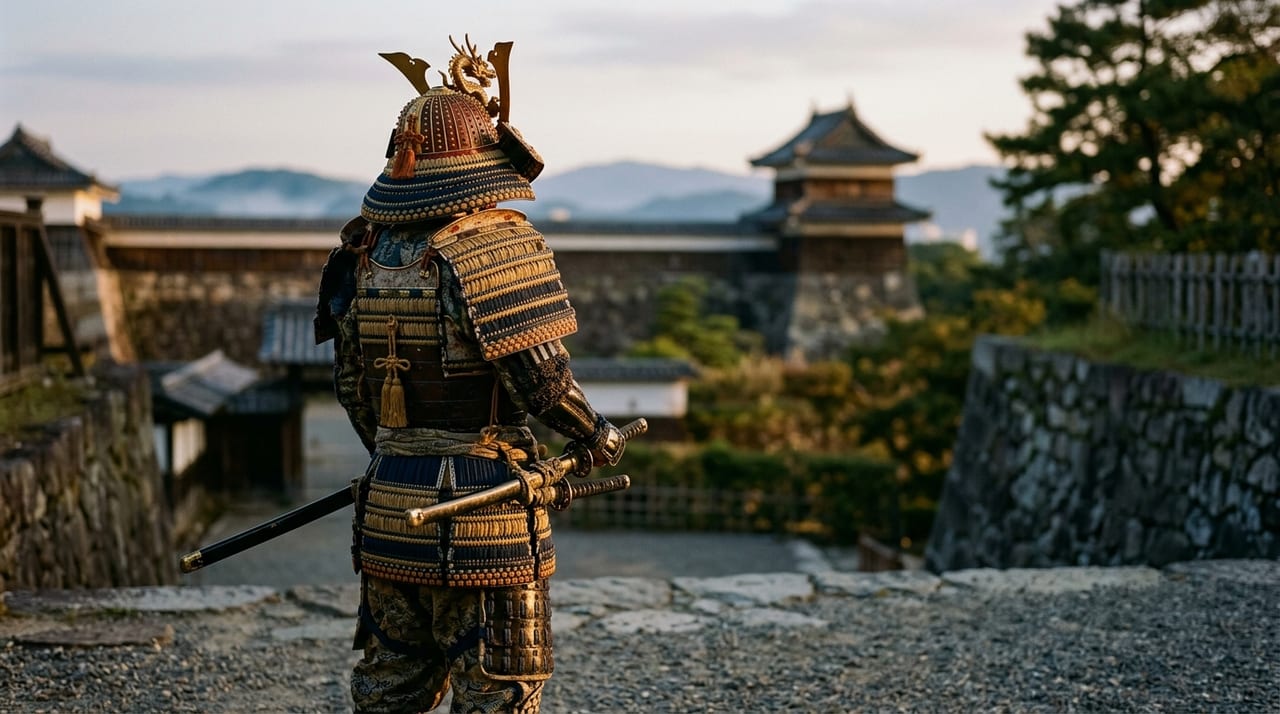
 * Image is for illustrative purposes only.
Ōta Dōkan
太田道灌
The Warlord of Edo Castle—Excelling in Poetry, He Carved Out Kanto's Supremacy with Sword and Brush as Chief Retainer of the Uesugi Ōgigayatsu Clan
Description
Warrior of Both Letters and Arms
In the 4th year of Eikyō (1432), Ōta Dōkan (personal name Sukenaga) was born as the eldest son of Ōta Sukekiyo, a senior retainer of the Ōgigayatsu Uesugi clan in Sagami Province. In the Kantō region of the late Muromachi period, he won fame as a warrior accomplished in both letters and arms. From youth he loved learning and acquired a cultivated education high enough to hold his own with the leading poets of his day in renga and waka. He also excelled in horsemanship, archery, and military strategy, and showed a distinctly outstanding military talent among the Kantō lords.
Construction of Edo Castle
In the 1st year of Chōroku (1457), Dōkan built the original form of Edo Castle on the upland of Edo Village in Toshima District, Musashi Province (present-day Chiyoda Ward, Tokyo). The site would later become the center of Japan's politics. The Edo Castle of that time was little more than a small fortress, but Dōkan saw the military and geographic value of the site and built a solid castle there. This decision thus came to provide the groundwork on which Tokugawa Ieyasu would establish the Edo shogunate a hundred and fifty years later. Based at Edo Castle, Dōkan analyzed the political and military situation of the Kantō keenly, and as a powerful figure of the Ōgigayatsu Uesugi house he skillfully navigated the complex power struggles with the Koga kubō and the Yamanouchi Uesugi clan.
The Anecdote of "Yamabuki-no-sato"
The anecdote of "Yamabuki-no-sato" is famous as a symbol of Dōkan's cultural refinement. One rainy day, while on a falconry outing, Dōkan asked a farmhouse for a rain cape (mino), and a young woman silently offered him a single branch of yamabuki flowers. Dōkan returned without understanding the meaning. When he asked his retainers, he learned that the woman had quoted an old poem: "Nanae yae / hana wa sakedomo / yamabuki no / mi no hitotsu da ni / naki zo kanashiki," which says that although the yamabuki blooms in seven and eight layers, it bears not a single seed, and that this is sad. The poem is a wordplay: its seed (mi) and the word for rain cape (mino) sound alike, so it apologized for a poverty so deep that one could not even provide a rain cape. Feeling shamed by this cultured young woman, Dōkan is said to have studied waka deeply from then on. The anecdote is still told today as an illustration of a warrior's cultural humility.
Military Achievements
Dōkan's military talent was displayed in many battles. In the 8th year of Bunmei (1476), the Nagao Kageharu Rebellion broke out, and he defeated the main forces of the rebels one after another in various places, establishing the hegemony of the Ōgigayatsu Uesugi house in the Kantō. Dōkan's tactics skillfully combined surprise attacks, flanking maneuvers, and the division of enemy forces. He was a warrior with a sense of military strategy that might be called modern, thoroughly aware of the importance of using terrain and gathering intelligence. He also devoted himself to the improvement of castles across the Kantō, including Kawagoe Castle and Iwatsuki Castle, and contributed greatly to building a defensive network.
Swords and the Essence of Martial Arts
Dōkan set up an archery range within Edo Castle where his soldiers trained daily. Those who slacked off were fined, and the money was used for the soldiers' tea. In terms of swords, even in the Kantō of the late Muromachi period there were active smiths who followed the Sōshū-den tradition, which traces its lineage to Shintōgo Kunimitsu of the late Kamakura period as its effective founder.
Assassination and Tragic End
In the 7th month of Bunmei 18 (1486), Dōkan was invited by his lord, Ōgigayatsu Uesugi Sadamasa, who had long feared his power, to his residence at Kasuya in Sagami Province. After he bathed, he was attacked as he came out of the bath and was murdered. He was 55 years old. It is said that as the assassins' blades closed in, Dōkan cried "Tōhō metsubō" ("our house is doomed") and died. Because this phrase seemed to foretell the start of the decline of the Ōgigayatsu Uesugi clan, it was widely passed down to later generations. Indeed, after Dōkan's death the Ōgigayatsu Uesugi clan was abandoned by many local lords (kokujin) and quickly fell into distress. Through the Chōkyō Disturbance with the Yamanouchi Uesugi clan, it eventually declined in the face of the rise of the Hōjō, which proved how great Dōkan's presence had been.
Influence on Later Generations and the Foundation of Edo
After Dōkan's death, Edo Castle passed through the hands of various warlords and came into the possession of Tokugawa Ieyasu. It has remained the center of Tokyo, the capital of Japan, to the present day. The foundation of Edo that Dōkan laid came to have a historical significance greater than he had imagined. Today, statues of Dōkan stand at the Tokyo International Forum (Chiyoda Ward, Tokyo) and in front of Nippori Station (Arakawa Ward, Tokyo), conveying his achievements as a pioneer of Edo to later generations. The way of life of Dōkan, who embodied the ideal of mastery of both letters and arms, continues to live on today as a spiritual model for the Japanese people.