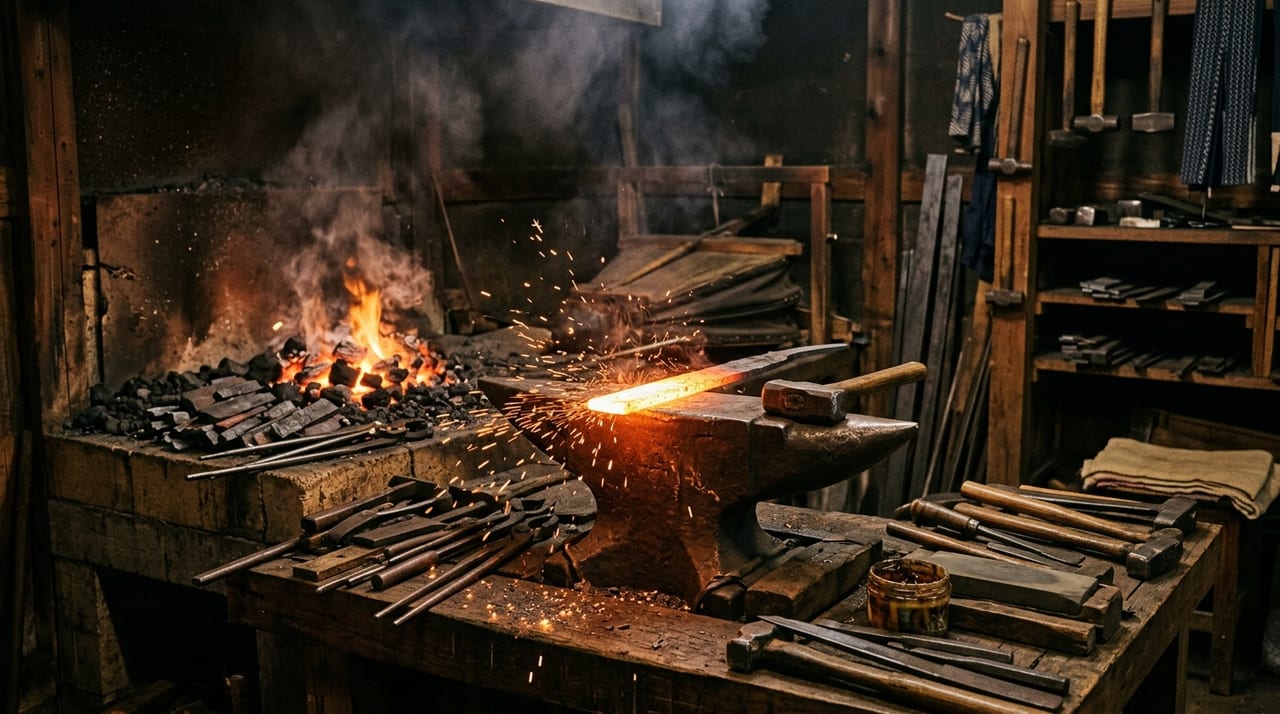
 * Image is for illustrative purposes only.
Tsunahiro
綱広
Description
Tsunahiro was a swordsmith active in Odawara, Sagami Province (present-day Kanagawa Prefecture), during the late Muromachi period, belonging to the Sue-Sōshū (Odawara Sōshū) tradition. His original name was Masahiro. It is said that he was summoned by Hōjō Ujitsuna, forged swords in Odawara, and, after receiving the character “tsuna” from Ujitsuna, changed his name to Tsunahiro. The Tsunahiro family continued the same name until the late Edo (bakumatsu) period. He is known as a smith who forged practical battle swords under the Hōjō clan and established the style of the Sue-Sōshū in the Odawara area.
Tsunahiro's swords are characterized by a forceful, practical finish typical of the Sue-Sōshū. The jigane shows well-forged itame-hada that stands out, with a moist-looking ground and ji-nie typical of the Sōshū tradition. The hamon is mainly nie-deki, consisting of gunome mixed with notare, and the bright nie gives a powerful impression. His swords, as battle swords of the Sengoku period, combine the sturdiness needed for actual combat with the richness of appearance inherited from the Sōshū tradition, and this well shows the individuality of Tsunahiro as a Sue-Sōshū smith.
Signed works by Tsunahiro are known, bearing the inscriptions “Tsunahiro” or “Sōshū jū Tsunahiro,” and the calligraphy of the signatures conveys vigor and a plain, unadorned dignity. In works in the uchigatana form, the highlights are the combination of itame-hada jigane with gunome and notare hamon, while the blade has dimensions and kasane suited to practical wear by samurai. Both the demand for practical swords in the Sengoku era and the aesthetic of the Sōshū tradition are conveyed through them.
The Tsunahiro family continued the name across generations after the first Tsunahiro and carried on the Sue-Sōshū (Odawara Sōshū) lineage until the late Edo period. Established under the Hōjō clan, based in Odawara, this line supplied battle swords in the Kantō region during the Sengoku period and came to embody the regional development of the Sōshū tradition. Successive Tsunahiro, while inheriting the style of the first, made swords responding to the demands of their own times.
Tsunahiro's works are valued as important sources for understanding the style of the Sue-Sōshū (Odawara Sōshū) and the sword culture of the Kantō in the Sengoku period. In studies of the Odawara Sōshū lineage, Tsunahiro's existence is also noted as a key to clarifying the process by which the Sōshū tradition, developed under the Hōjō clan, was passed on.
Famous Works
- Katana, signed Tsunahiro