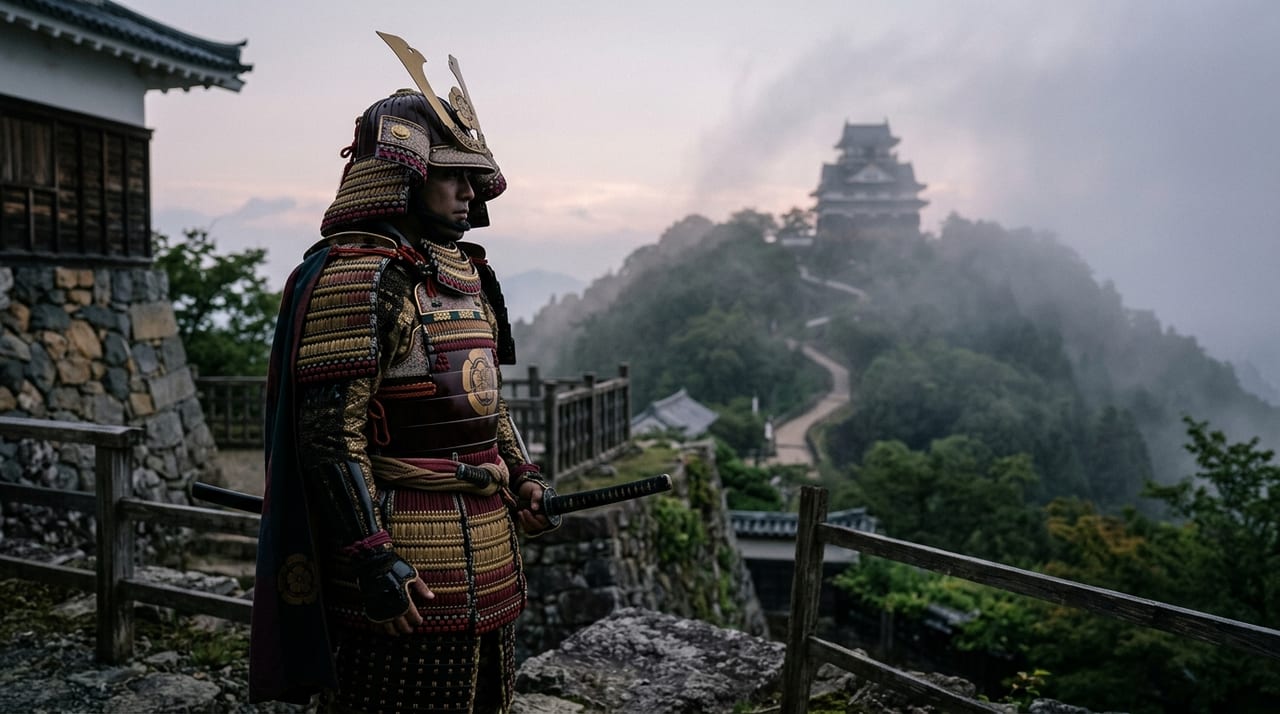
 * Image is for illustrative purposes only.
Rokkaku Yoshikata
六角義賢
Shugo Daimyo of Southern Ōmi, Lord of Kannonji Castle, Jōtei
Description
Life and Origins
Rokkaku Yoshikata was born in Daiei 1 (1521) as the eldest son of Rokkaku Sadayori, shugo (provincial governor) of Ōmi Province. The Rokkaku clan was a prominent shugo house of Ōmi descended from the Sasaki clan of the Uda Genji. When his father died in Tenbun 21 (1552), Yoshikata succeeded to the headship and became the 15th head of the Rokkaku clan. He received a character from the name of the 12th shogun, Ashikaga Yoshiharu, and took the name “Yoshikata.” He later styled himself “Jōtei.”
Peak and Turning Point of the Rokkaku Clan
When Yoshikata first succeeded to the headship, the Rokkaku clan was a powerful daimyō centered on southern Ōmi, with influence extending to Ōmi and Iga. Yoshikata supported the shogun Ashikaga Yoshiteru and was deeply involved in the politics of the Kinai region, where he was in conflict with Miyoshi Nagayoshi. However, the turning point came with his heavy defeat to Azai Nagamasa at the Battle of Norada in Eiroku 3 (1560). After this defeat, the Azai clan strengthened its tendency toward independence from the Rokkaku, and the former relationship of subordination was reversed.
House Code and the Rokkaku-shi Shikimoku
One of the important legacies of Yoshikata's era is the Rokkaku-shi Shikimoku, enacted in Eiroku 10 (1567). It was the house code (domain law, bunkokuhō) of the Rokkaku clan, a written codification of matters such as the protection of retainers' rights, the litigation system, and landholding disputes. It is historically highly regarded as a legal document of a Sengoku daimyō. The fact that retainers were permitted to take part in drafting its articles is noted as a feature of how order within a Sengoku daimyō's house was structured.
The Anti-Nobunaga Coalition and Resistance
In the 9th month of Eiroku 11 (1568), when Oda Nobunaga, who had Ashikaga Yoshiaki with him, marched up to Kyoto, Yoshikata and his eldest son Rokkaku Yoshiharu refused Nobunaga's request for military service and fought. However, they were heavily defeated at the Battle of Kannonji Castle, abandoned Kannonji Castle, and fled to Kōka District. This defeat and withdrawal effectively ended the Rokkaku clan's standing as a Sengoku daimyō. Afterward, Yoshikata continued guerrilla-style resistance in various regions from Genki 1 (1570) to Tenshō 1 (1573) as a member of the anti-Nobunaga coalition, but he was isolated after the fall of the Asakura and Azai clans.
Later Years and Cultural Activities
Afterward, Yoshikata submitted to Toyotomi Hideyoshi and served him as an otogishū (companion-adviser). He was known as a master of both archery and horsemanship. His son Yoshiharu also served Toyotomi Hideyori as an archery instructor, so the martial and cultural traditions of the Rokkaku house continued. Yoshikata died at the age of 78 on the 14th day of the 3rd month of Keichō 3 (1598), several months before the death of Toyotomi Hideyoshi, who had become the ruler of the realm.
Legacy and Assessment
Rokkaku Yoshikata is remembered in history as a ruler who, although his military standing declined as a Sengoku daimyō, was involved in enacting the advanced domain law (bunkokuhō) known as the Rokkaku-shi Shikimoku. His long life in his later years and his career as an otogishū also show one aspect of a daimyō who survived the turbulent currents of the Sengoku period.