Gekken Kōgyō and the Dai-Nippon Butokukai — How Kenjutsu Survived the Sword Abolishment Edict
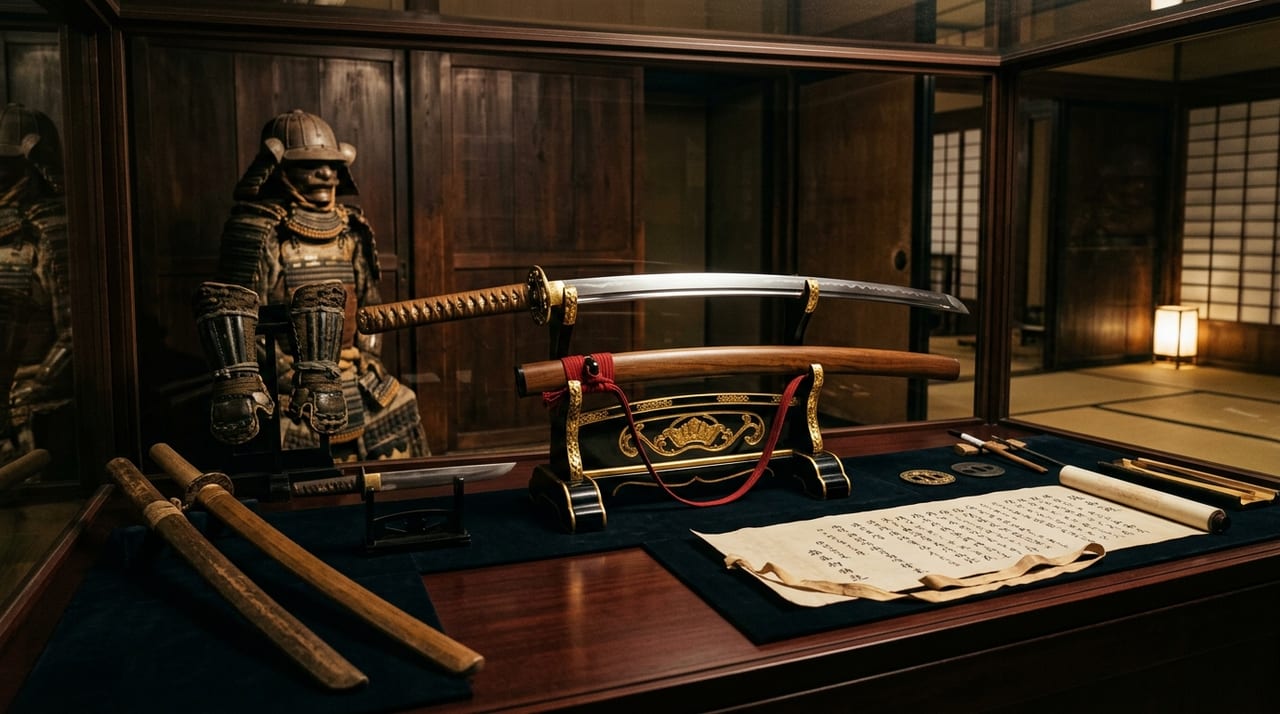 * Image is for illustrative purposes only.
Table of Contents
The Haitōrei and the Loss of Kenjutsu's Livelihood
The Sword Abolishment Edict (Haitōrei) of Meiji 9 (1876) legally abolished the samurai's privilege of wearing swords. But the reality it forced upon people went further than that. Town dojos, which had numbered in the hundreds throughout the country during the Edo period, lost their entire customer base — the samurai who came to train — and many kenjutsu practitioners were deprived of their means of earning a living. In a society where wearing a sword had been severed from everyday life, there was a growing atmosphere in which kenjutsu itself risked being treated as something unnecessary.
That same year of Meiji 9, the stipends paid to samurai families were also cut off through the abolition of hereditary stipends (chitsuroku shobun), and the plight of the former warrior class — who had simultaneously lost both the right to bear arms and their economic foundation — constituted a crisis of a scale that threatened the very survival of kenjutsu as an art. It is not difficult to imagine that the more a kenjutsu practitioner relied on teaching students as an instructor, the more acutely they faced the failure of their dojo's operations.
In the midst of this crisis, there emerged a person who devised a scheme to open kenjutsu to the general public as a form of entertainment and generate revenue for the performers. That person was Sakakibara Kenkichi, the last instructor at the Tokugawa shogunate's Kobusho training institute.
Gekken Kōgyō — Kenjutsu as Spectacle Saves the Dojos
In April of Meiji 6 (1873), Sakakibara Kenkichi staged a "gekken-kai" at Saemon-gashi outside Asakusa-mitsuke. The concept of charging admission to watch practitioners spar using shinai and protective armor was unusual by the standards of kenjutsu up to that point. Yet the initial ten-day run proved tremendously popular, and swordsmen who had been unemployed began organizing their own gekken-kai one after another. It is said that there were 37 venues in Tokyo alone, and the phenomenon spread to the provinces as well.
After the Haitōrei, Sakakibara is said to have devised a wooden sword called a "wajo" to replace the sword, and a wooden fan called a "gankosen" to replace the wakizashi. This anecdote reveals the ingenuity of a swordsman who, even when the wearing of swords itself was prohibited, refused to relinquish the techniques he had mastered in his body.
At the venues of the gekken kogyō, practitioners from different schools sparred with shinai and armor in public view. Techniques that had once been transmitted as secret traditions within master-disciple relationships or within the same school were now opened before the general public as spectacles that anyone could watch for the price of admission. This format is considered one of the source streams leading to the culture of competing in matches that later kendo would develop.
There was criticism at the time that the gekken kogyō had "degraded the martial arts into a money-making spectacle." However, the result was that these performances supported the livelihoods of impoverished kenjutsu practitioners and served as a bridge ensuring that techniques and dojo culture were passed on to the next generation without dying out.
The Dai-Nippon Butokukai — Birth of a Nationwide Organization Transcending Schools
While kenjutsu maintained its vital thread in the private sphere as spectacle, the momentum for state-sponsored promotion of the martial arts grew in the later Meiji period. With the backdrop of the commemorative projects marking the 1100th anniversary of the transfer of the capital to Heian-kyo and Japan's victory in the Sino-Japanese War, the Dai-Nippon Butokukai was established in Kyoto in April of Meiji 28 (1895). Prince Komatsu Akihito became the first president, and Watanabe Chiaki, the governor of Kyoto Prefecture, became the chairman.
The Dai-Nippon Butokukai was groundbreaking in the way it functioned as an integrating organization not affiliated with any particular school.
- It held an annual Butokusai Grand Martial Arts Demonstration (the predecessor of today's All-Japan Kendo Demonstration Tournament) and awarded the seirensho certificate to outstanding kenjutsu practitioners.
- It established branch offices in each prefecture and constructed dedicated training facilities called Butokuden throughout the country.
- It set up a martial arts teacher training institute (later the Martial Arts Vocational School) to systematically train instructors.
- It established the titles of hanshi, kyoshi, and renshi, along with rules for match officiating, laying the foundation for the dan ranking system that continues to this day.
In Taisho 8 (1919), the terms "kenjutsu" and "jujutsu" were renamed "kendo" and "judo" respectively, and the institutional transformation from martial arts focused on refining technique to a "way" (do) aimed at cultivating character was made explicit. What had during the era of the gekken kogyō been nothing more than a venue where individual swordsmen competed in their techniques as a spectacle was, through the work of the Dai-Nippon Butokukai, reorganized into an educational system equipped with a uniform nationwide ranking and examination structure — this process is clearly visible here.
Postwar Rupture and a New Start as a Competitive Sport
After the last war, the Dai-Nippon Butokukai was ordered to dissolve under the Allied Occupation, and kendo in school education was also temporarily banned. The martial arts were seen as militaristic training. Kenjutsu and kendo once again disappeared from the public sphere.
However, the techniques themselves were not lost. Those involved continued their practice under the name "shinai kyogi" (shinai competition), and later the All-Japan Kendo Federation was formed, giving kendo a new start as a competitive sport. The path by which the gekken kogyō overcame the crisis of the Haitōrei era, and the path by which kendo made its postwar restart, differ in their historical moment but look like repetitions of the same wisdom: "change the form in order to preserve the technique."
A Perspective for Appreciating Fine Swords
The artistic value of swords themselves and the history of kenjutsu as the technique for wielding them tend to be discussed separately, but they are in essence two wheels of the same culture. When appreciating a sword, knowing what crises the kenjutsu culture of the era when that sword was actually wielded went through in order to be transmitted to the present day adds further depth to the background of a single sword. Widening one's view beyond the shape of the blade and the koshirae (mounting) to include what kind of era the kenjutsu practitioners who wielded it lived through makes the story contained in a single sword come alive in three dimensions. Reading about this kind of peripheral history of sword culture together with the historical development of iai deepens one's understanding.