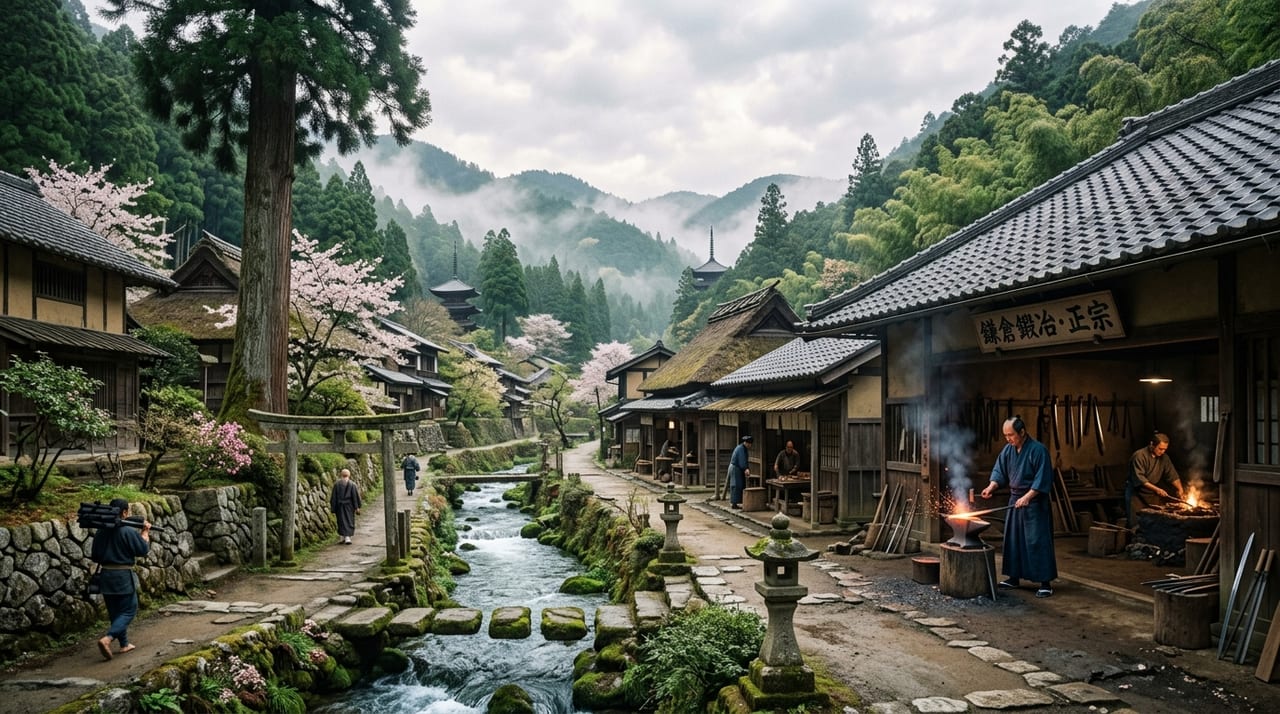
 * Image is for illustrative purposes only.
Rai School
来派
An elite Yamashiro school founded by Rai Kuniyuki, celebrated for finely forged ko-itame jigane and deeply nie-active suguha. It set the gold standard for refined Kyoto swordmaking throughout the Kamakura period.
Description
The Birth of the Rai School and the Mystery of the Character "Rai"
The Rai school was established in Yamashiro Province (present-day Kyoto Prefecture) in the mid-Kamakura period and is a prestigious sword-smithing lineage. Several theories exist regarding the origin of the school's name, "Rai." The most widely supported theory holds that the school's founder was a smith who arrived from the Korean Peninsula (Goryeo), as the Kanchi-in manuscript of the Meizukushi relates. Because the character "rai" has long meant "to arrive from abroad" (as in tōrai), the interpretation that the founder brought continental or peninsular techniques carries a degree of persuasiveness. On the other hand, some hold that the "Rai" in "Rai Kuniyuki" is merely part of the signature and does not indicate any special origin. In any case, the jigane and hamon of the Rai school possess distinctive technical characteristics that clearly set them apart from other Yamashiro smiths. Whatever their source, there is no doubt that the school achieved outstanding results that shine brilliantly in the history of Japanese swords in the mid-to-late Kamakura period. The Rai school produced many outstanding smiths, including Kuniyuki, Kunitoshi, Rai Kunitoshi, Rai Kunimitsu, Rai Kunitsugu, Mitsukane, and Ryōkai, and grew into a major lineage that branched into several regional groups, including the Enju school.
The Pinnacle of Jigane: The World of Ko-Itame
The jigane of the Rai school is characterized by a finely packed itame grain known as ko-itame, and well-refined steel presents a dense texture resembling the skin of a Japanese pear (nashiji). This ko-itame grain is the result of highly developed techniques of steel refining and folded forging, and it is a technical achievement that can only be realized through a large number of forging cycles and the use of high-quality tamahagane. Fine, evenly distributed ji-nie is present, and ji-kei and nie-utsuri are also visible. The beauty of this jigane is a visual hallmark representative of the Yamashiro tradition. When one observes a Rai Kunitoshi tachi with the naked eye, the hiraji (flat surface of the blade) gleams with a texture as fine as pear skin, and the view of the hamon's nie biting deeply into it possesses a sublime beauty that words cannot fully express. It differs from the brilliance of Bizen and the ruggedness of Sōshū; it is the pinnacle of ga, refined elegance, cultivated by the courtly culture of Kyoto.
Rai Kunitoshi: The Apex of the Rai School
Among the smiths of the Rai school, the most highly regarded is Rai Kunitoshi. Active in the late Kamakura period, Kunitoshi brought the ko-itame technique handed down since Rai Kuniyuki to perfection and further opened new frontiers in hamon. Kunitoshi's hamon is fundamentally suguha with deeply set ko-nie, but occasionally it shows variation through mixed ko-midare and ko-chōji, giving it a rich expression that avoids monotony. Within the hamon, kinsuji run through and sunagashi flow finely, unfolding an intricate scene; examining these point by point alone brings an appreciative experience that makes one forget the time. The bōshi (the hardened tip of the blade) mostly features ko-maru-gaeri, and this refined finish is common to the entire Rai school. Kunitoshi left masterpieces in both tachi and tantō, and many of his extant signed works have been designated National Treasures or Important Cultural Properties. The calligraphy of his signature is fluid and graceful, and since false signatures are not uncommon, careful authentication is necessary.
The Style of Rai Kunimitsu
Rai Kunimitsu is considered to have been a son or disciple of Rai Kunitoshi, and he was active from the late Kamakura period into the Nanboku-chō period. While inheriting his teacher's style, Kunimitsu produced many swords of somewhat broader and more powerful build, and he also left bold works reflecting the spirit of the war-torn Nanboku-chō period. Many of Kunimitsu's hamon combine suguha with gunome-midare, and they demonstrate the breadth of his flexible range, incorporating influences from the Sōshū tradition. Kunimitsu is also especially noted for many outstanding tantō, and works that masterfully embody the tantō styles of the late Kamakura period, with shallow uchizori (inward curvature) or hira-zukuri (flat-sided construction), are known. In comparison with Awataguchi Yoshimitsu, Kunimitsu's tantō are said to fall slightly short in the fineness of their jigane, yet they are regarded as showing a distinctive achievement in the free, expansive character of their hamon.
Kyoto as a Cultural Milieu
Behind the Rai school's development as the pinnacle of the Yamashiro tradition lay the cultural and economic wealth of Kyoto as a city. The aesthetic discernment accumulated by courtly culture since the Heian period, together with the practical demand generated by the Kamakura warrior government, gave Rai swords the rare value of "the coexistence of dignity and capability." Rai smiths often received commissions directly from the imperial court, the nobility, and powerful warrior households, which placed them in an advantageous position to obtain the finest-quality tamahagane. Furthermore, by establishing themselves in Kyoto, a hub of information, they were able to quickly perceive developments in other traditions such as Bizen, Yamato, and Sōshū, and they possessed the flexibility to adopt techniques as needed.
Collecting Value and the Present Day
Among signed Rai works, many authentic pieces by Rai Kunitoshi and Rai Kuniyuki have come down as National Treasures or Important Cultural Properties in museums, shrines and temples. Swords bearing a "Rai" signature that circulate in the private market are often false signatures or later-added signatures (oikoku-mei), so acquiring a genuine Rai work requires a high level of connoisseurship and an authentication certificate from a trustworthy specialist institution. On the other hand, unsigned works bearing the kiwame (authentication attribution) "Rai Kunitoshi" or "Rai Kunimitsu," which have received the Special Important Sword designation from the Nihon Bijutsu Tōken Hozon Kyōkai (NBTHK), a public interest foundation, are accorded the highest valuation in the sword market. Owning a Rai sword means possessing a portion of the supreme cultural achievement that Kyoto produced during the Kamakura period, and even a single example in a sword collection fundamentally changes the depth of the collection.
Characteristics of This Era
- Dense ko-itame ji-gane (base steel) — a fine, tightly forged hada reminiscent of nashiji (pear skin), where ji-nie and ji-kei appear and nie-utsuri stands out; this distinctive beauty is the supreme expression of the Yamashiro tradition
- Suguha with deep ko-nie, sometimes mixing ko-midare or ko-chōji — refined and dignified
- Ko-maru kaeri (small round turn) in the bōshi — shared trait across the school
- Fine kinsuji and sunagashi in the hamon — intricate activity visible on close inspection