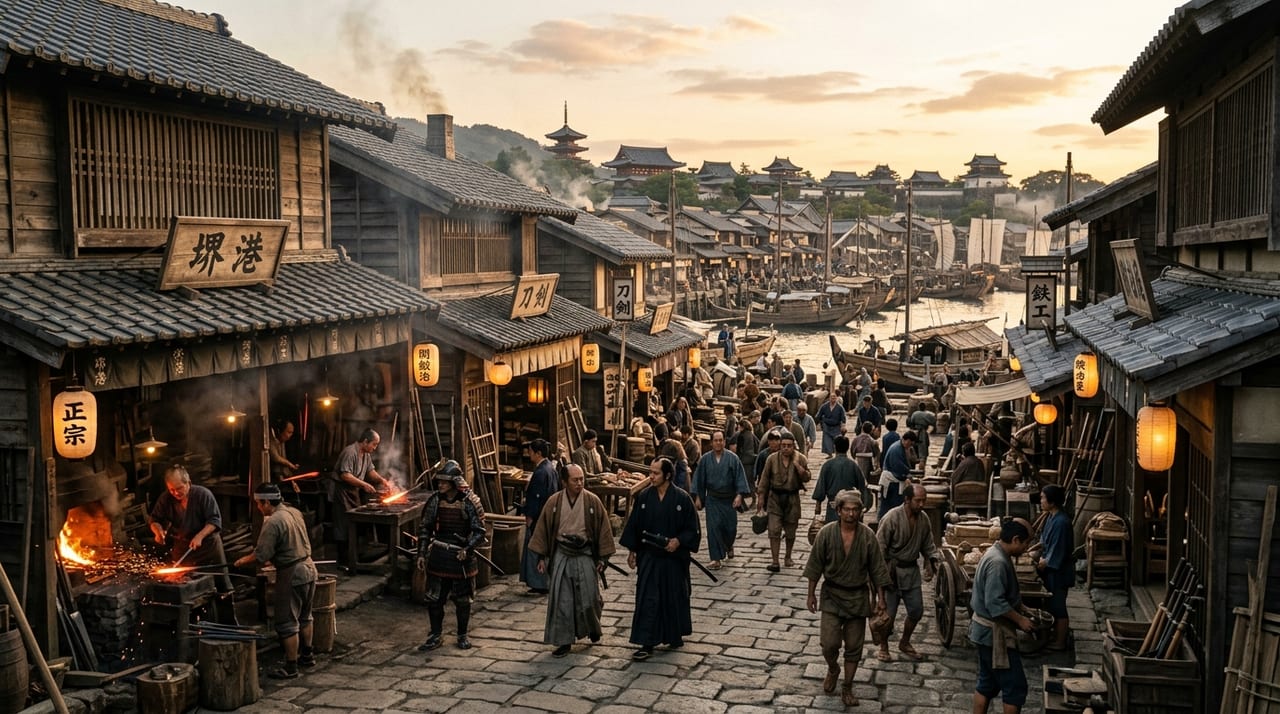
 * Image is for illustrative purposes only.
The Arrival of Firearms and the Transformation of Sword Culture
鉄砲伝来と刀剣文化の変容
The 1543 arrival of firearms in Japan drove the reinforcement of armor, which in turn reshaped sword design toward wider, thicker, two-handed blades with larger points. Following the 1575 Battle of Nagashino, firearms-centered tactics came to dominate the battlefield, while swords endured as a close-combat backup weapon and a mark of samurai status.
Description
In 1543, Portuguese traders arrived at Tanegashima and introduced the matchlock harquebus to Japan. Within a few years the weapon was being domestically reproduced and mass-produced, transforming both battlefield tactics and the design of arms and armor across the Sengoku period. The Japanese sword, too, was pushed to change in both form and battlefield role by the arrival of this new weapon.
Introduction and Domestic Production
After the lord of Tanegashima purchased matchlocks from the Portuguese and had local smiths study their manufacture, production centers such as Sakai, Negoro, and Kunitomo rapidly began reproducing and mass-producing firearms. By the Eiroku-Tenshō era, matchlocks had become indispensable to the armies of the sengoku daimyo, prized as weapons that allowed large numbers of foot soldiers (ashigaru) to be mobilized and deployed in coordinated volleys.
Armor Reinforcement and Changing Sword Form
To counter the power of firearms, armor such as the tōsei gusoku was reinforced with thicker plates. Swords changed in response: rather than the one-handed grip typical of earlier tachi, blades increasingly came to be wielded two-handed, with a wider mihaba, thicker kasane, and a larger kissaki (ō-kissaki) — features suited to delivering greater striking force and to penetrating gaps in reinforced armor.
The Battle of Nagashino and the Shift in Tactics
The 1575 Battle of Nagashino is widely regarded as the moment that demonstrated how coordinated volley fire could decide the outcome of a battle. The traditional warrior virtues of being "tall, large, and fast" no longer guaranteed victory; tactics centered on sustained, organized musket fire came to dominate.
The Enduring Role of the Sword
Even as firearms and long spears (yari) took the leading role on the battlefield, the sword retained an important social function as a close-combat backup weapon and as a mark of samurai status. Swords mass-produced to meet the era's rising demand — known as kazuuchimono — were forged in a practical, battle-ready style and circulated widely across the provinces.
Characteristics of This Era
- 1543 arrival of firearms and rapid domestic production
- Sword form changing alongside armor reinforcement
- Emergence of wider, thicker blades with large kissaki
- Tactical shift demonstrated at the 1575 Battle of Nagashino
- Swords enduring as close-combat and status weapons