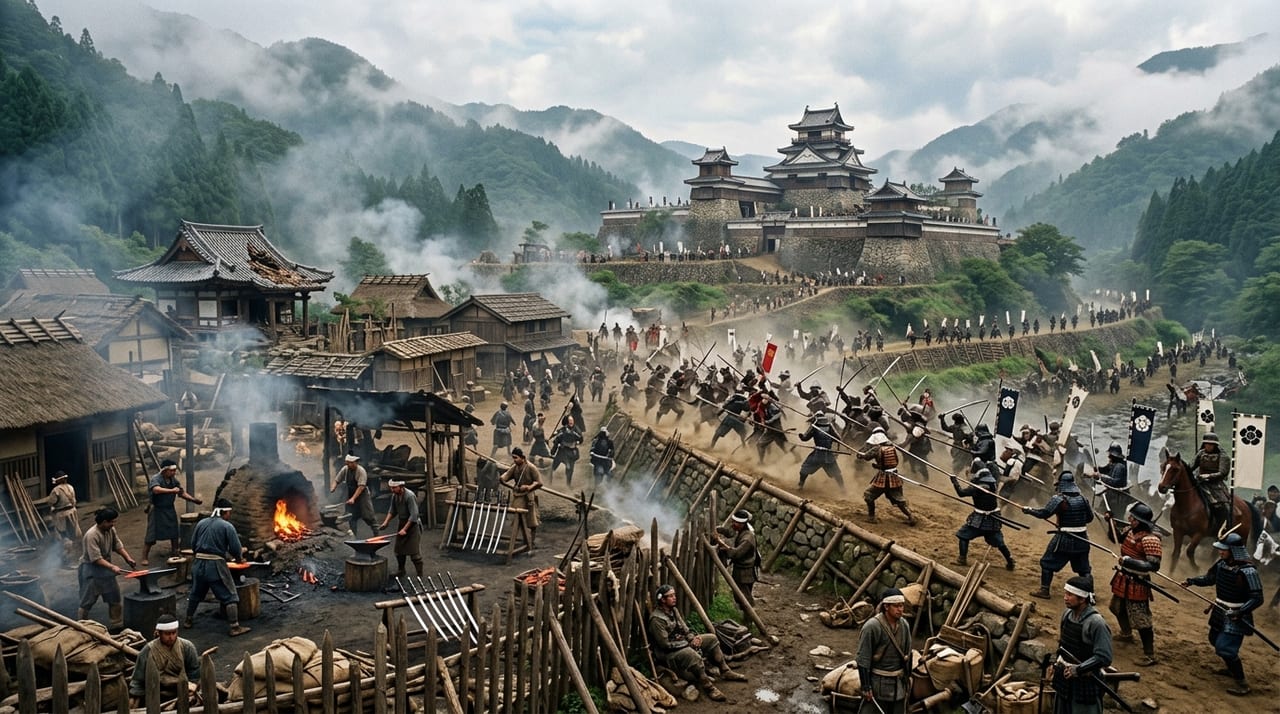
 * Image is for illustrative purposes only.
Eisho Era
永正(えいしょう)
The era name between Bunki and Daiei, during which mass production of kazu-uchimono accelerated in Mino and Bizen, and later-renowned smiths such as the second-generation Kanemoto ("Magoroku") rose to prominence.
Description
Historical Background
Eishō was the era name following Bunki and preceding Daiei, used from 1504 to 1521 during the reign of Emperor Go-Kashiwabara and the times of the 10th Muromachi shogunate shogun Ashikaga Yoshitane and the 11th shogun Ashikaga Yoshizumi. It falls within the early Sengoku period, when the turmoil that followed the Onin War continued, shogunal authority had become hollow, and provincial shugo daimyo and local warlords held effective control of their domains. Amid this political disorder, demand for practical battlefield swords rose still further across the country.
Characteristics of the Blades
The Eishō era was a period in which the production of standardized mass-produced blades known as kazu-uchimono accelerated further, centered on Mino and Bizen, and regional stylistic conventions became increasingly established. In the Bizen Osafune school, alongside mass production, custom-ordered blades forged with elaborate skill by renowned smiths also coexisted. In Mino, a distinctive forging method later called "shihozume" was taking shape, and during this period the groundwork was laid for the reputation these blades would build as practical swords that would neither break nor bend and could still cut.
Representative Smiths
In Mino, the second-generation Kanemoto (later known as "Magoroku Kanemoto," commonly called "Seki no Magoroku") is said to have trained under First Kanesada around the Eishō era, and to have formed a sworn brotherhood with the second-generation Kanesada (Izumi no Kami Kanesada, known as "Koresada"), the son of First Kanesada. In the Bizen Osafune school, smiths such as Katsumitsu and Sukesada were active, and blades dated to the Eishō era also survive.
Social Context
The Eishō period was an era in which the gekokujo trend that followed the Onin War took full hold, and Sengoku daimyo across the country consolidated their domains through their own strength. Reliability in actual combat came to determine the value of a blade, and smiths who honed their craft in this period, such as the second-generation Kanemoto, later counted among the saijō ōwazamono, laid the foundation for the immense trust that warlords placed in them throughout the Sengoku period.
Characteristics of This Era
- In Mino and Bizen, mass production of kazu-uchimono accelerated further, and regional stylistic conventions became increasingly established
- In the Bizen Osafune school, custom-ordered blades by renowned smiths were also made alongside the mass production of kazu-uchimono
- In Mino, the groundwork was formed for a distinctive forging method that led to what would later be called "shihozume"