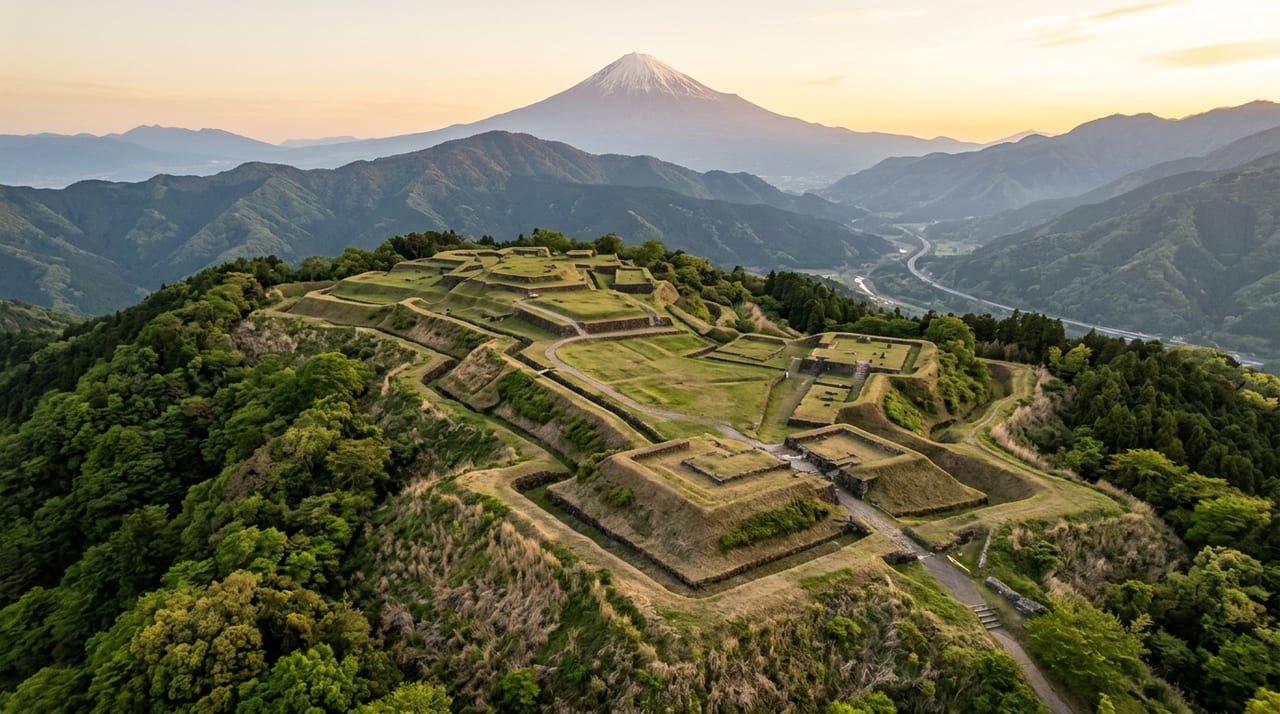
 * Image is for illustrative purposes only.
Kurushima Jin'ya
久留島陣屋
Kurushima Jin'ya is a historic castle in the Kyūshū region (The jin'ya was established around 1601 when Kurushima Nagachika (Yasuchika) entered Bungo Mori domain; the Kurushima clan then governed the 14,000-koku Bungo Mori domain for twelve generations and 270 years until the Meiji Restoration). Its lord was Kurushima clan (of the Kurushima naval force) — lords of the Bungo Mori domain.
Overview
Kurushima Jin'ya (also known as Mori Jin'ya, or the Bungo Mori domain administrative compound) is a well-preserved Edo-period administrative complex located in the Mori district of Kusu Town, Oita Prefecture. It served as the seat of governance for the Kurushima clan—descendants of the Kurushima naval force of the Seto Inland Sea—who ruled the Bungo Mori domain (14,000 koku) for approximately 270 years. The ruins of the jin'ya and samurai residences remain intact today. The garden constructed at the jin'ya site is designated a National Scenic Beauty, the "Former Kurushima Clan Garden," and offers visitors a serene historic atmosphere surrounded by the mountains of the Kyushu range.
The Kurushima clan originated in medieval Iyo Province (Ehime Prefecture). As one of the houses of the Murakami naval forces (the Kurushima Murakami), the Kurushima family controlled the Kurushima Strait in the Seto Inland Sea (off Imabari City) and commanded one of western Japan's foremost naval forces during the Sengoku period. Kurushima Michifusa (1561–1597) is particularly renowned for his service in Toyotomi Hideyoshi's Bunroku and Keicho campaigns in Korea, where he distinguished himself as a naval commander. In the Battle of Sekigahara (1600), however, the clan sided with the western forces (Ishida Mitsunari faction), bringing them to the brink of confiscation. Michifusa's son, Kurushima Nagachika (later called Yasuchika), who had sided with the Western army, lost his domain, but through the intercession of Fukushima Masanori, his wife's uncle, he was granted 14,000 koku at Mori in Kusu District, Bungo Province, in Keichō 6 (1601), where he established the jin'ya.
Bungo Mori, a small domain of 14,000 koku below the castle-building threshold, was governed through a jin'ya (administrative compound) rather than a fortified castle with a main tower. In Genna 2 (1616), under the second lord Michiharu, the family changed the writing of its name (from 来島 to 久留島, both read "Kurushima"), and it administered the domain through twelve generations spanning 270 years. The eighth lord, Kurushima Michihiro, pursued domain reforms, founded the domain school Shūshinsha, and rebuilt the Mishima Shrine within the jin'ya so that it resembled a castle.
The jin'ya ruins are well-preserved today, with earthworks, stone walls, gate ruins, and samurai residence remains surviving in good condition. Particularly significant is the garden at the jin'ya site, which is designated a National Scenic Beauty, the "Former Kurushima Clan Garden," and represents one of Kyushu's rare intact jin'ya-type warrior compound groupings, possessing considerable scholarly value. The jin'ya site (Mishima Park) is also home to the Kurushima Takehiko Memorial Museum, honouring the children's author Kurushima Takehiko, a descendant of the Kurushima family. Kusu Town is also known for the distinctive mesa topography of Mount Kirikabuyama, making the jin'ya ruins part of an integrated natural and historical landscape of Bungo.
Connection to Swords
Kurushima Jin'ya's connection to the Japanese sword can be read through the history of the Kurushima naval force and the sword tradition of Bungo Province (Ōita Prefecture). Kurushima Michifusa served as a naval commander in the Bunroku and Keichō campaigns and was killed in action during the Keichō campaign in Keichō 2 (1597). Bungo Province is known as the home of the renowned smith Bungo Yukihira, active from the end of the Heian period into the early Kamakura period. The Seihōrō pavilion that survives on the jin'ya site (an Ōita Prefecture Tangible Cultural Property) is said to have been built by the eighth lord, Kurushima Michihiro, as a stand-in for a castle keep when he rebuilt the Mishima Shrine, and it conveys the pride of a small domain whose lords were not permitted to hold a castle.
Highlights
- Former castle-town administrative center and samurai residence ruins (the old Kurushima clan garden is a nationally designated scenic site) — well-preserved earthen ramparts, stone walls, and gate remains representing some of Kyushu's finest examples of castle-town administrative center structures
- Kurushima Takehiko Memorial Museum — honouring the children's author Kurushima Takehiko, a descendant of the Kurushima family
- Seihōrō — a two-storey pavilion said to have been built by the eighth lord, Kurushima Michihiro, as a stand-in for a castle keep (Ōita Prefecture Tangible Cultural Property)
- Mishima Shrine (now Suehiro Shrine), associated with Kurushima Michihiro — given stone walls by the eighth lord so that it resembled a castle
- Bungo Mori Engine House Park — a combined tourist route featuring the adjacent Showa-era steam locomotive depot (registered tangible cultural property)
- Vista from Mount Kirikabu — overlooking the jin'ya ruins set against Kusu Town's distinctive mesa terrain, a spectacular scenic vista of Oita and the Kyushu Mountains
* Opening hours and admission fees are subject to change. Please check the official website before visiting.