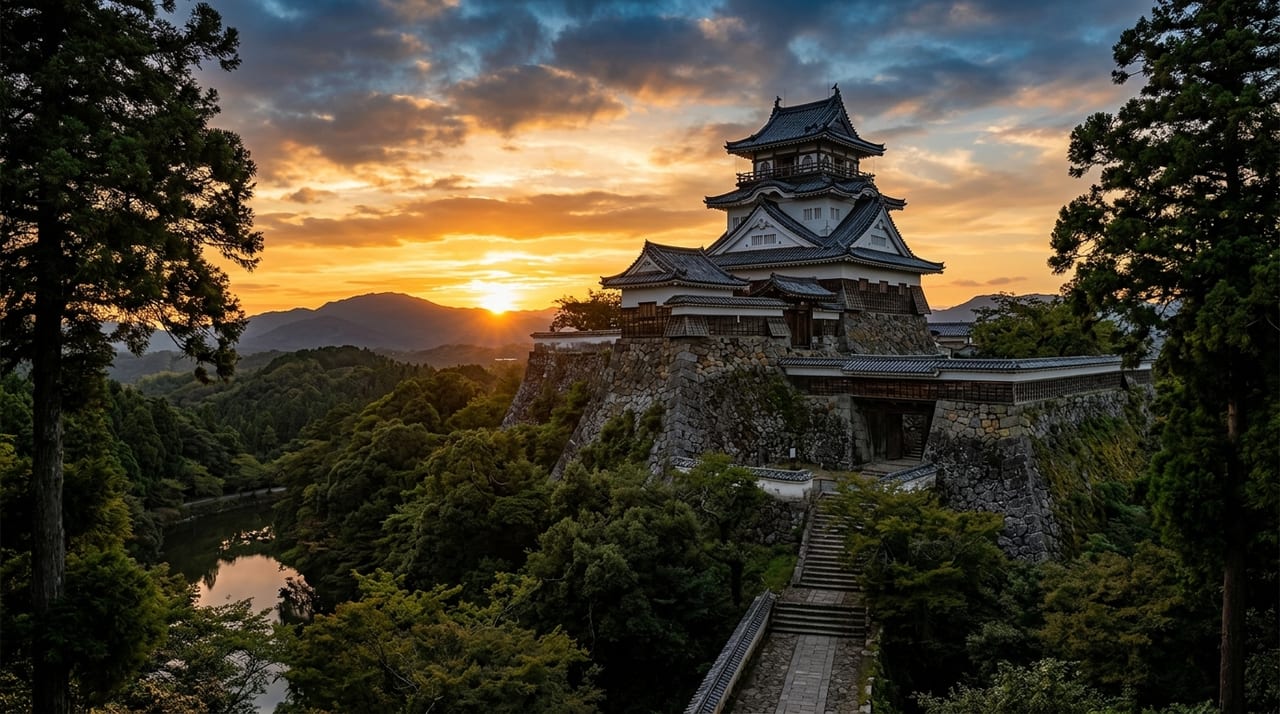
 * Image is for illustrative purposes only.
Obi Castle
飫肥城
Obi Castle is a historic castle in the Kyūshū region (Tensho 16 (1588): Entry of the Ito clan). Its lord was Itō Suketake.
Overview
About the Castle
Obi Castle is a hirayama-jō (a castle on low hills) located in Nichinan, Miyazaki Prefecture. It is a famous castle that developed throughout the Edo period as the center of a castle town known as the 'Little Kyoto of Kyūshū'. The castle's origins are said to date to the Nanboku-chō period, when it was built by the Tsuchimochi clan. During the Sengoku period it was a strategic point repeatedly contested between the powerful Itō clan of Hyūga and the Shimazu clan of Satsuma. In Tenshō 4 (1576) the Shimazu clan again brought it under their control. In Tenshō 16 (1588), Itō Suketake entered the castle with the support of Toyotomi Hideyoshi, and from then until the Meiji Restoration the Itō clan ruled the Obi Domain (51,000 koku) for 14 generations and 280 years.
Castle Town and Samurai Culture
The Itō clan's ancestors are traced back to Kudō Suketsune, a warrior of the Heian period, making them a prestigious house. The Itō clan of Hyūga had been a powerful samurai force in southern Kyūshū since the Kamakura period. During Toyotomi Hideyoshi's invasions of Korea (Imjin War, Bunroku-Keichō campaigns), Itō clan warriors also took part, and their combat experience against Korea and Ming had a distinctive influence on the samurai culture of Obi. The castle town of Obi has a structure in which samurai residences, merchant quarters, and temples and shrines form a single whole. Its historic townscape today draws tourists from across the country as the 'Little Kyoto of Kyūshū'. The stone walls from the Ōte-mon Gate to the honmaru, and the grounds where giant Obi cedars stand in rows, have a special charm. At the Obi Castle Town Festival (Obi Jōka Matsuri) in October, the Taihei-odori dance and parades enliven the town.
Obi Cedar and Economic Power
The economic base of the Obi Domain lay in Obi cedar forestry and shipbuilding. Obi cedar has excellent water resistance and rot resistance. During the Edo period, large quantities were shipped as boat timber from Aburatsu port, facing Hyūga-nada, to Ōsaka and Edo. This forestry income stabilized domain governance and was also used to develop educational facilities and promote martial arts. The domain's academy, the Shintokudō domain school, became the center of civil and martial education in the Nichinan area. In the late Bakumatsu period, Komura Jutarō (later foreign minister) studied there.
Komura Jutarō and the Meiji Legacy
Komura Jutarō was a Meiji-era diplomat who handled the negotiations for the Treaty of Portsmouth after the Russo-Japanese War, and he left his name in the history of Japan's modern diplomacy. As a land that nurtured such talent, Obi also holds an important place in the history of the late Edo and Meiji periods. The present Obi Castle ruins include the Ōte-mon Gate, the Honmaru ruins, and Matsuo-no-maru (a palace built based on historical research). The Obi Castle History Museum displays swords, armor, and old documents associated with the Itō family.
Swordsmiths of the Obi Domain
Kunihiro, born in Aya, Hyūga Province (later known as Horikawa Kunihiro), served the Itō clan. After his lord's house declined, he traveled through various provinces making swords. Later he was invited by Itō Suketake, who had regained Obi, and again served the Itō family. His disciple Inoue Kunisada (Izumi no Kami Kunisada), born in Kibana, Hyūga Province, and Kunisada's son Inoue Shinkai, who also served the Itō family, are known as swordsmiths of the Itō household.
Connection to Swords
Obi Castle and the sword culture of the Itō clan can be discussed through the swordsmiths who served the Itō family. Horikawa Kunihiro (Tanaka Kunihiro), said to be the founder of shintō (new swords), was born in Aya, Hyūga Province. He first served the Itō clan. When his lord's house declined during the Tenshō era, he traveled through various provinces making swords. Later he was invited by Itō Suketake, who had regained Obi, and again served the Itō family. His early works bear the inscription 'Nisshū Furuya-jū Kunihiro', and from around Keichō 4 (1599) he settled at Kyoto Ichijō Horikawa and was called the foremost figure in the shintō world. Inoue Kunisada (Izumi no Kami Kunisada), a disciple of Kunihiro born in Kibana, Hyūga Province, received the title Izumi no Kami and, declining an invitation from the Hosokawa clan of Higo, served the Itō family as a retainer. His son Inoue Shinkai was also taken into the service of the Itō family and gained fame as one of the finest smiths of the shintō period. The Obi Castle History Museum displays many items from the age of battles, including armor and swords associated with Itō Suketake and others.
Highlights
- Obi Castle Ōte-mon Gate and Honmaru ruins — A castle ruin where giant Obi cedars stand in rows. The contrast between the stone walls and the greenery is beautiful
- Matsuo-no-maru — A residence built based on historical research, modeled on the palace of a senior samurai family in the early Edo period
- Obi Castle History Museum — Displays swords, armor, and old documents of the Itō family
- Obi castle town — A preserved district where samurai residences and merchant quarters form a single whole. The 'Little Kyoto of Kyūshū'
- Komura Jutarō Memorial Museum — Introduces the life and achievements of Komura Jutarō, a Meiji-era diplomat
* Opening hours and admission fees are subject to change. Please check the official website before visiting.