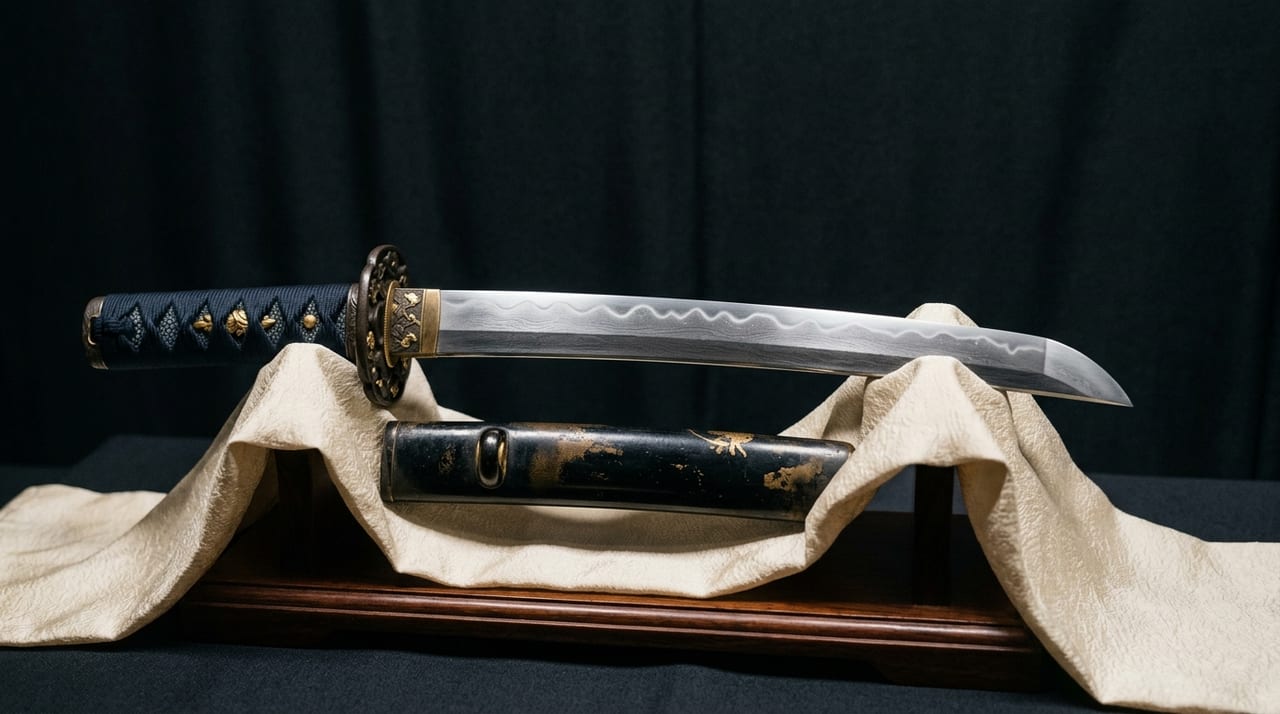
 * Image is for illustrative purposes only.
Taikō Samonji
太閤左文字
Also known as: The Taikō's Samonji
Description
The Taikō Samonji is a tantō attributed to Samonji, a swordsmith who was active in Chikuzen Province (present-day Fukuoka Prefecture) during the Nanboku-chō period, and is designated a National Treasure. The tang bears the signature "Sa" on the obverse and "Chikuzhu-jū" on the reverse. Though small at approximately 23.6 cm in blade length, it is renowned as a masterpiece representing the Samonji school. The name "Taikō Samonji" derives from its ownership and treasuring by Toyotomi Hideyoshi (the Taikō), the unifier of Japan. It is currently housed in the Fukuyama Art Museum (Fukuyama, Hiroshima Prefecture).
Maker: Samonji and the Blade's Workmanship
Samonji (son of Jitsua, known by the epithet "Ōsa," with the given name Gen'kei) was a swordsmith based in Hakata, Chikuzen. Beginning with the classical elegance characteristic of Kyushu forging traditions inherited from his ancestors, he later absorbed the influence of the Sōshū tradition, establishing a bright, refined workstyle marked by strong nie. The Taikō Samonji exhibits hirazukuri (flat construction) with three ridges and shows almost no curvature. The jigane displays tightly packed koitame grain that is bright and sharp, with fine chikei detail lines. The hamon consists of small notare interspersed with gunome patterns; the nioiguchi is deep and bright with well-placed ashi. The precisely tempered, refined finish exemplifies Samonji's high technical skill, and it is regarded as one of his finest works.
Origin of the Name and Alternative Designation "Jurakusamonji"
The name "Taikō Samonji" derives from its ownership by Toyotomi Hideyoshi. It combines Hideyoshi's epithet "Taikō" with the maker's name "Samonji," following the traditional Japanese sword nomenclature of appending the owner's name or deeds to the blade. The designation "Taikō Samonji" was formally applied during the Showa period; prior to this, it was also called "Jurakusamonji," named after Hideyoshi's Jurakudai palace.
Provenance
The blade began in the collection of Toyotomi Hideyoshi, later passed to Tokugawa Ieyasu, and entered the possession of the second shogun, Tokugawa Hidetada. Hidetada granted it to Inoue Masanari, daimyo of Hamamatsu Castle in Tōtōmi Province, where it remained in the Inoue family for generations. Upon entering the modern era, it left the Inoue family and passed through several owners before entering the collection of businessman Komatsuyasuhiro. In 2018 (Heisei 30), the Komatsuyasuhiro family donated it to the city of Fukuyama. Its provenance through the hands of three unifiers of Japan—Hideyoshi, Ieyasu, and Hidetada—attests to the blade's high status.
National Treasure Designation and Current Housing
The Taikō Samonji was designated a National Treasure on November 22, 1952 (Showa 27). It is currently housed in the Fukuyama Art Museum in Fukuyama, Hiroshima Prefecture, where it is known as one of the museum's most important treasures. As the tantō that best exemplifies Samonji's workmanship and as a renowned blade with connections to Japan's great unifier, it holds a secure place in sword history.
Legends & Stories
This sword is one of the favorites of Toyotomi Hideyoshi. It appears in the Kōtoku Katana Ezu, the picture of Hideyoshi's sword collection painted by Hon'ami Kōtoku, together with the name "Shiyuraku" (Juraku). It is said to have later passed to Tokugawa Ieyasu, become the sashiryō of the second shogun, Tokugawa Hidetada, and then been bestowed on Inoue Masanari, lord of Hamamatsu Domain. It has been designated a National Treasure and is currently held by the Fukuyama Art Museum in Fukuyama, Hiroshima Prefecture.